Basic 5 · Science · Materials
Reversible and Irreversible Changes
In this topic you will learn that some changes to materials can be reversed while others cannot.
By the end of these notes you should be able to:
- Explain reversible and irreversible changes
- Give everyday examples of each
- Classify changes as reversible or irreversible
What you already know
- Classifying materials
Copy everything that has a blue line on its left into your notebook. The other parts are for reading.
- Strand
- Diversity Of Matter
- Sub-strand
- Materials
- Indicator
- B5.1.2.2.1 – Know that some changes are reversible while others cannot be reversed
Introduction
When shea butter is warmed, it melts into oil. When it cools, it becomes solid again. But when you fry an egg, you can never turn it back into a raw egg. Why is one change reversible and the other not?
1. Reversible Changes
Reversible change: A change that can be undone, so the material returns to its original form.
In a reversible change, no new substance is made. The material only changes its state or shape. Melting, freezing, evaporation, condensation and dissolving are reversible changes. Ice melts into water and the water can be frozen back into ice. Salt dissolves in water, and when the water evaporates the salt is left behind.
| Change | How it is reversed |
|---|---|
| melting shea butter | cool it |
| freezing water into ice | warm it |
| dissolving salt in water | evaporate the water |
| boiling water into steam | cool the steam (condensation) |
| folding paper | unfold it |
2. Irreversible Changes
Irreversible change: A change that cannot be undone because new substances are formed.
In an irreversible change, the original material is changed into something new. Burning, cooking, rusting and rotting are irreversible. When firewood burns, it becomes ash, smoke and gases. The ash can never become wood again. When cassava dough is fried into kaklo or flour is baked into bread, new substances form. When an iron roofing sheet rusts, the iron reacts with water and air to form rust.
| Change | New substance(s) formed |
|---|---|
| burning firewood | ash, smoke, carbon dioxide |
| frying an egg | cooked egg |
| rusting of iron | rust |
| rotting of fruit | rotten material, gases |
| mixing cement and water | hard concrete |
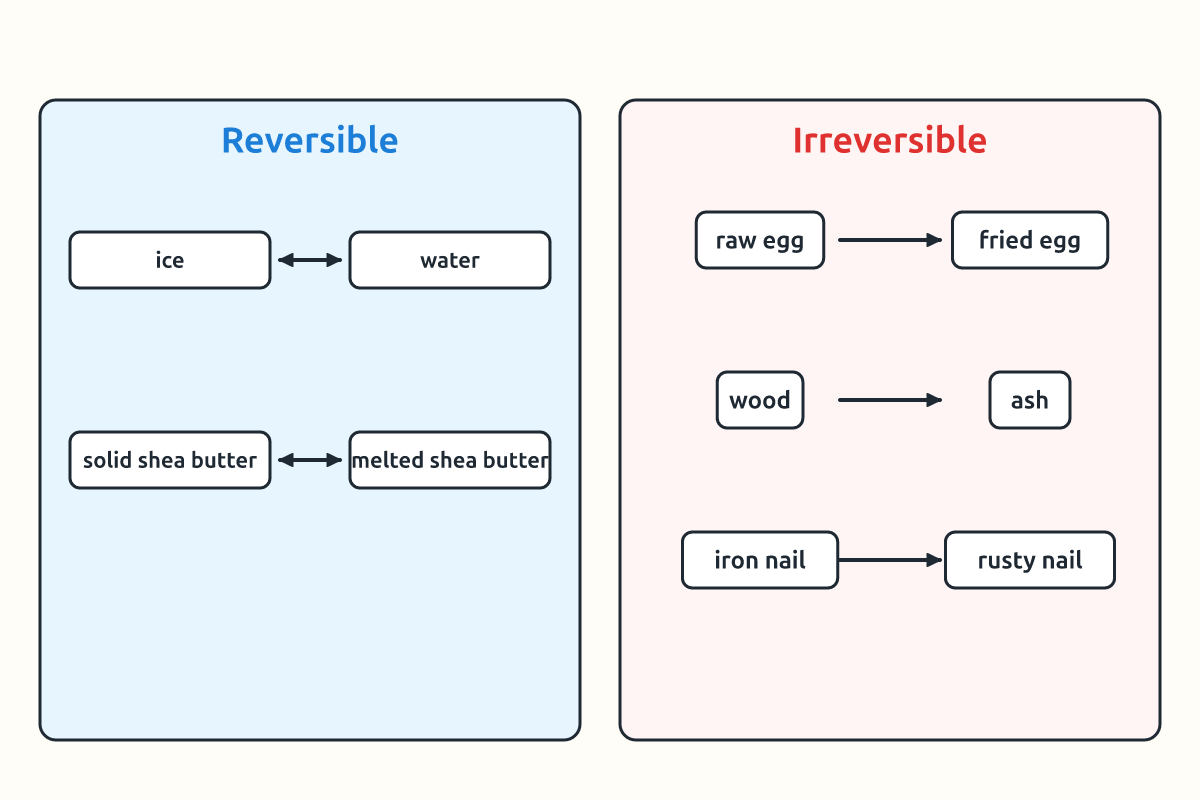
3. How to Tell the Difference
Ask two questions. First, has a new substance been formed? Look for signs such as a change in colour, a new smell, gas bubbles, heat or light. Second, can you get the original material back easily? If no new substance is formed and you can get the original back, the change is reversible. If a new substance is formed, the change is irreversible.
Tip: Two-way arrow (⇄) for reversible, one-way arrow (→) for irreversible.
New words
- reversible change
- A change that can be undone.
- irreversible change
- A change that cannot be undone.
- melting
- Changing from solid to liquid.
- dissolving
- Mixing a solid into a liquid until it disappears.
- rusting
- Iron reacting with water and air to form rust.
- new substance
- A material that was not there before.
Summary
- Reversible changes can be undone; no new substance forms.
- Irreversible changes form new substances.
- Melting, freezing and dissolving are reversible.
- Burning, cooking and rusting are irreversible.
Class activity: Change Cards
- Use the printed change cards.
- Sort them into reversible and irreversible.
- For each reversible card, write how it can be reversed.
You need: Shea butter in a metal cup, Bowl of teacher-provided warm water, Printed reversible-and-irreversible change cards
Exercises
Answer in your exercise book first, then check your answers.
1. Which change is reversible?
- A. Melting ice
- B. Burning paper
- C. Frying an egg
- D. Rusting
Show answer
Answer: Melting iceWater can be frozen again.2. Which is a sign of an irreversible change?
- A. A new substance forms
- B. The shape changes
- C. It gets wet
- D. It is folded
Show answer
Answer: A new substance formsNew substances cannot change back easily.3. How can you get salt back from salt water?
- A. Evaporate the water
- B. Freeze it
- C. Stir it
- D. Filter it
Show answer
Answer: Evaporate the waterThe salt is left behind.4. Burning firewood is an irreversible change.
- A. True
- B. False
Show answer
Answer: TrueAsh cannot become wood again.5. Dissolving sugar in tea is irreversible.
- A. True
- B. False
Show answer
Answer: FalseEvaporating the water would leave the sugar.6. When iron reacts with air and water, it forms ______.
Show answer
Answer: rustRusting is irreversible.7. Give two reversible and two irreversible changes that happen in the kitchen.
Show answer
Answer: Reversible: melting butter, boiling water. Irreversible: frying eggs, cooking rice.Any correct examples.8. Explain why mixing cement with water is irreversible.
Show answer
Answer: The cement and water react to form hard concrete, a new substance that cannot be separated back.A new substance forms.
Homework
- Watch someone cook at home. List three reversible and three irreversible changes you see.