Basic 5 · Science · Materials
Classifying Materials by Their Properties
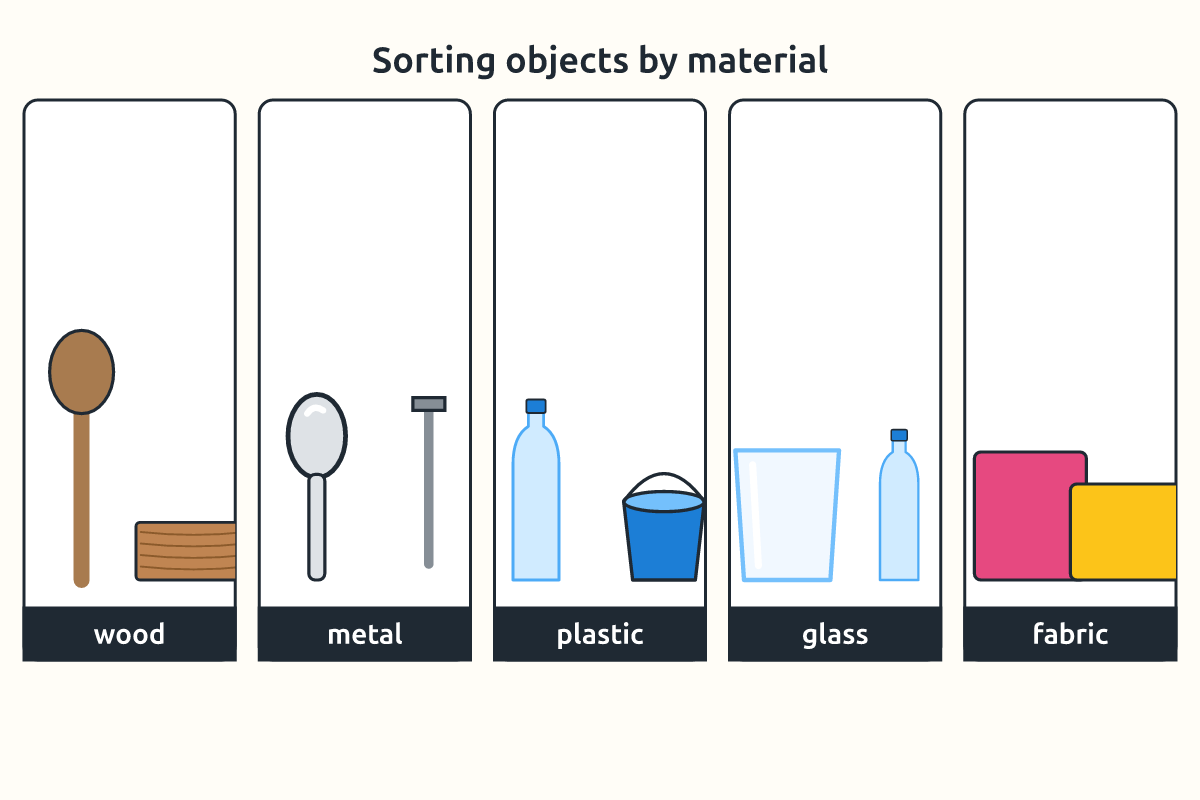
In this topic you will classify everyday materials such as wood, metal, plastic, glass and fabric according to their properties.
By the end of these notes you should be able to:
- Name common materials and their properties
- Classify materials using properties such as hardness, transparency and flexibility
- Explain why materials are chosen for particular uses
What you already know
- Living, dead and never alive
Copy everything that has a blue line on its left into your notebook. The other parts are for reading.
- Strand
- Diversity Of Matter
- Sub-strand
- Materials
- Indicator
- B5.1.2.1.1 – Classify everyday materials based on their properties
Introduction
Why is a cooking pot made of metal and not plastic? Why are windows made of glass? Each material has properties that make it good for some jobs and bad for others.
1. What Is a Property?
A property is a feature that describes how a material looks, feels or behaves. We can find properties by looking, touching, bending, scratching, heating or putting the material in water. Knowing the properties of materials helps engineers, carpenters, tailors and cooks choose the right material for each job.
| Property | Meaning | Opposite |
|---|---|---|
| hard | difficult to scratch or dent | soft |
| flexible | bends without breaking | rigid |
| transparent | lets light through so you can see through it | opaque |
| waterproof | does not let water through | absorbent |
| strong | does not break easily | weak |
| conductor | lets heat or electricity pass through | insulator |
| magnetic | is attracted by a magnet | non-magnetic |
2. Properties of Everyday Materials
| Material | Main properties | Uses |
|---|---|---|
| wood | hard, strong, opaque, poor conductor of heat | furniture, doors, cooking-spoon handles |
| metal | hard, strong, shiny, good conductor of heat and electricity | pots, wires, roofing sheets |
| plastic | light, waterproof, flexible or rigid, insulator | buckets, bottles, wire covers |
| glass | hard, transparent, waterproof, breaks easily | windows, bottles, spectacles |
| fabric | soft, flexible, absorbent | clothes, towels, curtains |
3. Choosing the Right Material
A cooking pot is made of metal because metal is strong and a good conductor of heat, so the food cooks quickly. Its handle is often made of wood or plastic because these are insulators and do not get too hot to hold. Windows use glass because it is transparent and lets in light while keeping out rain. A raincoat is made of plastic or rubber because it is waterproof. A towel is made of cotton because it is absorbent.
Example
Why is electrical wire made of copper covered with plastic?
- Copper is a metal and a good conductor, so electricity flows through it.
- Plastic is an insulator, so it stops electricity from reaching your hand.
Answer: The copper carries the current and the plastic keeps people safe.
Safety: Never touch a bare electric wire. Metals conduct electricity and can give a dangerous shock.
New words
- material
- The substance an object is made from.
- property
- A feature that describes a material.
- transparent
- Lets light pass through clearly.
- opaque
- Does not let light through.
- conductor
- Lets heat or electricity pass through.
- insulator
- Does not let heat or electricity pass easily.
Summary
- Materials have properties such as hardness, flexibility and transparency.
- Metals are good conductors; wood and plastic are insulators.
- We choose materials whose properties suit the job.
- One object can use several materials for different parts.
Class activity: Material Tests
- Test a wooden offcut, a metal spoon and a plastic bottle.
- Check each for hardness (scratch with a nail), flexibility (bend gently) and transparency (hold up to light).
- Record the results in a table.
You need: Wood offcut, Metal spoon, Clear plastic bottle
Exercises
Answer in your exercise book first, then check your answers.
1. Which material is transparent?
- A. Glass
- B. Wood
- C. Metal
- D. Cloth
Show answer
Answer: GlassYou can see through it.2. Why are pot handles made of wood?
- A. Wood is an insulator
- B. Wood is shiny
- C. Wood is magnetic
- D. Wood is transparent
Show answer
Answer: Wood is an insulatorIt does not get hot quickly.3. Which property makes a towel useful?
- A. Absorbent
- B. Waterproof
- C. Magnetic
- D. Transparent
Show answer
Answer: AbsorbentIt soaks up water.4. Metals are good conductors of heat.
- A. True
- B. False
Show answer
Answer: TrueHeat passes through them easily.5. Plastic is used to cover wires because it conducts electricity.
- A. True
- B. False
Show answer
Answer: FalseIt is used because it is an insulator.6. A material that bends without breaking is ______.
Show answer
Answer: flexibleIt is flexible.7. Give two properties of metal and one use for each.
Show answer
Answer: Strong (roofing sheets) and good conductor (cooking pots).Any correct pairs.8. Explain why a raincoat should not be made of cotton.
Show answer
Answer: Cotton is absorbent, so rain would soak through and the wearer would get wet.A raincoat needs a waterproof material.
Homework
- Choose five objects at home. Name the material each is made of and one property that suits its use.