Basic 5 · Science · Living and Non-Living Things
Living, Dead and Never Alive
In this topic you will compare things that are living, things that are dead and things that have never been alive.
By the end of these notes you should be able to:
- Explain the difference between living, dead and never-alive things
- Classify objects into the three groups
- Give reasons for each classification
What you already know
- Life processes of living things
Copy everything that has a blue line on its left into your notebook. The other parts are for reading.
- Strand
- Diversity Of Matter
- Sub-strand
- Living and Non-Living Things
- Indicator
- B5.1.1.2.1 – Compare the differences among things that are living dead and things that have never been alive
Introduction
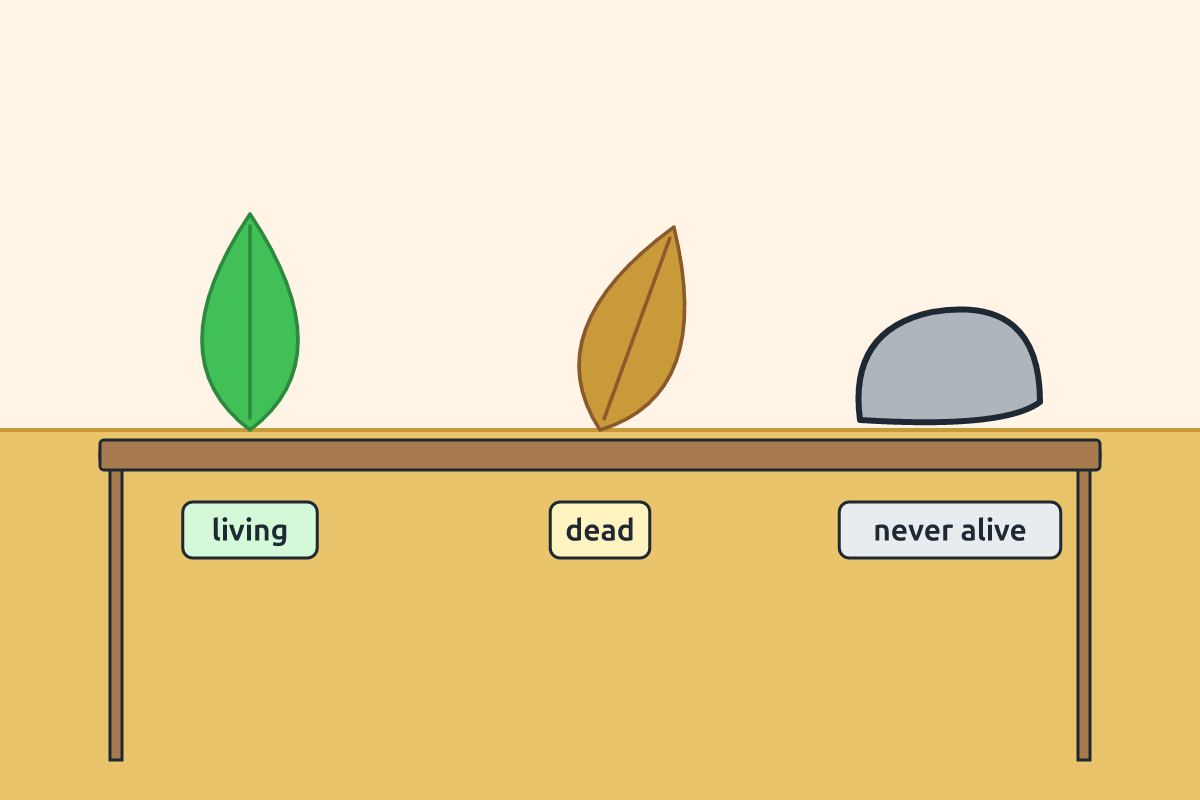
A green mango leaf on the tree is living. A dry brown leaf on the ground was once living but is now dead. A stone beside it has never been alive. These three things look different, and science gives us clear ways to tell them apart.
1. Three Groups
| Group | Meaning | Examples |
|---|---|---|
| living | carries out all life processes now | goat, mango tree, child, mushroom |
| dead | was once alive but has stopped all life processes | dry leaf, wooden chair, cooked fish, firewood |
| never alive | has never carried out life processes | stone, water, metal spoon, plastic bottle |
A living thing is carrying out the life processes now. A dead thing was once living: it grew, fed and respired, but these processes have stopped for ever. A thing that has never been alive is made of materials that never had cells and never carried out any life process.
2. How to Decide
- Ask: Is it carrying out life processes now (growing, respiring, responding)? If yes, it is living.
- If not, ask: Was it ever part of a living thing? Look for signs such as cells, wood grain, bone, feathers or leaf veins. If yes, it is dead.
- If it was never part of a living thing, it has never been alive.
Many things we use every day are dead materials. A wooden table came from a tree. Leather comes from animal skin. Cotton cloth comes from the cotton plant. Paper is made from wood. A kente cloth made of cotton is dead material, but one made of nylon has never been alive because nylon is made from crude oil in a factory.
3. Tricky Examples
| Object | Group | Reason |
|---|---|---|
| seed in a packet | living | it is alive but resting; it germinates when watered |
| fire | never alive | it moves and "grows" but has no cells and does not reproduce |
| charcoal | dead | it was made from wood |
| a car | never alive | it moves and uses fuel but has no cells and cannot grow |
| egg in the market | living or dead | a fertilised egg can hatch; a cooked egg is dead |
Common mistake: Moving does not prove that something is alive. A car, a river and the wind all move but are never alive.
Did you know?: Some seeds can stay alive for many years before they germinate. Scientists have grown plants from seeds that were hundreds of years old.
New words
- living
- Carrying out life processes now.
- dead
- Once living, but no longer carrying out life processes.
- never alive
- Never having carried out any life process.
- material
- What an object is made of.
- cell
- The smallest living unit of a living thing.
- dormant
- Alive but resting, like a dry seed.
Summary
- Things are living, dead or never alive.
- Dead things were once alive; never-alive things never were.
- Many materials (wood, cotton, leather, paper) are dead.
- Movement alone does not prove life.
Class activity: Sorting Table
- Collect ten objects from around the school (leaf, twig, stone, chalk, cloth, bottle, feather, etc.).
- Sort them into living, dead and never alive.
- Write one reason for each choice and compare with another group.
You need: Local leaves, Twigs, Stones, Printed photographs of goats, Mango trees
Exercises
Answer in your exercise book first, then check your answers.
1. Which has never been alive?
- A. Stone
- B. Dry leaf
- C. Wooden spoon
- D. Goat
Show answer
Answer: StoneIt has no cells.2. A wooden chair is…
- A. dead
- B. living
- C. never alive
- D. growing
Show answer
Answer: deadWood came from a tree.3. Why is fire not living?
- A. It has no cells and cannot reproduce
- B. It is hot
- C. It moves
- D. It uses air
Show answer
Answer: It has no cells and cannot reproduceIt only seems to grow.4. A dry seed can still be alive.
- A. True
- B. False
Show answer
Answer: TrueIt is dormant.5. A plastic bottle was once living.
- A. True
- B. False
Show answer
Answer: FalsePlastic is made from crude oil in a factory.6. A thing that was once alive but has stopped all life processes is ______.
Show answer
Answer: deadIt is dead.7. Name two dead materials used to make clothes.
Show answer
Answer: Cotton and leather (or wool, silk).They come from living things.8. Explain why a car moves but is not living.
Show answer
Answer: It does not grow, reproduce, respire with cells or respond on its own; it is never alive.Movement alone is not enough.
Homework
- List ten objects in your home and classify each as living, dead or never alive.