Basic 5 · Science · Living and Non-Living Things
Life Processes of Living Things
In this topic you will learn the life processes that all living things carry out, focusing on growth, sensitivity, respiration and excretion.
By the end of these notes you should be able to:
- Name the main life processes of living things
- Explain growth, sensitivity, respiration and excretion
- Give examples of each process in plants and animals
What you already know
- Living and non-living things (Basic 4)
Copy everything that has a blue line on its left into your notebook. The other parts are for reading.
- Strand
- Diversity Of Matter
- Sub-strand
- Living and Non-Living Things
- Indicator
- B5.1.1.1.1 – Know the life processes of living things (growth sensitivity to the environment respiration and excretion)
Introduction
A goat eats grass, grows bigger, runs away when chased and breathes in and out. A mango tree also grows, turns its leaves towards light and gives out gases. Both are alive because they carry out life processes. A stone does none of these things.
1. What Are Life Processes?
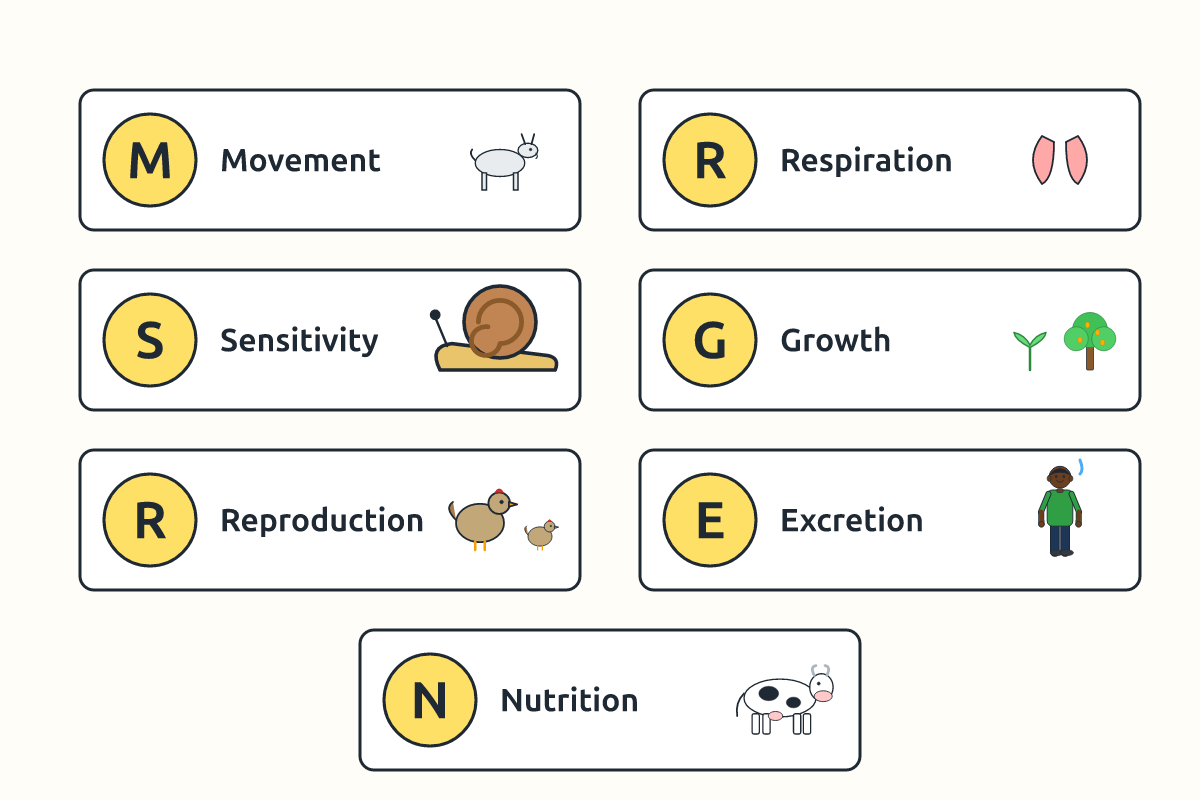
Life processes are the activities that every living thing must carry out to stay alive. Scientists often remember them with the word MRS GREN: Movement, Respiration, Sensitivity, Growth, Reproduction, Excretion and Nutrition. If something carries out all of these processes, it is a living thing. Now we focus on four of them: growth, sensitivity, respiration and excretion.
| Process | Meaning | Example |
|---|---|---|
| Movement | changing position | a goat walks; a plant's leaves turn to light |
| Respiration | releasing energy from food | we breathe in oxygen to burn food |
| Sensitivity | responding to changes around | a snail pulls back when touched |
| Growth | increasing in size | a seedling becomes a tree |
| Reproduction | producing young ones | a hen lays eggs |
| Excretion | removing waste from the body | we sweat and urinate |
| Nutrition | taking in food | a plant makes food; a cow eats grass |
2. Growth
Growth is a permanent increase in the size and mass of a living thing. A baby grows into a child and then an adult. A maize seed grows into a tall plant. Living things grow by making new cells from the food they eat or make. Plants keep growing all their lives at the tips of their roots and shoots, but most animals stop growing when they become adults. A balloon getting bigger is not growth, because it is only filled with air and has no cells.
3. Sensitivity
Sensitivity is the ability of a living thing to notice changes around it and respond to them. A change that a living thing responds to is called a stimulus. When you touch a hot pot, you quickly pull your hand away. When a lizard sees a cat, it runs away. The leaves of the Mimosa plant (touch-me-not, common in Ghana) fold up when touched. Plants grow towards light, and their roots grow towards water.
4. Respiration
Respiration is the process in which living things break down food to release energy. Most living things use oxygen for this, and they give out carbon dioxide and water. Breathing is not the same as respiration. Breathing is moving air in and out of the lungs; respiration happens inside every cell. Plants also respire, day and night, through tiny holes in their leaves called stomata.
5. Excretion
Excretion is the removal of waste substances made inside the body. If wastes stay in the body, they become poisonous. Humans excrete carbon dioxide through the lungs, sweat through the skin and urine through the kidneys. Plants excrete oxygen and water vapour through their leaves, and some store wastes in old leaves that fall off.
Remember: Removing undigested food (faeces) is called egestion, not excretion, because that food was never part of the body's cells.
New words
- life processes
- Activities all living things carry out to stay alive.
- growth
- A permanent increase in size and mass.
- sensitivity
- Responding to changes in the surroundings.
- stimulus
- A change that a living thing responds to.
- respiration
- Breaking down food to release energy.
- excretion
- Removing waste made inside the body.
Summary
- All living things carry out the seven life processes (MRS GREN).
- Growth is a permanent increase in size.
- Sensitivity is responding to a stimulus.
- Respiration releases energy from food; excretion removes body wastes.
Class activity: Life Process Hunt
- Walk around the school compound with your group.
- Find one example of each of the four life processes studied this week.
- Record your examples in a table and present them to the class.
You need: Local leaves, Twigs, Stones, Printed photographs of goats, Mango trees
Exercises
Answer in your exercise book first, then check your answers.
1. Which life process releases energy from food?
- A. Respiration
- B. Excretion
- C. Growth
- D. Sensitivity
Show answer
Answer: RespirationFood is broken down to release energy.2. A snail pulls into its shell when touched. This shows…
- A. sensitivity
- B. growth
- C. excretion
- D. nutrition
Show answer
Answer: sensitivityIt responds to a stimulus.3. Which organ excretes urine?
- A. Kidneys
- B. Lungs
- C. Heart
- D. Stomach
Show answer
Answer: KidneysThe kidneys filter waste from the blood.4. A stone can grow.
- A. True
- B. False
Show answer
Answer: FalseStones are non-living.5. Plants respire both day and night.
- A. True
- B. False
Show answer
Answer: TrueAll living cells respire all the time.6. A change that a living thing responds to is called a ______.
Show answer
Answer: stimulusPlural: stimuli.7. State two ways humans excrete waste.
Show answer
Answer: Through the lungs (carbon dioxide) and the skin (sweat) or kidneys (urine).Any two.8. Explain why a balloon getting bigger is not growth.
Show answer
Answer: It is only being filled with air; it has no cells and does not make new material.Growth comes from new cells.
Homework
- Observe a pet or plant at home for three days and record one example of growth, sensitivity, respiration and excretion.