Basic 5 · Science · Materials
Forming and Separating Mixtures
In this topic you will form solid-liquid and liquid-liquid mixtures and use methods such as filtration, decanting and separating funnels to separate them.
By the end of these notes you should be able to:
- Explain what a mixture is
- Form solid-liquid and liquid-liquid mixtures
- Separate mixtures using suitable methods
What you already know
- Reversible and irreversible changes
Copy everything that has a blue line on its left into your notebook. The other parts are for reading.
- Strand
- Diversity Of Matter
- Sub-strand
- Materials
- Indicator
- B5.1.2.3.1 – Demonstrate formation and separation of mixtures (solid-liquid and liquid-liquid mixtures)
Introduction
Muddy river water, palm soup and gari soaked in water are all mixtures. Making a mixture is easy. Separating it again needs the right method.
1. What Is a Mixture?
Mixture: Two or more substances put together without forming a new substance.
In a mixture, each substance keeps its own properties. The parts are not joined chemically, so they can be separated by physical methods. Mixing is a reversible change. A mixture of sand and water can be separated, and so can palm oil and water.
| Type | Example | Notes |
|---|---|---|
| solid–liquid (insoluble) | sand and water | the sand settles; it does not dissolve |
| solid–liquid (soluble) | salt and water | the salt dissolves and cannot be seen |
| liquid–liquid (immiscible) | palm oil and water | they form two layers |
| liquid–liquid (miscible) | water and alcohol | they mix completely |
2. Separating Solid–Liquid Mixtures
Decanting: Leave the mixture to stand until the solid settles at the bottom. Then gently pour off the liquid. This works for sand and water, or for rice being washed.
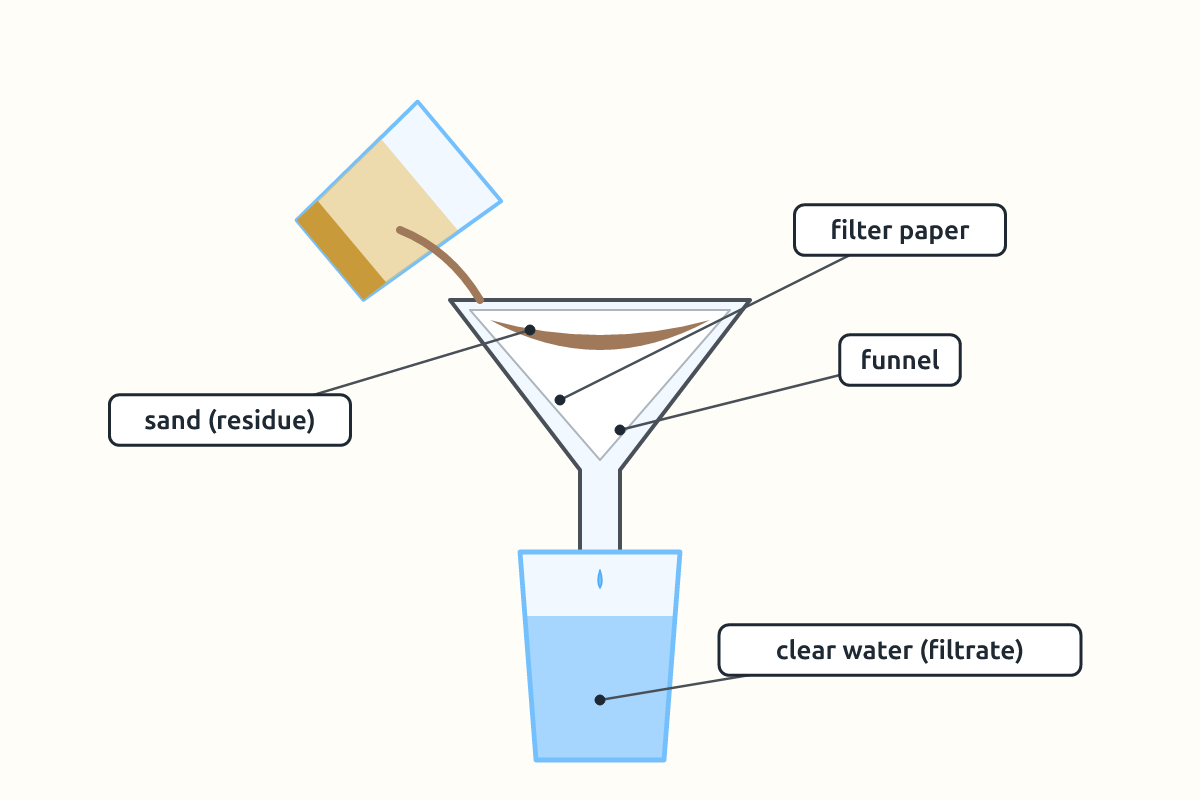
Filtration: Pour the mixture through a filter such as filter paper or a clean cloth. The solid (residue) stays on the filter and the liquid (filtrate) passes through. This is how muddy water is cleaned before boiling.
Evaporation: Heat a solution, such as salt water, until the water turns to vapour. The dissolved solid is left behind. In Ada and Keta, salt is made by letting seawater evaporate in the sun.
3. Separating Liquid–Liquid Mixtures
Palm oil and water do not mix. The oil is less dense, so it floats on top. We can scoop off the oil with a spoon or use a separating funnel. A separating funnel has a tap at the bottom. Open the tap to let the water run out, then close it before the oil comes through. Women who make palm oil in villages skim the oil from the top of the boiling water in the same way.
| Mixture | Method |
|---|---|
| sand and water | decanting or filtration |
| salt and water | evaporation |
| palm oil and water | separating funnel or skimming |
| chaff and rice grains | winnowing |
Safety: Do not taste unknown mixtures. Ask your teacher before heating any liquid.
New words
- mixture
- Substances mixed without forming a new substance.
- filtration
- Separating an insoluble solid from a liquid with a filter.
- decanting
- Pouring off a liquid and leaving the solid behind.
- evaporation
- Heating a liquid until it becomes vapour.
- immiscible
- Liquids that do not mix.
- residue
- The solid left on a filter.
Summary
- A mixture forms without a new substance being made.
- Filtration and decanting separate insoluble solids from liquids.
- Evaporation recovers a dissolved solid.
- Immiscible liquids such as oil and water are separated with a separating funnel or by skimming.
Class activity: Mixture Lab
- Make a sand–water mixture and a palm oil–water mixture in clear bottles.
- Separate the sand by filtration using a cloth.
- Leave the oil–water mixture to settle and skim off the oil.
You need: Sand, Water, Water, Palm oil, Clear plastic bottles
Exercises
Answer in your exercise book first, then check your answers.
1. Which method separates sand from water?
- A. Filtration
- B. Evaporation
- C. Magnet
- D. Winnowing
Show answer
Answer: FiltrationThe sand stays on the filter.2. Palm oil and water are…
- A. immiscible
- B. miscible
- C. soluble
- D. the same
Show answer
Answer: immiscibleThey form two layers.3. How is salt obtained from seawater in Ada?
- A. Evaporation
- B. Filtration
- C. Decanting
- D. Winnowing
Show answer
Answer: EvaporationThe sun evaporates the water.4. A mixture is a new substance.
- A. True
- B. False
Show answer
Answer: FalseThe parts keep their own properties.5. In filtration, the liquid that passes through is the filtrate.
- A. True
- B. False
Show answer
Answer: TrueThe solid left is the residue.6. Pouring off a liquid and leaving the solid behind is called ______.
Show answer
Answer: decantingIt is decanting.7. Describe how to separate palm oil from water.
Show answer
Answer: Let it settle; the oil floats; skim it off or use a separating funnel to drain the water.The oil floats on top.8. Why can filtration not separate salt from water?
Show answer
Answer: The salt is dissolved and its particles are small enough to pass through the filter.Use evaporation instead.
Homework
- Write three mixtures found at home and the method you would use to separate each.