Basic 6 · Science · Life Cycle of Organism
What Plants Need to Survive
In this topic you will learn the materials and conditions plants need to survive and grow well.
By the end of these notes you should be able to:
- Name the needs of plants
- Investigate how light and water affect plant growth
- Explain how farmers provide for plant needs
What you already know
- Photosynthesis (Basic 5)
Copy everything that has a blue line on its left into your notebook. The other parts are for reading.
- Strand
- Cycle
- Sub-strand
- Life Cycle of Organism
- Indicator
- B6.2.2.1.1 – Know the materials needed for the survival of plants in the environment
Introduction
A farmer plants two maize fields. One grows tall and green; the other is short and yellow. The difference may be in the water, light, soil or space each plant received.
1. Needs of Plants
| Need | Why it is needed | Sign of shortage |
|---|---|---|
| light | for photosynthesis to make food | pale, tall, weak stems (etiolation) |
| water | carries nutrients; used in photosynthesis; keeps the plant firm | wilting, dry leaves |
| air (carbon dioxide and oxygen) | carbon dioxide for photosynthesis; oxygen for respiration in roots | poor growth in waterlogged soil |
| mineral nutrients (nitrogen, phosphorus, potassium) | healthy leaves, roots, flowers and fruits | yellow leaves, poor fruits |
| suitable temperature | allows growth processes to work | slow growth or death in extreme heat or cold |
| space | room for roots and leaves to spread | weak plants when overcrowded |
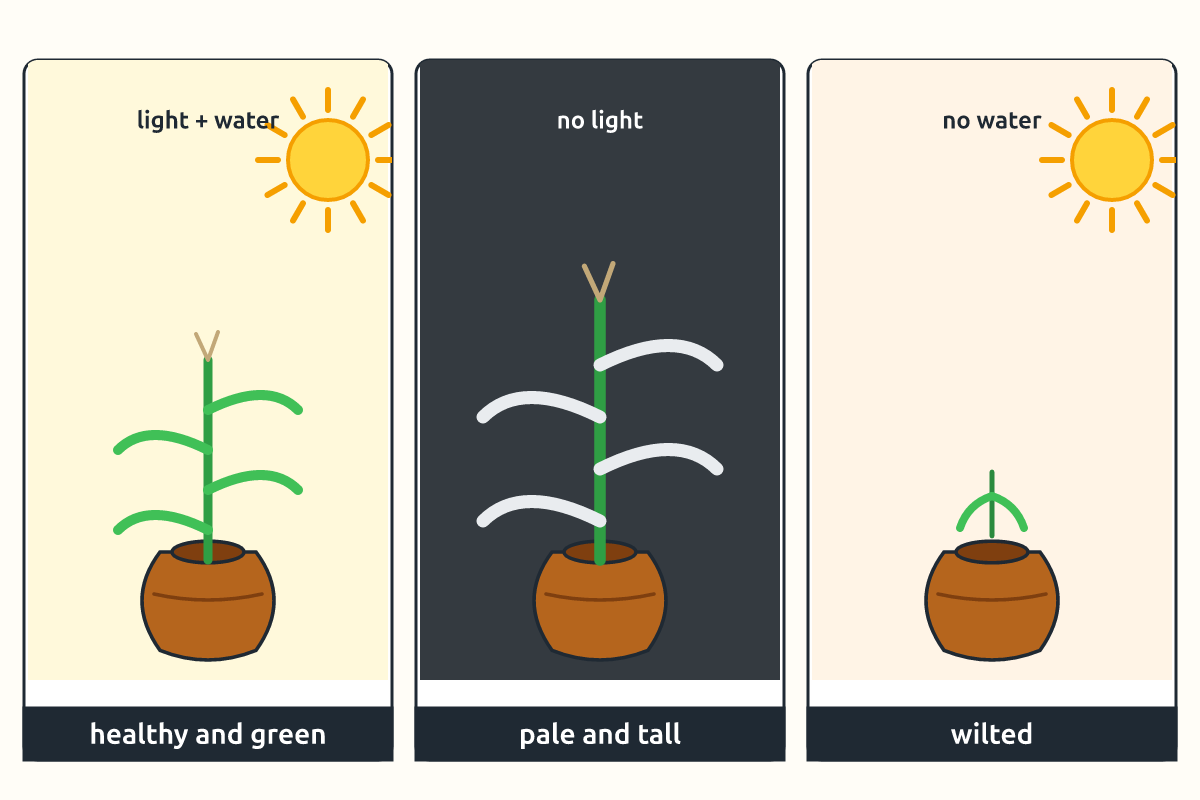
2. Investigating Plant Needs
Experiment
Do plants need light?
- Plant maize seeds in two pots with the same soil and water.
- Place pot A in sunlight and pot B in a dark cupboard.
- Water both equally and observe for 10 days.
Answer: Pot A grows green and healthy; pot B grows pale, thin and weak. Plants need light to grow well.
In a fair test, only one condition is changed at a time, so we know which condition caused the difference.
3. How Farmers Meet Plant Needs
- Plant in sunny places and at the right spacing.
- Water crops during the dry season or use irrigation.
- Add manure, compost or fertiliser for nutrients.
- Loosen the soil so air reaches the roots.
- Remove weeds that compete for water, light and nutrients.
- Plant at the right season for suitable temperature and rainfall.
Weeds compete with crops for the same water, light and nutrients, which is why farmers weed regularly. Too much water can also harm plants, because waterlogged soil has no air for the roots.
Different plants need different amounts of each condition. Rice grows well in wet fields, while cassava survives dry soils.
New words
- nutrient
- A substance a plant needs for healthy growth.
- wilting
- Drooping because of lack of water.
- etiolation
- Pale, weak growth caused by lack of light.
- fair test
- An experiment where only one condition is changed.
- fertiliser
- A substance added to soil to supply nutrients.
- waterlogged
- Soaked with too much water.
Summary
- Plants need light, water, air, nutrients, suitable temperature and space.
- Shortages show as wilting, yellow leaves or weak growth.
- A fair test changes only one condition.
- Farmers water, fertilise, weed and space crops to meet plant needs.
Class activity: Plant Needs Investigation
- Set up four pots of seedlings: full care, no water, no light, no fertile soil (sand only).
- Observe and measure them every two days for two weeks.
- Present your results in a table and explain them.
You need: Potted maize seedlings, Local soil, Cup of water
Exercises
Answer in your exercise book first, then check your answers.
1. Plants need light to…
- A. make food
- B. drink water
- C. sleep
- D. move
Show answer
Answer: make foodPhotosynthesis.2. A plant kept in the dark becomes…
- A. pale and weak
- B. dark green
- C. shorter and stronger
- D. flowering
Show answer
Answer: pale and weakEtiolation.3. Why do farmers remove weeds?
- A. Weeds compete for water, light and nutrients
- B. Weeds are pretty
- C. Weeds give fertiliser
- D. Weeds make shade for crops
Show answer
Answer: Weeds compete for water, light and nutrientsCompetition.4. Wilting is a sign that a plant lacks water.
- A. True
- B. False
Show answer
Answer: TrueIt droops.5. More water is always better for plants.
- A. True
- B. False
Show answer
Answer: FalseWaterlogging removes air from roots.6. An experiment where only one condition is changed is a fair ______.
Show answer
Answer: testIt gives reliable results.7. State four things plants need to survive.
Show answer
Answer: Light, water, air and nutrients (or temperature, space).Any four.8. Explain why a fair test changes only one condition.
Show answer
Answer: So that any difference in results can be linked to that one condition.Reliability.
Homework
- Grow a seedling at home. Record how much water and light it gets and how it grows.