Basic 6 · Physical Education · Locomotive Skills
Jumping for Distance and Landing Safely
In this topic you will jump for distance and land on both feet, bending the hips, knees and ankles to reduce impact force.
By the end of these notes you should be able to:
- Perform the standing long jump correctly
- Land safely by absorbing force
- Measure and record jumping distance
What you already know
- Applying and receiving force (Basic 5)
Copy everything that has a blue line on its left into your notebook. The other parts are for reading.
- Strand
- Motor Skill And Movement Patterns
- Sub-strand
- Locomotive Skills
- Indicator
- B6.1.2.1.2 – Jump for distance landing on both feet and bending the hips knees and ankles to reduce the impact force
Introduction
Long jumpers fly through the air and land in the sand pit. A good landing protects the body from injury and adds valuable centimetres to the jump.
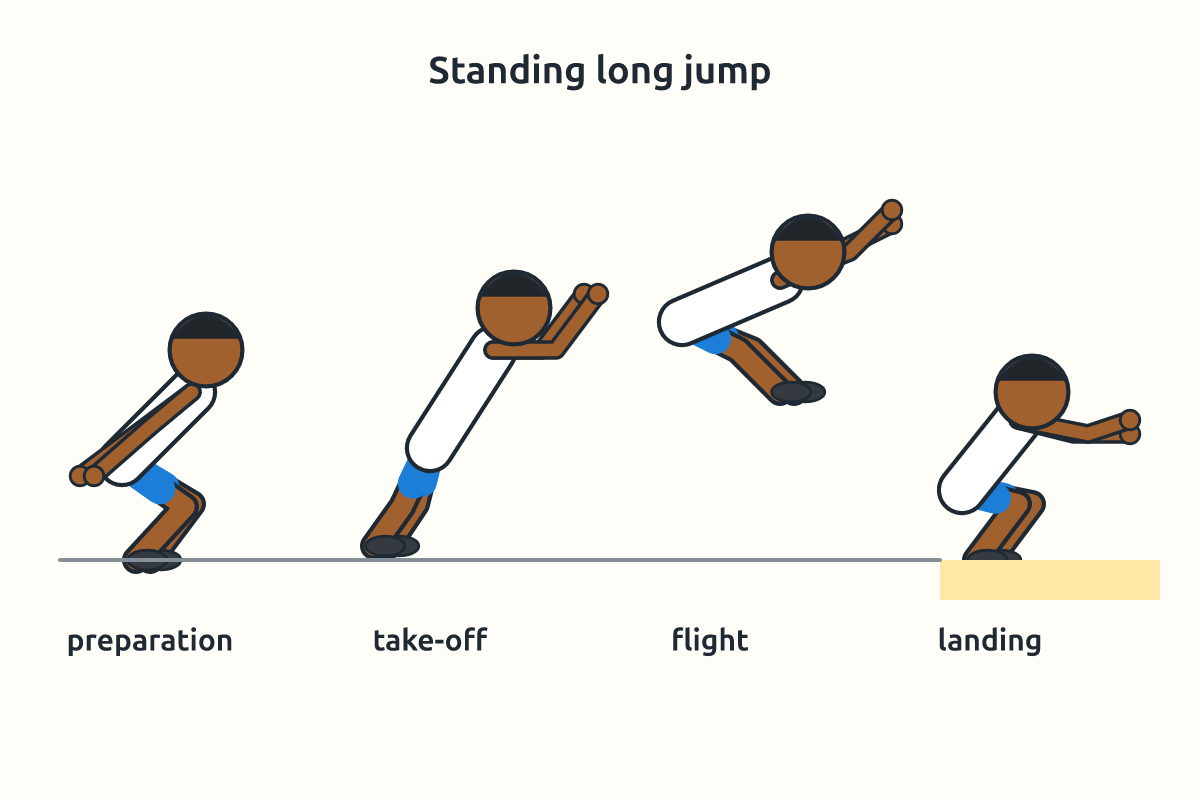
1. The Standing Long Jump
| Phase | Action |
|---|---|
| preparation | stand behind the line, feet shoulder-width apart, knees bent, arms swung back |
| take-off | swing arms forward and upward strongly; push off with both feet at the same time |
| flight | stretch the body forward; bring the knees up and legs forward |
| landing | land on both feet, heels first; bend hips, knees and ankles; push arms forward to avoid falling back |
2. Why Bend on Landing?
When you land, the ground pushes back on your body with a large force. Bending the hips, knees and ankles makes the landing last a little longer, which spreads the force out and reduces the strain on the joints and bones. Landing stiff-legged sends the force straight to the knees and spine and can cause injury.
3. Measuring the Jump
- Measure from the take-off line to the nearest mark made by any part of the body.
- If you fall backward and touch with your hands, the measurement is taken from the hand mark.
- Record the best of three attempts.
| Pupil | Attempt 1 (cm) | Attempt 2 (cm) | Attempt 3 (cm) | Best (cm) |
|---|---|---|---|---|
| Ama | 145 | 152 | 149 | 152 |
| Kojo | 160 | 158 | 166 | 166 |
4. Tips to Improve
Swing your arms strongly, as they add momentum. Lean forward at take-off at about 45°. Bring your feet forward in flight. Practise jumping exercises such as squat jumps to build leg power.
Safety: Jump into a sand pit or onto soft grass. Rake the sand before each jump and check for stones.
New words
- standing long jump
- A jump for distance from a standing position.
- take-off
- Pushing off the ground.
- flight
- The time in the air.
- impact
- The force when landing.
- absorb
- To reduce or soak up force.
- momentum
- The force of a moving body.
Summary
- The jump has preparation, take-off, flight and landing.
- Land on both feet, bending hips, knees and ankles.
- Measure from the line to the nearest body mark.
- Strong arm swing and forward lean improve distance.
Class activity: Jump and Record
- Take three standing long jumps each.
- Your partner measures and records each jump.
- Find your best jump and set a target to improve it.
You need: Plastic-bottle approach cones, Rope take-off marker, Soft sand landing pit
Exercises
Answer in your exercise book first, then check your answers.
1. You should land on…
- A. both feet
- B. one hand
- C. your back
- D. your head
Show answer
Answer: both feetFor balance and safety.2. Bending the knees on landing helps to…
- A. absorb force
- B. jump higher
- C. fall backward
- D. stop breathing
Show answer
Answer: absorb forceProtects joints.3. The jump is measured to…
- A. the nearest body mark
- B. the furthest toe
- C. your hands only
- D. the middle of the pit
Show answer
Answer: the nearest body markRule.4. Swinging the arms helps you jump farther.
- A. True
- B. False
Show answer
Answer: TrueAdds momentum.5. Landing with straight legs is safest.
- A. True
- B. False
Show answer
Answer: FalseIt can cause injury.6. The time in the air during a jump is the ______.
Show answer
Answer: flightSecond phase.7. Describe a safe landing.
Show answer
Answer: Land on both feet, bend hips, knees and ankles, push arms forward.Absorb force.8. Explain why bending on landing reduces injury.
Show answer
Answer: It makes the landing take longer, spreading the force and reducing strain on joints.Physics of landing.
Homework
- Do 3 sets of 10 squat jumps each day this week.