Basic 6 · Physical Education · Manipulative Skills
Applying and Receiving Force in Jumping for Height and Distance
In this topic you will perform jumps for height and for distance and show the differences in how force is applied and received.
By the end of these notes you should be able to:
- Perform a vertical jump and a long jump
- Show the different directions of force at take-off
- Land safely after each type of jump
What you already know
- Jumping for distance
Copy everything that has a blue line on its left into your notebook. The other parts are for reading.
- Strand
- Motor Skill And Movement Patterns
- Sub-strand
- Manipulative Skills
- Indicator
- B6.1.2.1.3 – Perform the differences in applying and receiving force when jumping for height and distance
Introduction
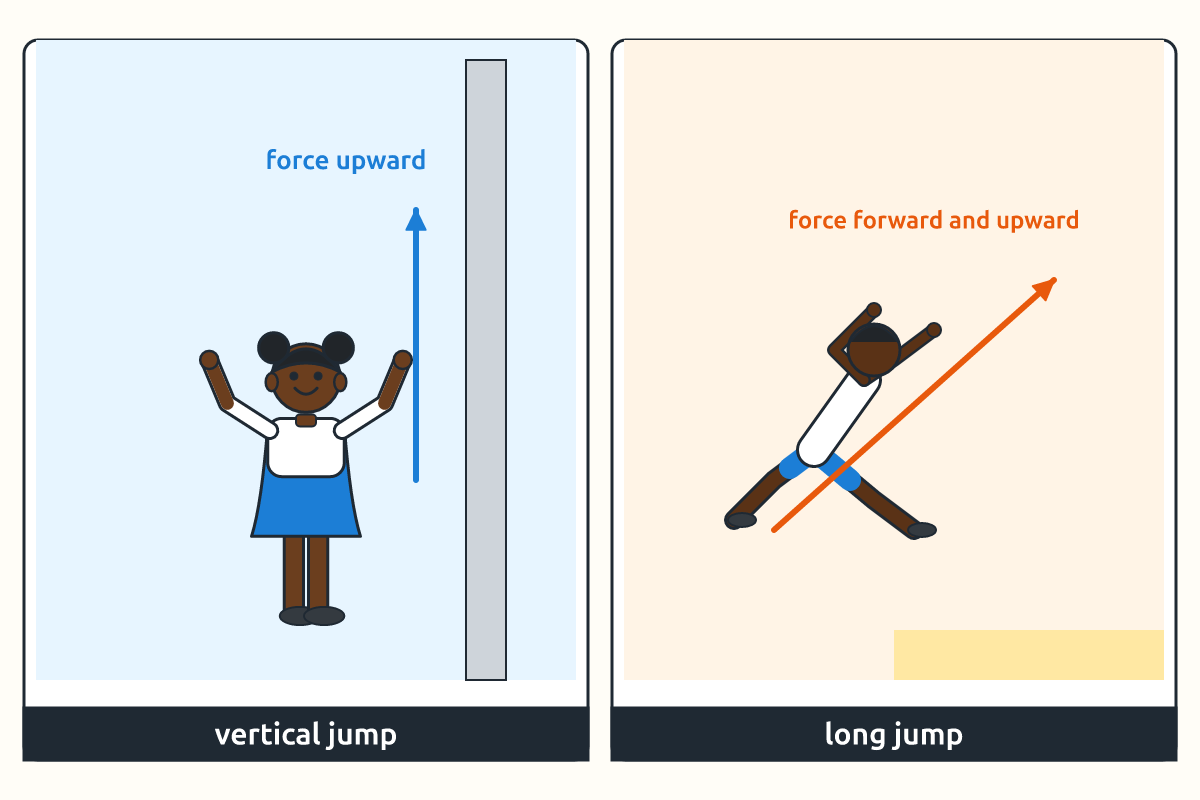
A basketball player jumping to shoot and a long jumper jumping into the sand both push hard against the ground. But one pushes mainly upward and the other pushes forward and upward.
1. Jumping for Height
| Phase | Action |
|---|---|
| preparation | stand near a wall, feet shoulder-width apart, bend knees, swing arms down |
| take-off | drive arms upward; push the ground straight down with both feet |
| flight | stretch the body tall; reach up with one hand |
| landing | land softly on both feet in the same place, bending hips, knees and ankles |
2. Jumping for Distance
For distance, the body leans forward and pushes against the ground backward and downward, so it moves forward and up. The arms swing forward. A running approach (long jump) adds speed and increases distance.
3. Comparing the Two
| Feature | Jump for height | Jump for distance |
|---|---|---|
| direction of push | straight down (body goes up) | down and back (body goes up and forward) |
| body position | upright | leaning forward |
| arm swing | upward | forward and upward |
| landing | in the same place, feet together | forward, heels first into sand |
| sports examples | basketball, volleyball, high jump | long jump, triple jump |
4. Testing Your Jumps
Vertical jump test
How high can you jump?
- Stand side-on to a wall and reach up; mark the highest point with chalk on your fingers.
- Jump and touch the wall as high as possible.
- Measure the distance between the two marks.
Answer: The difference is your vertical jump height in centimetres.
Compare your vertical jump and your long jump. Many pupils find that strong legs help both jumps, but technique decides which direction the force goes.
Safety: Make sure the landing area is clear and soft. Do not jump near walls with sharp edges.
New words
- vertical jump
- A jump straight upward.
- force
- A push or pull.
- direction
- The way something moves.
- approach
- The run-up before a jump.
- technique
- The correct way of performing a skill.
- high jump
- An athletics event jumping over a bar.
Summary
- For height, push straight down to go up.
- For distance, lean forward and push down and back.
- Arm swing direction differs for each jump.
- Always land softly, bending the joints.
Class activity: Jump Stations
- Station 1: vertical jump test against a wall.
- Station 2: standing long jump into sand.
- Record results and compare the techniques used.
You need: Plastic-bottle approach cones, Rope take-off marker, Soft sand landing pit
Exercises
Answer in your exercise book first, then check your answers.
1. Jumping straight up is a…
- A. vertical jump
- B. long jump
- C. triple jump
- D. roll
Show answer
Answer: vertical jumpUpward.2. For a long jump, the body should…
- A. lean forward
- B. stand straight back
- C. lie down
- D. sit
Show answer
Answer: lean forwardTo go forward.3. In which sport is jumping for height important?
- A. Volleyball
- B. Swimming
- C. Chess
- D. Cycling
Show answer
Answer: VolleyballBlocking and spiking.4. A run-up can increase long jump distance.
- A. True
- B. False
Show answer
Answer: TrueAdds speed.5. Arms swing backward at take-off in a vertical jump.
- A. True
- B. False
Show answer
Answer: FalseThey swing upward.6. The correct way of performing a skill is ______.
Show answer
Answer: techniqueGood form.7. Give two differences between jumping for height and distance.
Show answer
Answer: Height: upright, upward arm swing. Distance: lean forward, forward arm swing.Any two.8. Explain how to measure a vertical jump.
Show answer
Answer: Mark your standing reach, jump and mark the highest touch, then measure the difference.Test method.
Homework
- Measure your vertical jump at home against a wall with an adult's help.