Basic 6 · Physical Education · Locomotive Skills
Creating a Cooperative Movement Game
In this topic you will develop a cooperative game that combines locomotor skills and object manipulation.
By the end of these notes you should be able to:
- Explain cooperative games
- Combine locomotor and manipulative skills in a game
- Design, play and improve a group game
What you already know
- Locomotor and manipulative skills (Basic 5)
Copy everything that has a blue line on its left into your notebook. The other parts are for reading.
- Strand
- Motor Skill And Movement Patterns
- Sub-strand
- Locomotive Skills
- Indicator
- B6.1.1.1.1 – Develop a cooperative movement game that uses locomotor skills object manipulation
Introduction
In most games, one team wins and the other loses. In cooperative games, everyone works together towards a shared goal. These games build teamwork, communication and fair play.
1. Skills in Games
| Locomotor skills | Manipulative (object) skills |
|---|---|
| walking, running, skipping | throwing and catching |
| hopping, jumping, leaping | kicking and dribbling |
| sliding, galloping | rolling, striking, bouncing |
2. What Makes a Game Cooperative?
- Everyone works towards the same goal.
- No one is left out; all members take part.
- Players must communicate and help each other.
- Success depends on teamwork, not individual stars.
3. Designing a Cooperative Game
| Element | Example: "Pass the River" |
|---|---|
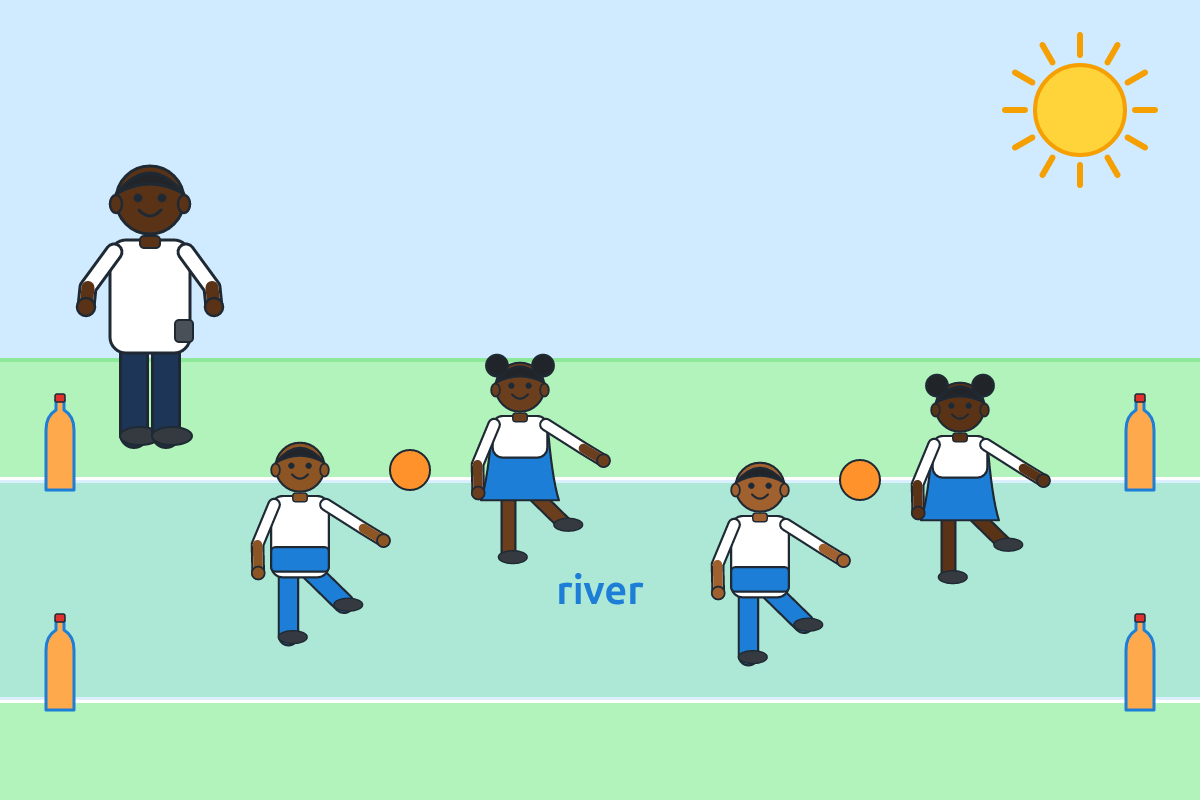
| goal | move all balls across a "river" (marked area) in 3 minutes |
| players | groups of 6 |
| equipment | 4 balls, cones, chalk lines |
| rules | players must skip across; each ball must be passed at least 3 times; no one may hold a ball for more than 3 seconds |
| skills used | skipping, throwing, catching |
| safety | play on soft ground; keep 1 metre apart when running |
4. Playing and Improving
- Explain the rules clearly to all players.
- Play the game once.
- Discuss what worked and what was difficult.
- Change one rule to make it more challenging or fairer.
- Play again and compare results.
Good cooperative games are simple to learn, safe, keep everyone active and need communication. When designing, think about players of different abilities so that everyone can take part.
Traditional Ghanaian games such as ampe, pilolo and chaskele can also be adapted into cooperative games. For example, in a cooperative version of ampe, the whole group tries to reach a target number of matched jumps together instead of competing against one another.
New words
- cooperative game
- A game in which players work together towards a shared goal.
- locomotor skill
- A movement that takes you from one place to another.
- manipulative skill
- A skill that involves controlling an object.
- teamwork
- Working well together.
- communication
- Sharing information with others.
- fair play
- Playing honestly and respecting others.
Summary
- Cooperative games have a shared goal and involve everyone.
- They combine locomotor and object skills.
- A game plan includes goal, players, equipment, rules, skills and safety.
- Play, discuss and improve the game.
Class activity: Design a Game
- Design a cooperative game using one locomotor and one manipulative skill.
- Write its rules on a card.
- Teach and play it with another group.
You need: Locally made ball, Plastic-bottle cones, Rope
Exercises
Answer in your exercise book first, then check your answers.
1. In a cooperative game, players…
- A. work together
- B. play alone
- C. fight
- D. leave others out
Show answer
Answer: work togetherShared goal.2. Which is a manipulative skill?
- A. Catching
- B. Skipping
- C. Hopping
- D. Walking
Show answer
Answer: CatchingControlling an object.3. Why change a rule after playing?
- A. To make the game fairer or more challenging
- B. To stop playing
- C. To leave people out
- D. To cheat
Show answer
Answer: To make the game fairer or more challengingImprovement.4. Cooperative games build teamwork.
- A. True
- B. False
Show answer
Answer: TruePlayers help each other.5. Only the best players should touch the ball in a cooperative game.
- A. True
- B. False
Show answer
Answer: FalseEveryone should take part.6. Playing honestly and respecting others is fair ______.
Show answer
Answer: playSportsmanship.7. List four elements of a game design plan.
Show answer
Answer: Goal, players, equipment, rules (or skills, safety).Any four.8. How can a game be designed so that pupils of different abilities can join?
Show answer
Answer: Use simple rules, allow different roles, and require everyone to touch the ball.Inclusion.
Homework
- Teach your cooperative game to friends or family and record how it went.