Basic 6 · Mathematics · Ratio and Proportion
Proportion
In this topic you will use models to explain proportion as the equality of two ratios and solve simple proportion problems.
By the end of these notes you should be able to:
- Explain proportion as two equal ratios
- Check whether two ratios form a proportion
- Solve problems using the unitary method
What you already know
- Equivalent ratios
Copy everything that has a blue line on its left into your notebook. The other parts are for reading.
- Strand
- Number
- Sub-strand
- Ratio and Proportion
- Indicator
- B6.1.4.2.1 – Use models to explain proportion as a comparison between quantities with equal ratios
Introduction
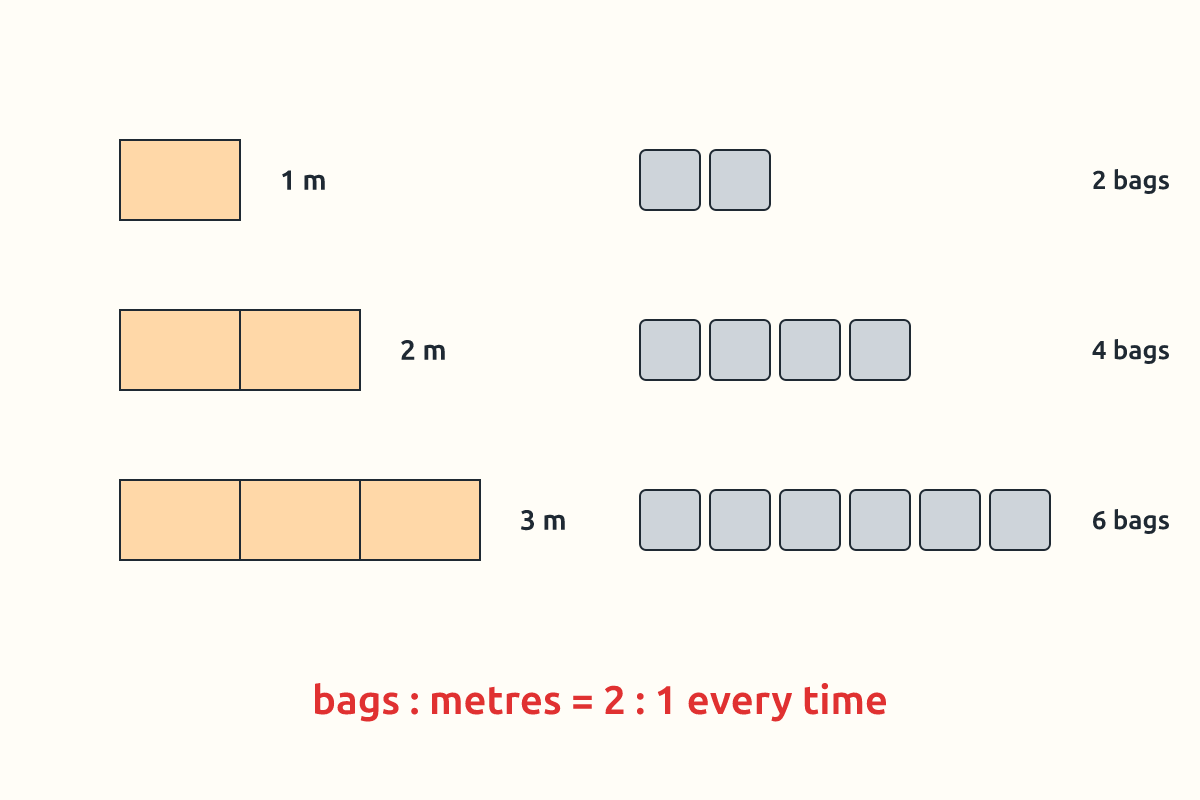
If 2 bags of cement are needed for 1 metre of wall, then 6 bags will be needed for 3 metres. The amounts grow together in the same ratio. This is proportion.
1. What Is a Proportion?
Proportion: A statement that two ratios are equal, for example 2 : 1 = 6 : 3.
Two quantities are in direct proportion when they increase or decrease at the same rate. If one doubles, the other doubles.
2. Checking a Proportion
Cross-multiply: a : b = c : d is a proportion if a × d = b × c.
Example 1
Is 4 : 6 = 10 : 15 a proportion?
- 4 × 15 = 60
- 6 × 10 = 60
Answer: Yes, the products are equal, so it is a proportion.
3. The Unitary Method
Find the value of one unit first, then multiply.
Example 2
5 exercise books cost GH₵35. How much do 8 books cost?
- 1 book costs 35 ÷ 5 = GH₵7
- 8 books cost 8 × 7
Answer: GH₵56
Example 3
A car travels 180 km on 15 litres of fuel. How far can it go on 25 litres?
- 1 litre → 180 ÷ 15 = 12 km
- 25 litres → 25 × 12
Answer: 300 km
4. Using a Proportion Table
| Books | 1 | 5 | 8 | 10 |
|---|---|---|---|---|
| Cost (GH₵) | 7 | 35 | 56 | 70 |
Each column has the same ratio of cost to books (7 : 1). The table helps us see the pattern.
Common mistake: Not every relationship is proportional. A taxi fare with a fixed starting charge does not double when the distance doubles.
New words
- proportion
- Two equal ratios.
- direct proportion
- When two quantities increase or decrease at the same rate.
- cross-multiply
- Multiply the outer and inner terms of two ratios.
- unitary method
- Finding the value of one unit first.
- rate
- A ratio comparing two different quantities, such as cost per item.
- table
- An arrangement of numbers in rows and columns.
Summary
- A proportion is two equal ratios.
- Check by cross-multiplying.
- The unitary method finds one unit, then multiplies.
- In direct proportion, quantities change at the same rate.
Class activity: Shop Proportions
- Use a price list (e.g. 3 pencils for GH₵6).
- Find the cost of 1, 5 and 12 pencils.
- Record your answers in a proportion table.
You need: Bottle tops in two colours, Beans, Maize grains, Exercise books
Exercises
Answer in your exercise book first, then check your answers.
1. Which is a proportion?
- A. 2 : 3 = 4 : 6
- B. 2 : 3 = 3 : 2
- C. 1 : 2 = 2 : 1
- D. 3 : 4 = 4 : 5
Show answer
Answer: 2 : 3 = 4 : 6Multiply by 2.2. 4 pens cost GH₵12. What do 7 pens cost?
- A. GH₵21
- B. GH₵28
- C. GH₵19
- D. GH₵24
Show answer
Answer: GH₵21GH₵3 each.3. Is 3 : 5 = 12 : 20 a proportion?
- A. Yes
- B. No
- C. Only sometimes
- D. Cannot tell
Show answer
Answer: Yes3 × 20 = 60 = 5 × 12.4. In direct proportion, if one quantity doubles, the other doubles.
- A. True
- B. False
Show answer
Answer: TrueSame rate.5. 6 : 8 = 9 : 13 is a proportion.
- A. True
- B. False
Show answer
Answer: False6 × 13 = 78 ≠ 8 × 9 = 72.6. Finding the value of one unit first is the ______ method.
Show answer
Answer: unitaryThen multiply.7. 6 workers earn GH₵480 a day. How much do 9 workers earn at the same rate?
Show answer
Answer: GH₵720480 ÷ 6 = 80; 80 × 9.8. A recipe for 4 people uses 600 g of rice. How much rice is needed for 10 people?
Show answer
Answer: 1,500 g (1.5 kg)150 g per person × 10.
Homework
- Use market prices to write and solve three proportion problems.