Basic 6 · Mathematics · Ratio and Proportion
Rates and Scales
In this topic you will use proportional reasoning to solve problems involving rates (such as speed and price) and scales (on maps and drawings).
By the end of these notes you should be able to:
- Calculate and compare rates
- Use scales to find real distances and drawing lengths
- Solve real-life proportional reasoning problems
What you already know
- Proportion
Copy everything that has a blue line on its left into your notebook. The other parts are for reading.
- Strand
- Number
- Sub-strand
- Ratio and Proportion
- Indicator
- B6.1.4.2.3 – Use various strategies to solve proportional reasoning problems involving rates and scales
Introduction
A trotro travels at 60 km per hour. A map of Ghana shows 1 cm for every 20 km. Both use proportion: one is a rate and the other is a scale.
1. Rates
Rate: A ratio comparing two different kinds of quantities, such as kilometres per hour or cedis per kilogram.
| Rate | Example |
|---|---|
| speed | 60 km per hour (km/h) |
| unit price | GH₵8 per kg |
| wage | GH₵50 per day |
| typing speed | 30 words per minute |
Example 1
A bus travels 240 km in 4 hours. What is its average speed?
- Speed = distance ÷ time
- 240 ÷ 4 = 60
Answer: 60 km/h
Example 2
Which is cheaper: 3 kg of rice for GH₵54 or 5 kg for GH₵85?
- 54 ÷ 3 = GH₵18 per kg
- 85 ÷ 5 = GH₵17 per kg
Answer: The 5 kg bag is cheaper per kilogram.
2. Scales
Scale: The ratio of a length on a map or drawing to the real length.
A scale of 1 cm : 20 km means 1 cm on the map represents 20 km on the ground. A scale of 1 : 100 means 1 unit on the drawing is 100 of the same units in real life.
Example 3
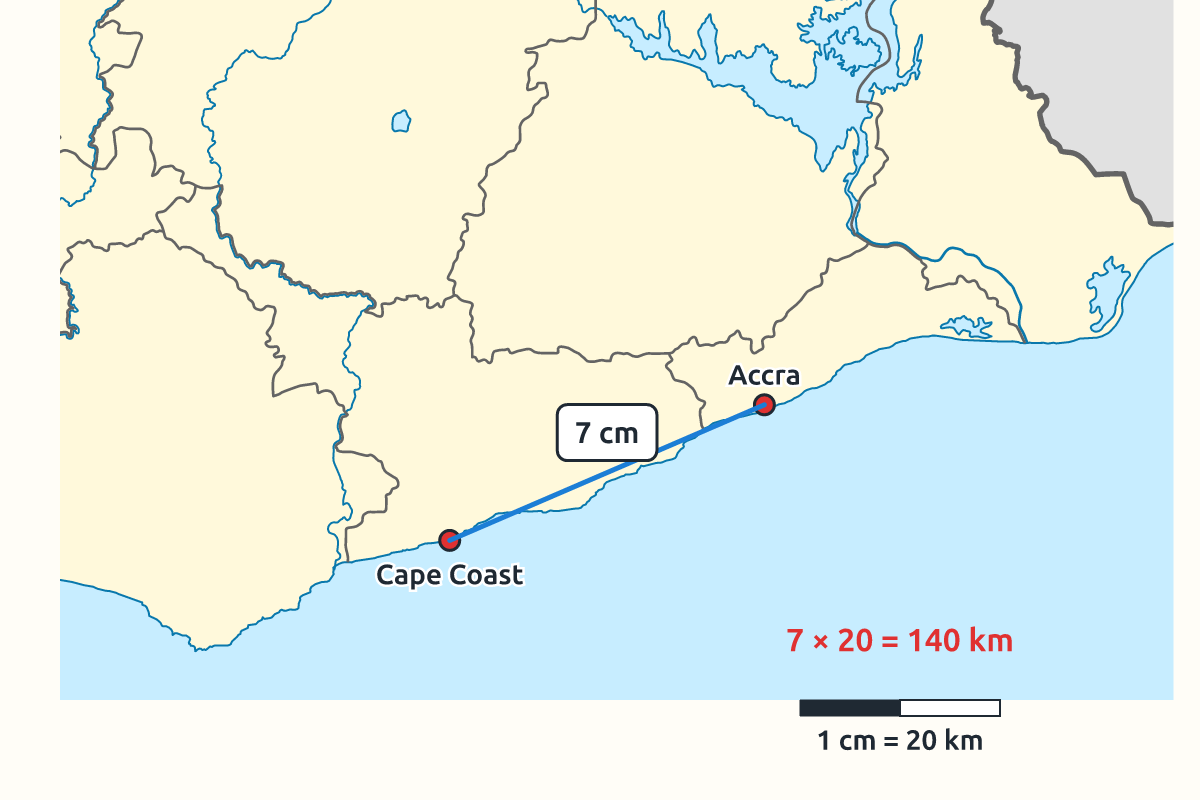
On a map with scale 1 cm : 20 km, Accra and Cape Coast are 7 cm apart. What is the real distance?
- 7 × 20
Answer: 140 km
Example 4
A classroom is 8 m long. Draw it with a scale of 1 cm : 2 m. How long is the drawing?
- 8 ÷ 2
Answer: 4 cm
3. Comparing Rates
To compare rates, change them to the same unit (per 1). The lower unit price is the better buy; the higher speed covers more distance in the same time.
Tip: Always write the units with rates and scales.
New words
- rate
- A comparison of two different quantities.
- speed
- Distance travelled per unit of time.
- unit price
- The cost of one unit.
- scale
- The ratio of drawing length to real length.
- scale drawing
- A drawing made smaller or larger than real life in a fixed ratio.
- average
- The typical value found by sharing equally.
Summary
- A rate compares different quantities, such as km/h.
- Find unit rates to compare prices or speeds.
- A scale links map or drawing lengths to real lengths.
- Multiply by the scale to find real distances; divide to find drawing lengths.
Class activity: Scale Drawing
- Measure your classroom with a tape.
- Choose a scale (e.g. 1 cm : 1 m).
- Draw the classroom plan on graph paper and label the real sizes.
You need: Bottle tops in two colours, Beans, Maize grains, Exercise books
Exercises
Answer in your exercise book first, then check your answers.
1. A car travels 150 km in 3 hours. Its speed is…
- A. 50 km/h
- B. 450 km/h
- C. 30 km/h
- D. 153 km/h
Show answer
Answer: 50 km/h150 ÷ 3.2. Scale 1 cm : 5 km. A map distance of 9 cm is…
- A. 45 km
- B. 14 km
- C. 4 km
- D. 59 km
Show answer
Answer: 45 km9 × 5.3. Which is the better buy?
- A. 4 tins for GH₵36
- B. 3 tins for GH₵30
- C. They are equal
- D. Cannot tell
Show answer
Answer: 4 tins for GH₵36GH₵9 vs GH₵10 per tin.4. km/h is a unit of speed.
- A. True
- B. False
Show answer
Answer: TrueKilometres per hour.5. On a 1 : 100 drawing, 3 cm represents 30 cm.
- A. True
- B. False
Show answer
Answer: FalseIt represents 300 cm (3 m).6. Speed = distance ÷ ______
Show answer
Answer: timeRate formula.7. A worker earns GH₵360 for 6 days. What is her daily rate?
Show answer
Answer: GH₵60 per day360 ÷ 6.8. A map scale is 1 cm : 25 km. Two towns are 300 km apart in a straight line. How far apart are they on the map?
Show answer
Answer: 12 cm300 ÷ 25 = 12.
Homework
- Find the distance between two towns on a map using its scale, and work out how long a trotro at 60 km/h would take.