Basic 6 · Mathematics · Ratio and Proportion
Equivalent Ratios: Comparing and Ordering
In this topic you will express ratios in simplest and equivalent forms, and compare and order ratios.
By the end of these notes you should be able to:
- Simplify ratios to their lowest terms
- Find equivalent ratios
- Compare and order ratios
What you already know
- Understanding ratio
Copy everything that has a blue line on its left into your notebook. The other parts are for reading.
- Strand
- Number
- Sub-strand
- Ratio and Proportion
- Indicator
- B6.1.4.1.2 – Express ratios in equivalent forms compare and order ratios
Introduction
A mixture of 2 cups of sugar to 4 cups of water tastes the same as 1 cup of sugar to 2 cups of water. The ratios 2 : 4 and 1 : 2 are equivalent.
1. Simplifying Ratios
Divide both terms by their highest common factor (HCF).
Example 1
Simplify 18 : 24.
- HCF of 18 and 24 = 6
- 18 ÷ 6 = 3; 24 ÷ 6 = 4
Answer: 3 : 4
Example 2
Simplify 1.5 kg : 500 g.
- Same units: 1,500 g : 500 g
- Divide by 500
Answer: 3 : 1
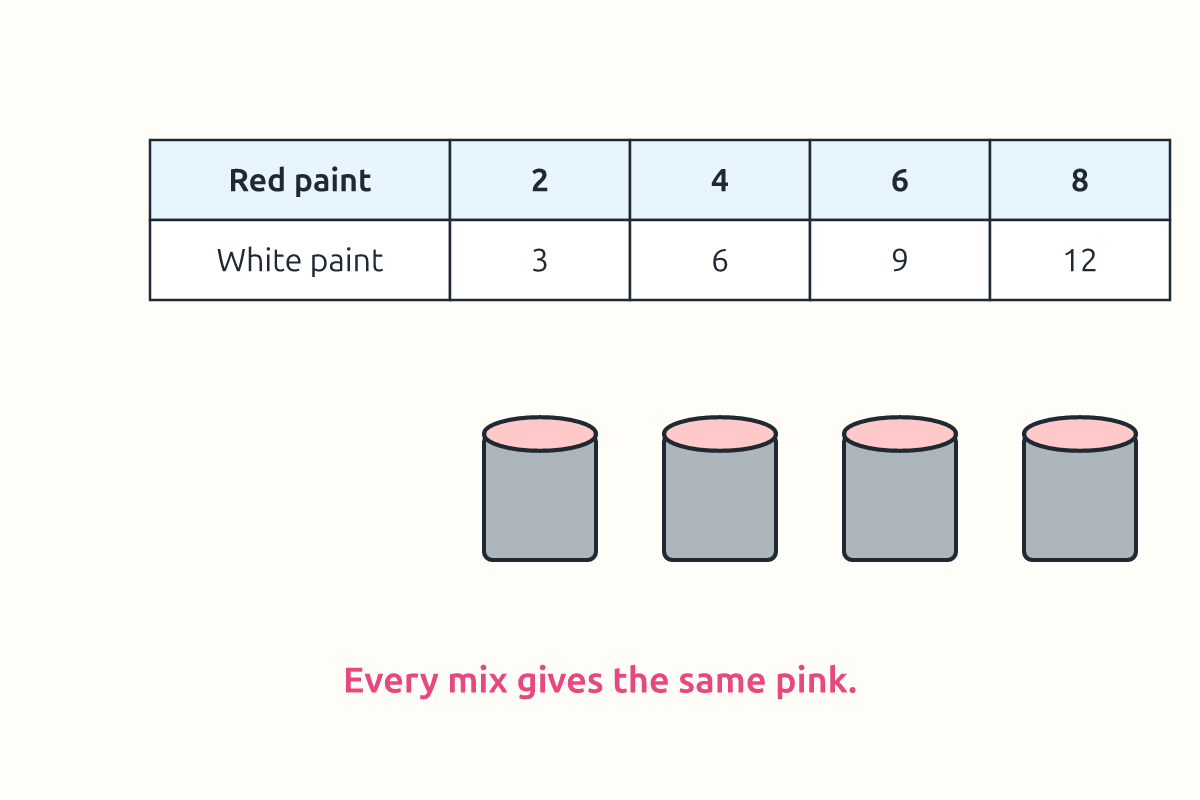
2. Equivalent Ratios
Multiply or divide both terms by the same number.
| × 1 | × 2 | × 3 | × 4 | × 5 |
|---|---|---|---|---|
| 2 : 3 | 4 : 6 | 6 : 9 | 8 : 12 | 10 : 15 |
3. Comparing Ratios
To compare ratios, write them as fractions with the same denominator, or as decimals.
Example 3
Which drink is sweeter: A has sugar : water = 2 : 5, B has 3 : 8?
- A: 2/5 = 0.40 of the water amount
- B: 3/8 = 0.375
- 0.40 > 0.375
Answer: Drink A is sweeter.
4. Ordering Ratios
Example 4
Order 1 : 2, 3 : 8, 2 : 3 from smallest to largest.
- As decimals: 0.5, 0.375, 0.667
Answer: 3 : 8, 1 : 2, 2 : 3
Tip: Ratios in simplest form use whole numbers only and have no common factor other than 1.
Equivalent ratios are used when cooking for more people, mixing cement and sand for building, or preparing medicine. A mason who uses 1 bag of cement to 3 wheelbarrows of sand for a small job will use 4 bags to 12 wheelbarrows for a job four times as big, keeping the same strength of mortar.
New words
- simplest form
- A ratio whose terms have no common factor except 1.
- equivalent ratio
- A ratio with the same value.
- HCF
- Highest common factor.
- ratio table
- A table listing equivalent ratios.
- compare
- To decide which is greater.
- term
- Each number in a ratio.
Summary
- Simplify ratios by dividing by the HCF.
- Equivalent ratios are made by multiplying or dividing both terms by the same number.
- Compare ratios by changing them to fractions or decimals.
- Use the same units before simplifying.
Class activity: Juice Taste Test
- Make two drinks with different ratios of concentrate to water (e.g. 1 : 4 and 2 : 5).
- Predict which is stronger using decimals.
- Taste to check your prediction.
You need: Bottle tops in two colours, Beans, Maize grains, Exercise books
Exercises
Answer in your exercise book first, then check your answers.
1. Simplify 10 : 15.
- A. 2 : 3
- B. 1 : 5
- C. 5 : 10
- D. 3 : 2
Show answer
Answer: 2 : 3Divide by 5.2. Which ratio is equivalent to 3 : 7?
- A. 9 : 21
- B. 6 : 12
- C. 3 : 14
- D. 7 : 3
Show answer
Answer: 9 : 21Multiply by 3.3. Which is larger: 2 : 5 or 3 : 10?
- A. 2 : 5
- B. 3 : 10
- C. they are equal
- D. cannot tell
Show answer
Answer: 2 : 50.4 > 0.3.4. 4 : 8 and 1 : 2 are equivalent.
- A. True
- B. False
Show answer
Answer: TrueDivide by 4.5. 2 m : 50 cm simplifies to 2 : 50.
- A. True
- B. False
Show answer
Answer: False200 : 50 = 4 : 1.6. 12 : 16 in simplest form is ______.
Show answer
Answer: 3 : 4Divide by 4.7. Find the missing number: 5 : 8 = ___ : 40.
Show answer
Answer: 25Multiply by 5.8. Order 3 : 4, 5 : 8 and 7 : 10 from largest to smallest.
Show answer
Answer: 3 : 4 (0.75), 7 : 10 (0.7), 5 : 8 (0.625)Decimals.
Homework
- Simplify five ratios from household recipes or mixtures.