Basic 6 · Mathematics · Number Operations
Number Properties for Multiplication and Division
In this topic you will use number properties (commutative, associative, distributive and identity) and mental strategies to recall multiplication facts to 81 and related division facts.
By the end of these notes you should be able to:
- State the commutative, associative, distributive and identity properties
- Use the properties to multiply mentally
- Use multiplication facts to find division facts
What you already know
- Mental strategies for multiplication (Basic 5)
Copy everything that has a blue line on its left into your notebook. The other parts are for reading.
- Strand
- Number
- Sub-strand
- Number Operations
- Indicator
- B6.1.2.1.1 – Apply mental mathematics strategies and number properties to determine answers for basic multiplication facts to 81 and related division facts
Introduction
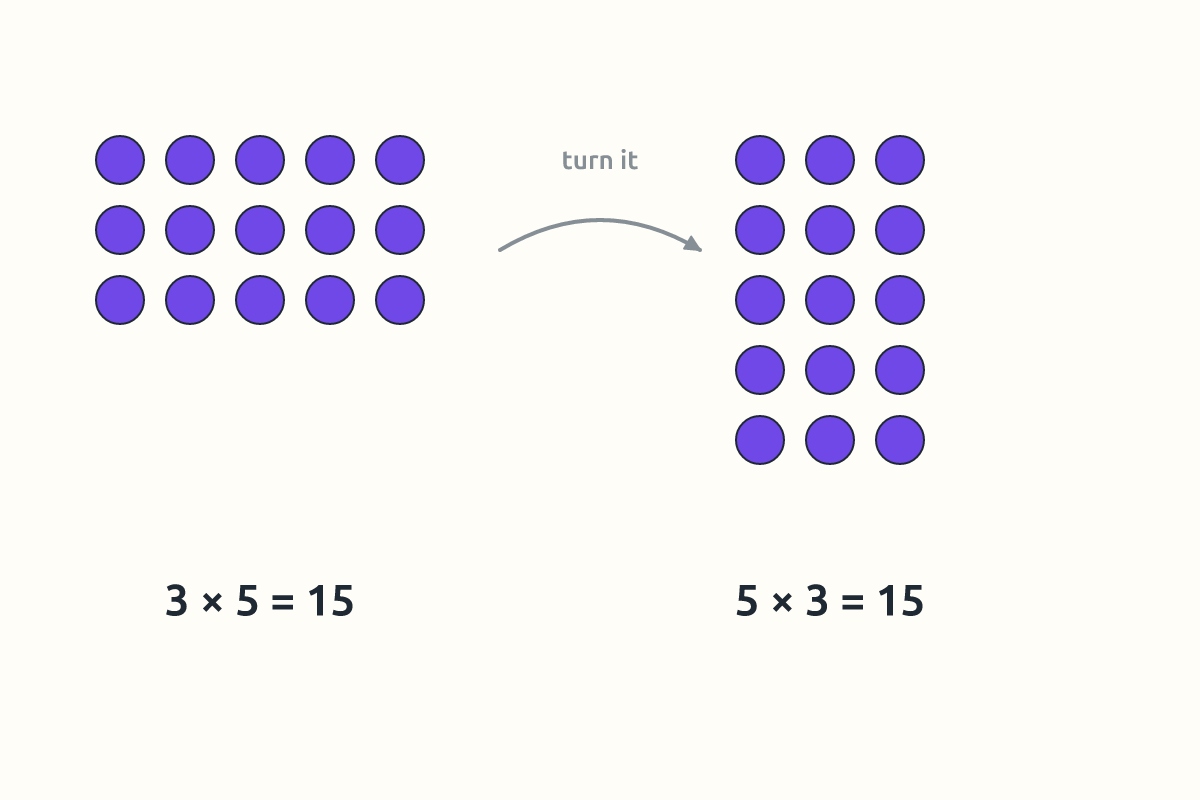
Mathematicians found rules that are always true for multiplication. These rules, called properties, make mental calculation faster.
1. The Properties
| Property | Rule | Example |
|---|---|---|
| commutative | order does not change the product | 7 × 8 = 8 × 7 = 56 |
| associative | grouping does not change the product | (2 × 9) × 5 = 2 × (9 × 5) = 90 |
| distributive | multiply each part and add | 7 × 12 = 7 × 10 + 7 × 2 = 84 |
| identity | multiplying by 1 leaves the number unchanged | 9 × 1 = 9 |
| zero | multiplying by 0 gives 0 | 6 × 0 = 0 |
2. Using Properties Mentally
Example 1
Use the associative property: 4 × 7 × 25
- Regroup: 7 × (4 × 25)
- 4 × 25 = 100
Answer: 7 × 100 = 700
Example 2
Use the distributive property: 6 × 9
- 6 × 9 = 6 × (10 − 1)
- 60 − 6
Answer: 54
3. Division Facts
Division is the inverse of multiplication. Because 8 × 9 = 72, we know 72 ÷ 9 = 8 and 72 ÷ 8 = 9. Division is not commutative: 72 ÷ 9 is not the same as 9 ÷ 72.
| Multiplication | Division |
|---|---|
| 7 × 6 = 42 | 42 ÷ 6 = 7 |
| 6 × 7 = 42 | 42 ÷ 7 = 6 |
Common mistake: Division by 0 is not possible. There is no number that multiplied by 0 gives 5.
Knowing these properties is like having shortcuts on a road. Instead of working through a long calculation, you look for pairs that make 10 or 100, split awkward numbers into friendly parts, or change the order. Before you calculate, pause and ask: Which property makes this easier?
New words
- property
- A rule that is always true.
- commutative
- Order does not matter.
- associative
- Grouping does not matter.
- distributive
- Splitting a number to multiply each part.
- identity
- Multiplying by 1 leaves a number unchanged.
- inverse
- The opposite operation.
Summary
- Commutative: a × b = b × a.
- Associative: (a × b) × c = a × (b × c).
- Distributive: a × (b + c) = a × b + a × c.
- Division undoes multiplication; you cannot divide by 0.
Class activity: Property Cards
- Each card shows a calculation (e.g. 5 × 13 × 2).
- Decide which property makes it easiest.
- Explain your method to the class.
You need: Bottle tops, Bundles of sticks, Exercise books
Exercises
Answer in your exercise book first, then check your answers.
1. 9 × 7 = 7 × 9 shows the…
- A. commutative property
- B. associative property
- C. identity property
- D. zero property
Show answer
Answer: commutative propertyOrder changes, product does not.2. 8 × 13 = 8 × 10 + 8 × 3 uses the…
- A. distributive property
- B. commutative property
- C. identity property
- D. zero property
Show answer
Answer: distributive propertySplit and multiply.3. 63 ÷ 7 = ?
- A. 9
- B. 8
- C. 7
- D. 6
Show answer
Answer: 97 × 9 = 63.4. Any number multiplied by 1 is the same number.
- A. True
- B. False
Show answer
Answer: TrueIdentity property.5. Division is commutative.
- A. True
- B. False
Show answer
Answer: False12 ÷ 3 ≠ 3 ÷ 12.6. Any number × 0 = ______.
Show answer
Answer: 0Zero property.7. Use the associative property to find 25 × 9 × 4.
Show answer
Answer: 9 × (25 × 4) = 9 × 100 = 900Regroup.8. Use the distributive property to find 7 × 48.
Show answer
Answer: 7 × 50 − 7 × 2 = 350 − 14 = 336Split 48.
Homework
- Use a property to work out 4 × 17 × 25, 9 × 23 and 6 × 99. Name the property used.