Basic 6 · Mathematics · Number Operations
Mental Strategies for Multiplication
In this topic you will use mental strategies to multiply by 10, 100 and 1,000, by multiples of 10, and by numbers such as 5, 9, 11 and 25.
By the end of these notes you should be able to:
- Multiply by 10, 100 and 1,000 mentally
- Use doubling and halving
- Use compensation and special-number strategies
What you already know
- Number properties
Copy everything that has a blue line on its left into your notebook. The other parts are for reading.
- Strand
- Number
- Sub-strand
- Number Operations
- Indicator
- B6.1.2.1.2-3 – Apply mental mathematics strategies for multiplication
Introduction
A trader sells 25 sachets of water at 50 pesewas each. She works out the total in her head in a second. Mental strategies make such calculations quick.
1. Multiplying by 10, 100 and 1,000
Each place moves one, two or three places to the left, so we write one, two or three zeros at the end of a whole number.
| Calculation | Answer |
|---|---|
| 37 × 10 | 370 |
| 37 × 100 | 3,700 |
| 37 × 1,000 | 37,000 |
| 40 × 300 | 4 × 3 = 12, plus 3 zeros = 12,000 |
2. Doubling and Halving
If you double one factor and halve the other, the product stays the same.
Example 1
16 × 25
- Halve 16 and double 25: 8 × 50
- Halve again and double again: 4 × 100
Answer: 400
3. Compensation
Example 2
49 × 6
- Round 49 to 50: 50 × 6 = 300
- Subtract the extra 1 × 6 = 6
Answer: 300 − 6 = 294
4. Special Numbers
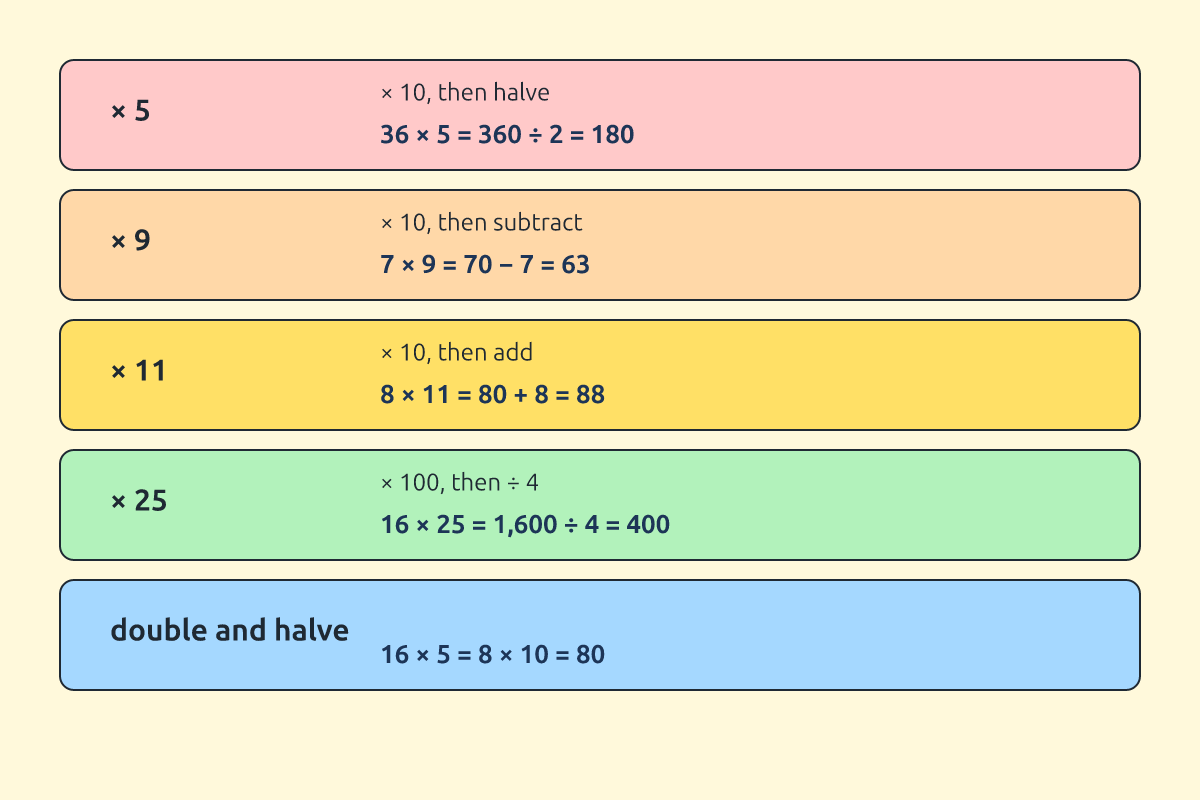
| Multiply by | Method | Example |
|---|---|---|
| 5 | × 10, then halve | 48 × 5 = 480 ÷ 2 = 240 |
| 9 | × 10, then subtract the number | 34 × 9 = 340 − 34 = 306 |
| 11 | × 10, then add the number | 23 × 11 = 230 + 23 = 253 |
| 25 | × 100, then divide by 4 | 36 × 25 = 3,600 ÷ 4 = 900 |
| 99 | × 100, then subtract the number | 14 × 99 = 1,400 − 14 = 1,386 |
Tip: Estimate first so you can tell if your mental answer is reasonable.
New words
- mental strategy
- A method for calculating in your head.
- doubling
- Multiplying by 2.
- halving
- Dividing by 2.
- compensation
- Adjusting after rounding to make the calculation easier.
- factor
- A number being multiplied.
- product
- The answer to a multiplication.
Summary
- Add zeros when multiplying whole numbers by 10, 100 or 1,000.
- Doubling one factor and halving the other keeps the product the same.
- Compensation rounds, multiplies, then adjusts.
- Use special methods for 5, 9, 11, 25 and 99.
Class activity: Mental Maths Quiz
- The teacher calls out calculations such as 45 × 11 or 28 × 25.
- Write answers within 10 seconds.
- Explain the strategy you used for one answer.
You need: Bottle tops, Bundles of sticks, Exercise books
Exercises
Answer in your exercise book first, then check your answers.
1. 58 × 100 = ?
- A. 5,800
- B. 580
- C. 58,000
- D. 5,080
Show answer
Answer: 5,800Add two zeros.2. 64 × 5 = ?
- A. 320
- B. 640
- C. 300
- D. 330
Show answer
Answer: 320640 ÷ 2.3. 27 × 11 = ?
- A. 297
- B. 270
- C. 277
- D. 287
Show answer
Answer: 297270 + 27.4. 70 × 400 = 28,000
- A. True
- B. False
Show answer
Answer: True7 × 4 = 28, plus 3 zeros.5. 39 × 4 = 160 − 4 = 156
- A. True
- B. False
Show answer
Answer: True40 × 4 − 1 × 4.6. 12 × 25 = 1,200 ÷ 4 = ______
Show answer
Answer: 300×100 then ÷4.7. Use doubling and halving to find 35 × 14.
Show answer
Answer: 70 × 7 = 490Double 35, halve 14.8. A school buys 99 bags of rice at GH₵45 each. Find the total mentally.
Show answer
Answer: 45 × 100 − 45 = 4,500 − 45 = GH₵4,455×99 strategy.
Homework
- Solve 15 mental multiplication problems and write the strategy beside each.