Basic 6 · Mathematics · Number Operations
Dividing 3-Digit Numbers by 1-Digit Numbers
In this topic you will recall division facts up to 81 and divide 3-digit numbers by 1-digit numbers, including with remainders.
By the end of these notes you should be able to:
- Recall division facts up to 81
- Divide 3-digit numbers by 1-digit numbers using long division
- Interpret remainders in word problems
What you already know
- Mental strategies for multiplication
Copy everything that has a blue line on its left into your notebook. The other parts are for reading.
- Strand
- Number
- Sub-strand
- Number Operations
- Indicator
- B6.1.2.3.1 – Determine basic division fact up to 81 and divide 3-digit numbers by 1-digit number efficiently
Introduction
A school has 384 exercise books to share equally among 8 classes. How many books does each class get? We need to divide a 3-digit number by a 1-digit number.
1. Long Division Steps
Remember the steps with the words Divide, Multiply, Subtract, Bring down (DMSB). Repeat until there are no more digits to bring down.
Example 1
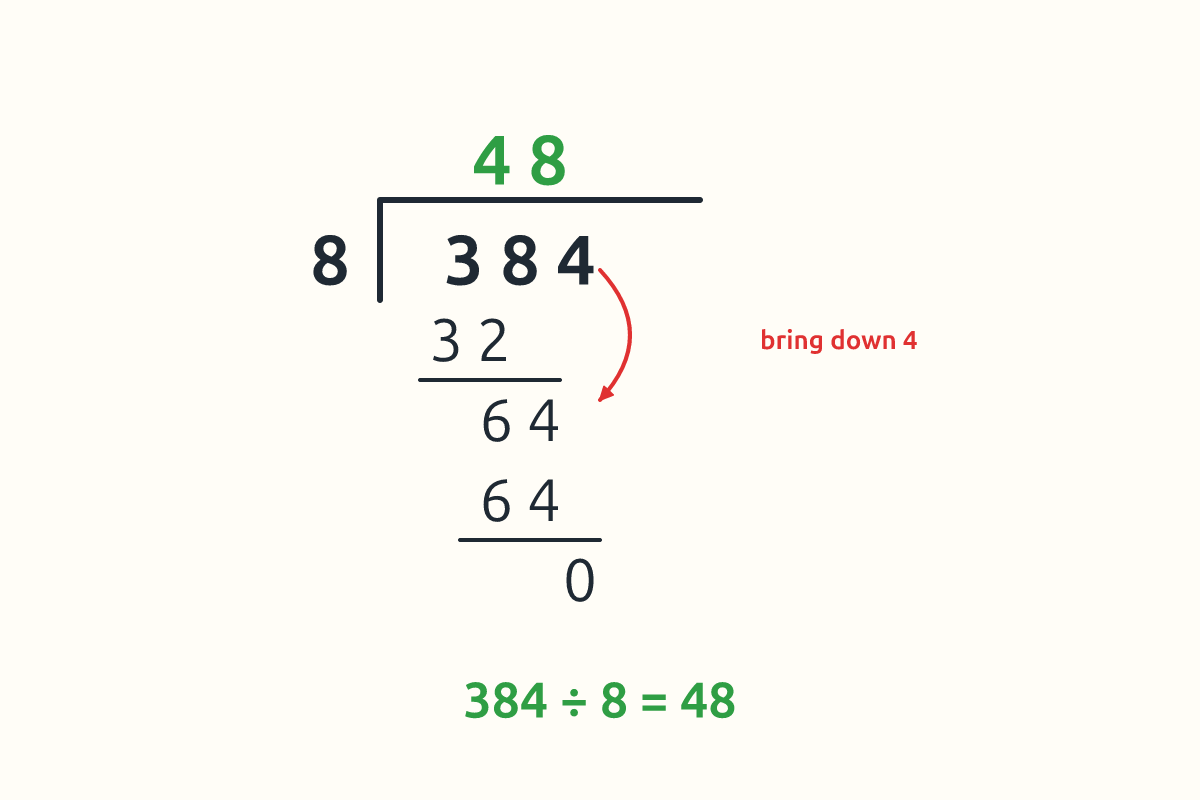
384 ÷ 8
- 8 cannot go into 3, so divide 38 by 8: 4 (8 × 4 = 32), remainder 6
- Bring down 4 to make 64
- 64 ÷ 8 = 8 (8 × 8 = 64), remainder 0
Answer: 384 ÷ 8 = 48 books per class
Example 2
659 ÷ 4
- 6 ÷ 4 = 1 remainder 2
- Bring down 5: 25 ÷ 4 = 6 remainder 1
- Bring down 9: 19 ÷ 4 = 4 remainder 3
Answer: 164 remainder 3 (written 164 r 3)
2. Checking Division
Check by multiplying the quotient by the divisor and adding the remainder: 164 × 4 + 3 = 656 + 3 = 659. ✓
3. Zeros in the Quotient
Example 3
624 ÷ 6
- 6 ÷ 6 = 1
- Bring down 2: 2 ÷ 6 = 0 remainder 2 (write 0 in the quotient)
- Bring down 4: 24 ÷ 6 = 4
Answer: 104
Common mistake: Do not skip the zero in the quotient. 624 ÷ 6 is 104, not 14.
4. Remainders in Word Problems
| Problem | Answer | Reason |
|---|---|---|
| 250 pupils, buses hold 6. How many buses? | 41 r 4 → 42 buses | the extra 4 pupils need a bus |
| 250 pupils in teams of 6. How many full teams? | 41 teams | the 4 left over cannot make a team |
New words
- dividend
- The number being divided.
- divisor
- The number you divide by.
- quotient
- The answer to a division.
- remainder
- What is left over.
- long division
- A written method of dividing step by step.
- inverse
- The opposite operation.
Summary
- Use Divide, Multiply, Subtract, Bring down.
- Write 0 in the quotient when the divisor does not go.
- Check: quotient × divisor + remainder = dividend.
- Decide whether to round up or ignore a remainder in word problems.
Class activity: Sharing Challenge
- Your group gets a number of bottle tops (e.g. 156).
- Share them equally among 4, 5 and 7 people.
- Record each division and its remainder.
You need: Bottle tops, Bundles of sticks, Exercise books
Exercises
Answer in your exercise book first, then check your answers.
1. 72 ÷ 9 = ?
- A. 8
- B. 7
- C. 9
- D. 6
Show answer
Answer: 89 × 8 = 72.2. 515 ÷ 5 = ?
- A. 103
- B. 13
- C. 130
- D. 113
Show answer
Answer: 103Zero in the quotient.3. 437 ÷ 6 = ?
- A. 72 r 5
- B. 72 r 1
- C. 73 r 1
- D. 71 r 5
Show answer
Answer: 72 r 572 × 6 = 432; 437 − 432 = 5.4. In 84 ÷ 4 = 21, the quotient is 21.
- A. True
- B. False
Show answer
Answer: TrueThe answer.5. 300 pupils need buses of 7 seats; 42 buses are enough.
- A. True
- B. False
Show answer
Answer: False300 ÷ 7 = 42 r 6, so 43 buses are needed.6. The number left over after dividing is the ______.
Show answer
Answer: remainderr.7. Divide 948 by 4.
Show answer
Answer: 2374 × 237 = 948.8. A farmer packs 875 oranges into bags of 8. How many full bags, and how many oranges are left?
Show answer
Answer: 109 full bags, 3 left8 × 109 = 872.
Homework
- Solve 5 long division problems and check each by multiplication.