Basic 6 · Mathematics · Counting, Representation and Cardinality
Comparing, Ordering and Rounding Large Numbers
In this topic you will compare and order whole numbers using >, < and =, and round numbers to the nearest ten, hundred, thousand and ten thousand.
By the end of these notes you should be able to:
- Compare and order large numbers using place value
- Use >, < and = correctly
- Round numbers to the nearest 10, 100, 1,000 and 10,000
What you already know
- Comparing numbers (Basic 5)
Copy everything that has a blue line on its left into your notebook. The other parts are for reading.
- Strand
- Number
- Sub-strand
- Counting, Representation and Cardinality
- Indicator
- B6.1.1.1.4-5 – Compare and order whole numbers up to 100,000 and represent the comparison using ">, < or ="
Introduction
News reports often say "about 33 million people" or "nearly GH₵2,000". These are rounded numbers. Rounding and comparing help us understand large numbers quickly.
1. Comparing and Ordering (Review)
Compare numbers by counting digits first; if equal, compare digit by digit from the left. The first different digit decides which number is greater.
Example 1
Arrange 87,604; 87,640; 86,999; 87,064 in descending order.
- Ten thousands: all 8.
- Thousands: 86,999 has 6, the others 7 → 86,999 is smallest.
- Hundreds: 87,604 and 87,640 have 6; 87,064 has 0.
- Tens: 87,640 (4) > 87,604 (0).
Answer: 87,640 > 87,604 > 87,064 > 86,999
2. Rounding
- Find the rounding digit (the place you are rounding to).
- Look at the digit immediately to its right.
- If it is 5 or more, round up (add 1 to the rounding digit).
- If it is 4 or less, keep the rounding digit the same.
- Change all digits to the right of the rounding digit to zeros.
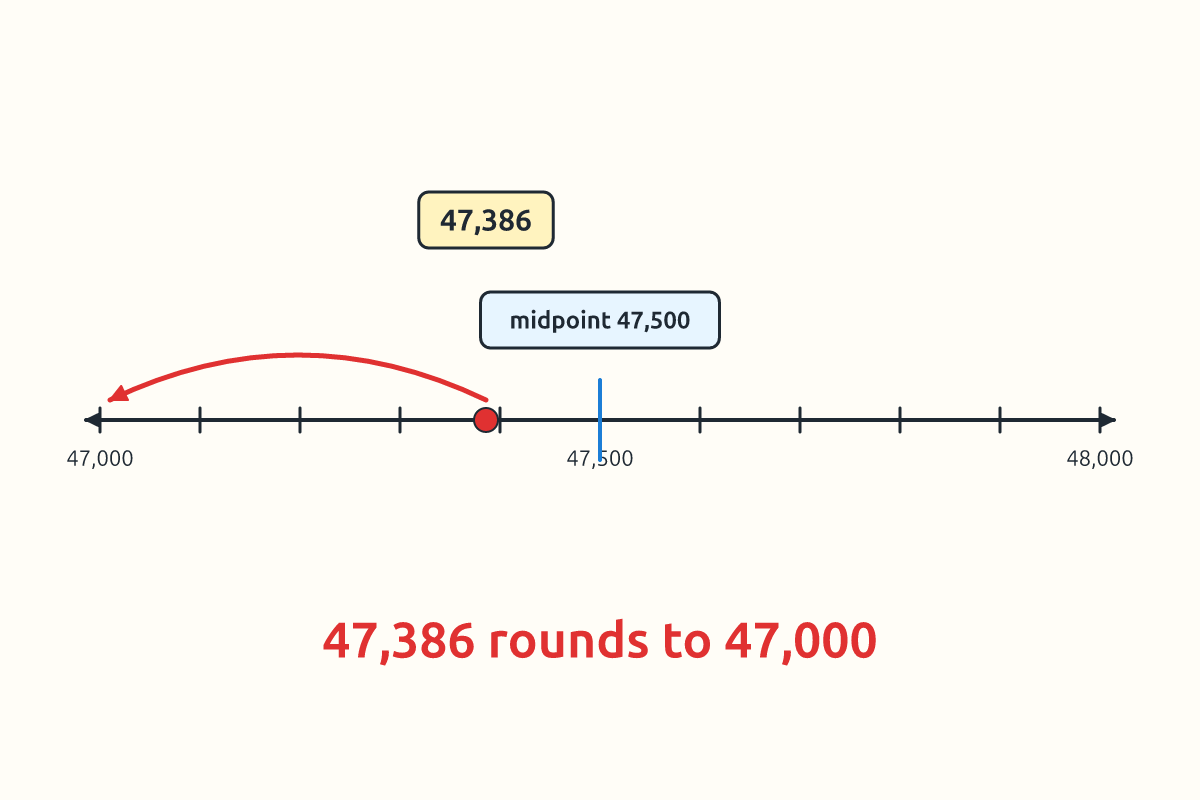
| Round to the nearest | Look at | Answer |
|---|---|---|
| 10 | 6 (ones) → up | 47,390 |
| 100 | 8 (tens) → up | 47,400 |
| 1,000 | 3 (hundreds) → same | 47,000 |
| 10,000 | 7 (thousands) → up | 50,000 |
3. Rounding to Estimate
Rounding helps us estimate quickly. 39,812 + 20,195 is about 40,000 + 20,000 = 60,000. Estimates help us check whether exact answers are sensible.
Common mistake: When rounding 99,960 to the nearest hundred, the 9 in the hundreds becomes 10, so carry: the answer is 100,000.
Rounding is used everywhere in daily life. A trader may say a bag of rice costs "about GH₵500" when the exact price is GH₵485. Governments round population figures in speeches. But exact numbers are still needed for money, measurements and records, so always use the exact figure when accuracy matters.
New words
- round
- To change a number to a nearby simpler number.
- rounding digit
- The digit in the place you round to.
- estimate
- A close, approximate answer.
- approximately
- Nearly; about (≈).
- descending
- From largest to smallest.
- ascending
- From smallest to largest.
Summary
- Compare digit by digit from the left.
- Round up if the next digit is 5 or more; otherwise keep it.
- Digits after the rounding place become zeros.
- Rounding helps us estimate.
Class activity: Rounding Race
- Pick a 5-digit number card.
- Round it to the nearest 10, 100, 1,000 and 10,000.
- The first group with all four correct answers wins the round.
You need: Place-value chart on manila card, Locally made large-number cards, Exercise books
Exercises
Answer in your exercise book first, then check your answers.
1. Round 4,682 to the nearest hundred.
- A. 4,700
- B. 4,600
- C. 4,680
- D. 5,000
Show answer
Answer: 4,7008 tens → round up.2. Which is true?
- A. 56,089 < 56,098
- B. 56,089 > 56,098
- C. 56,089 = 56,098
- D. 56,098 < 56,089
Show answer
Answer: 56,089 < 56,0988 tens < 9 tens.3. Round 74,950 to the nearest thousand.
- A. 75,000
- B. 74,000
- C. 74,900
- D. 70,000
Show answer
Answer: 75,0009 hundreds → up.4. 35 rounded to the nearest ten is 40.
- A. True
- B. False
Show answer
Answer: True5 rounds up.5. 61,449 rounded to the nearest thousand is 62,000.
- A. True
- B. False
Show answer
Answer: False4 hundreds → 61,000.6. ≈ means ______.
Show answer
Answer: approximately (about)Used for estimates.7. Round 128,563 to the nearest ten thousand.
Show answer
Answer: 130,0008 thousands → up.8. Estimate 48,720 + 31,390 by rounding to the nearest thousand.
Show answer
Answer: 49,000 + 31,000 = 80,000Round, then add.
Homework
- Find five large numbers in a newspaper and round each to the nearest thousand.