Basic 6 · History · Political Development
Indirect Rule
In this topic you will describe the system of indirect rule, how it worked in the Gold Coast and its advantages and disadvantages.
By the end of these notes you should be able to:
- Define indirect rule
- Explain why the British used indirect rule
- Assess the advantages and disadvantages of indirect rule
What you already know
- Structure of colonial government
Copy everything that has a blue line on its left into your notebook. The other parts are for reading.
- Strand
- Colonization & Development
- Sub-strand
- Political Development
- Indicator
- B6.4.4.1.1 – Describe the features of British colonial rule in Ghana including direct and indirect rule, 1874–1957
Introduction
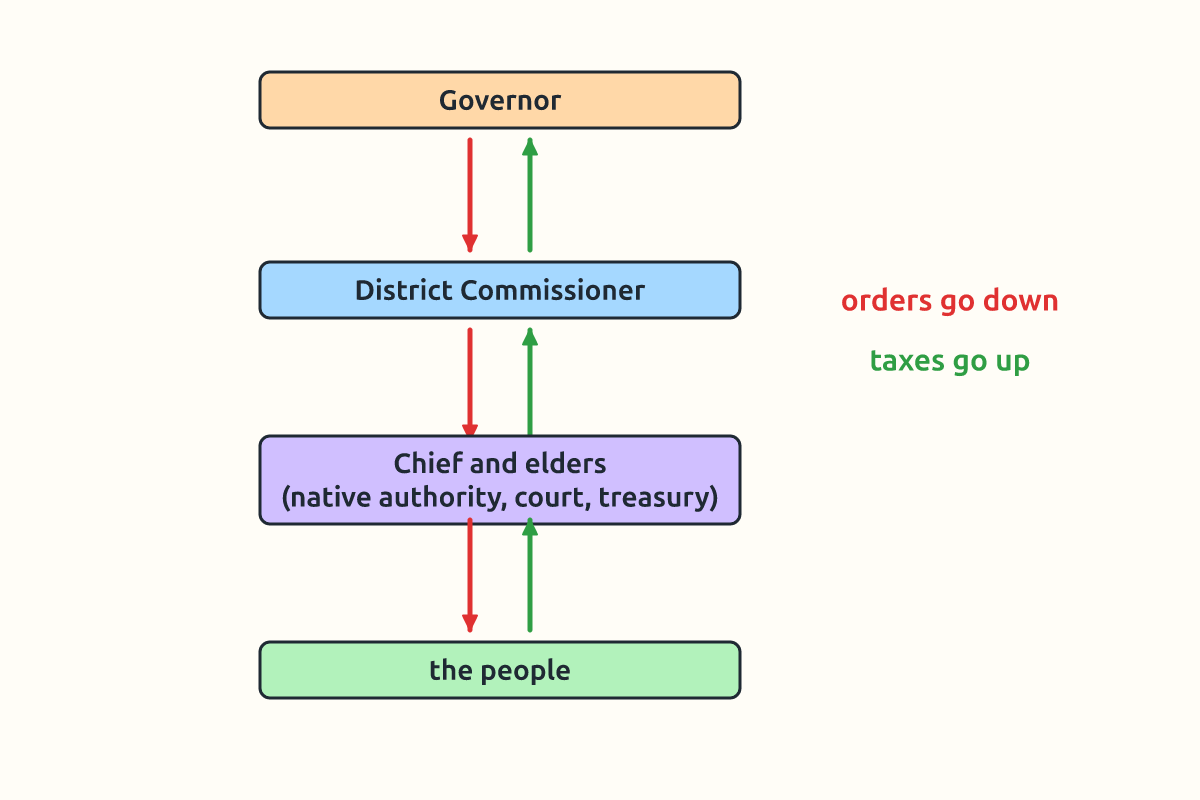
The British had only a few officials in the Gold Coast, but millions of people to govern. Their solution was to rule through the chiefs. This was called indirect rule.
1. What Is Indirect Rule?
Indirect rule: A system in which the British governed the people through their traditional rulers (chiefs), under the supervision of British officials.
The system was developed by Lord Frederick Lugard in Northern Nigeria and was applied in many British colonies. In the Gold Coast, it was used especially in Asante and the Northern Territories, and was strengthened by the Native Administration Ordinance of 1927.
2. How Indirect Rule Worked
| Feature | Explanation |
|---|---|
| chiefs as rulers | chiefs remained the rulers of their people |
| native authorities | chiefs and elders formed native authorities to govern local areas |
| native courts | chiefs judged minor cases using customary law |
| native treasuries | chiefs collected local taxes and fines for local projects |
| British supervision | District Commissioners supervised chiefs and could remove them |
| colonial laws | chiefs had to enforce colonial laws |
3. Why the British Used Indirect Rule
- There were too few British officials to govern directly.
- It was cheaper; chiefs did much of the work.
- People already respected and obeyed their chiefs.
- It reduced resistance because traditional rulers stayed in place.
- The British did not understand local languages and customs well.
4. Advantages and Disadvantages
| Advantages | Disadvantages |
|---|---|
| traditional institutions were preserved | chiefs became agents of the British, losing some respect |
| cheaper for the colonial government | some chiefs became dictatorial because the British protected them |
| chiefs gained experience in administration | educated Africans were left out of local government |
| fewer rebellions | in areas without strong chiefs (some northern communities), the British created "chiefs" who were not accepted |
| local customs and laws respected | it delayed the development of democracy |
Educated Ghanaians such as J.B. Danquah criticised the system because it gave power to chiefs supported by the British while keeping educated people out of government.
New words
- indirect rule
- Ruling the people through their traditional rulers.
- native authority
- A chief and elders governing a local area under colonial rule.
- customary law
- Traditional laws and customs.
- native treasury
- A local fund managed by chiefs.
- agent
- A person who acts for someone else.
- Lord Lugard
- The British official who developed indirect rule.
Summary
- Indirect rule governed people through chiefs supervised by the British.
- It used native authorities, courts and treasuries.
- It was cheap and preserved traditions.
- It also made some chiefs unpopular and excluded the educated elite.
Class activity: For and Against
- List three advantages and three disadvantages of indirect rule.
- Decide whether indirect rule helped or harmed chieftaincy.
- Present your view with evidence.
You need: Ghana map, Locally made colonial timeline cards, Printed photographs of Ghanaian chiefs, Colonial officials
Exercises
Answer in your exercise book first, then check your answers.
1. Indirect rule means ruling through…
- A. chiefs
- B. soldiers only
- C. elected presidents
- D. missionaries
Show answer
Answer: chiefsTraditional rulers.2. Who developed indirect rule?
- A. Lord Lugard
- B. Guggisberg
- C. Nkrumah
- D. Philip Quaque
Show answer
Answer: Lord LugardIn Northern Nigeria.3. Which was a disadvantage of indirect rule?
- A. Educated Africans were left out
- B. It was cheap
- C. Customs were respected
- D. Fewer rebellions
Show answer
Answer: Educated Africans were left outThey were excluded.4. Chiefs collected local taxes under indirect rule.
- A. True
- B. False
Show answer
Answer: TrueNative treasuries.5. Indirect rule was more expensive than direct rule.
- A. True
- B. False
Show answer
Answer: FalseIt was cheaper.6. Traditional laws and customs are called ______ law.
Show answer
Answer: customaryUsed in native courts.7. State three reasons why the British used indirect rule.
Show answer
Answer: Too few officials, cheaper, people respected chiefs (or fewer rebellions).Any three.8. Explain how indirect rule could make some chiefs unpopular.
Show answer
Answer: Chiefs enforced unpopular colonial laws and taxes and were protected by the British, so people saw them as British agents.Loss of respect.
Homework
- Interview an elder about how chiefs ruled in colonial times.