Basic 6 · History · Political Development
The Structure of British Colonial Government
In this topic you will describe how the British colonial government was organised in the Gold Coast.
By the end of these notes you should be able to:
- Describe the role of the Governor
- Explain the Executive and Legislative Councils
- Describe local administration through commissioners
What you already know
- How the Gold Coast became a colony
Copy everything that has a blue line on its left into your notebook. The other parts are for reading.
- Strand
- Colonization & Development
- Sub-strand
- Political Development
- Indicator
- B6.4.4.1.1 – Describe the features of British colonial rule in Ghana including direct and indirect rule, 1874–1957
Introduction
During colonial rule, Ghanaians did not elect their own government. Decisions were made by British officials, led by a Governor appointed in London.
1. The Colonial Office and the Governor
The Gold Coast was controlled by the Colonial Office in London, headed by the Secretary of State for the Colonies. In the Gold Coast, the most powerful official was the Governor, appointed by the British Crown. He made laws with the advice of councils, controlled the army and police, and reported to London. Christiansborg Castle (Osu Castle) in Accra was his official residence.
2. The Executive Council
The Executive Council advised the Governor on day-to-day government. It was made up of senior British officials such as the Colonial Secretary, the Attorney-General and the Treasurer. For most of the colonial period, no Africans sat on it.
3. The Legislative Council
The Legislative Council helped to make laws. At first it had only officials, but over time some Africans were nominated (chosen) to sit on it. Early African members included the lawyer John Mensah Sarbah, appointed in 1901, and later other lawyers and chiefs. Under the 1925 Constitution, six chiefs were included, and three members were elected from Accra, Cape Coast and Sekondi. The 1946 Burns Constitution gave Africans a majority in the Legislative Council for the first time.
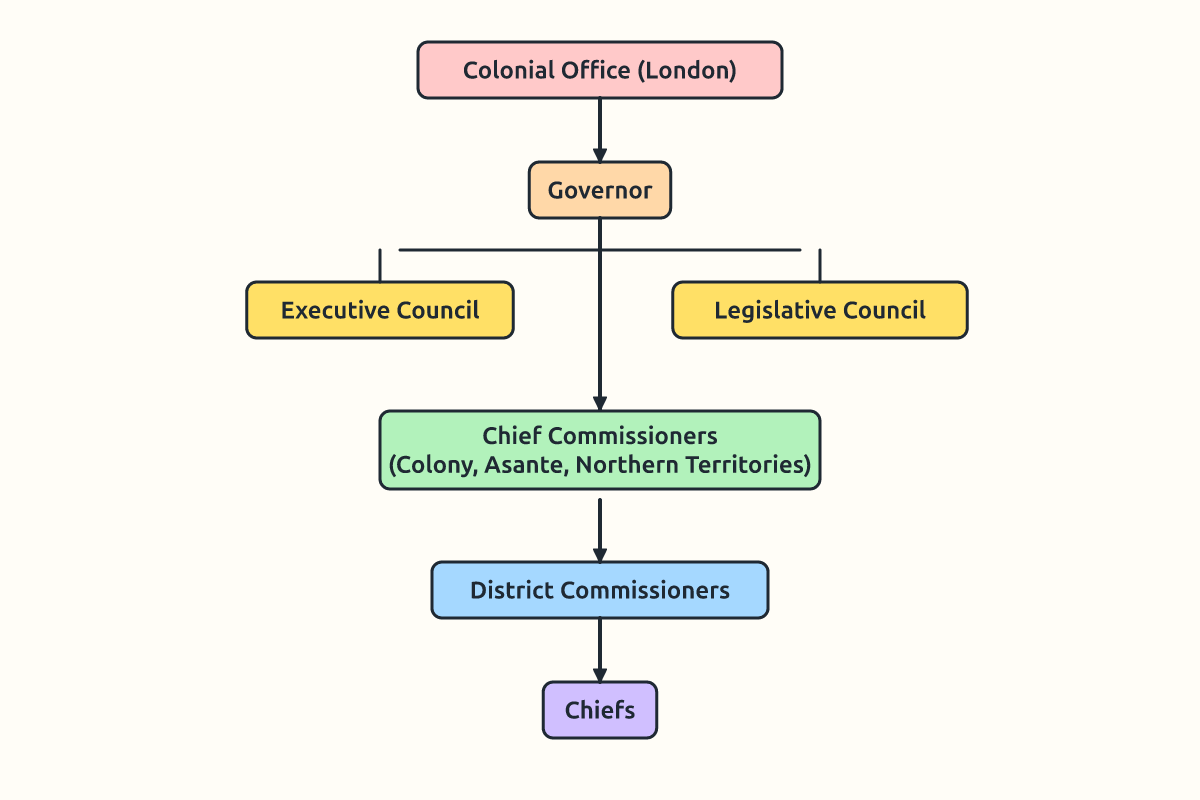
4. Local Administration
| Official | Role |
|---|---|
| Governor | head of the colonial government |
| Chief Commissioner | in charge of a large area (Colony, Asante or Northern Territories) |
| District Commissioner (DC) | in charge of a district; collected taxes, judged cases, supervised chiefs |
| chiefs | ruled their people under British supervision |
The DC was very powerful in his district. He travelled around, settled disputes, collected information and made sure that colonial laws were obeyed.
5. Features of Colonial Rule
- Power was held by British officials, not elected Ghanaians.
- Laws were made by the Governor and councils.
- Taxes and fees were collected to pay for administration.
- Chiefs were used to help govern their people.
- Africans gradually gained more seats in the Legislative Council.
New words
- Governor
- The head of a colonial government.
- Executive Council
- A council that advised the Governor on governing.
- Legislative Council
- A council that helped make laws.
- District Commissioner
- The British official in charge of a district.
- nominated
- Chosen for a position, not elected.
- constitution
- The rules that set out how a country is governed.
Summary
- The Governor ruled the Gold Coast under the Colonial Office in London.
- The Executive Council advised; the Legislative Council made laws.
- District Commissioners controlled districts with chiefs.
- Africans slowly gained more representation, with a majority in 1946.
Class activity: Colonial Government Role-Play
- Assign roles: Governor, Executive Council, Legislative Council, DC and chiefs.
- Act out how a new tax law is made and enforced.
- Discuss whether ordinary people had a voice.
You need: Ghana map, Locally made colonial timeline cards, Printed photographs of Ghanaian chiefs, Colonial officials
Exercises
Answer in your exercise book first, then check your answers.
1. The head of the colonial government was the…
- A. Governor
- B. President
- C. Asantehene
- D. Prime Minister
Show answer
Answer: GovernorAppointed by Britain.2. Which council helped make laws?
- A. Legislative Council
- B. Executive Council
- C. District Council
- D. Youth Council
Show answer
Answer: Legislative CouncilLaw-making.3. Which constitution first gave Africans a majority in the Legislative Council?
- A. Burns Constitution 1946
- B. 1925 Constitution
- C. Bond of 1844
- D. 1992 Constitution
Show answer
Answer: Burns Constitution 1946First African majority.4. District Commissioners were in charge of districts.
- A. True
- B. False
Show answer
Answer: TrueUnder the Governor.5. Ghanaians elected the Governor.
- A. True
- B. False
Show answer
Answer: FalseHe was appointed by Britain.6. The Governor lived at ______ Castle in Accra.
Show answer
Answer: Christiansborg (Osu)Official residence.7. State three duties of a District Commissioner.
Show answer
Answer: Collect taxes, settle disputes, supervise chiefs.Any three.8. Why did Ghanaians want more seats in the Legislative Council?
Show answer
Answer: To have a say in the laws that affected them and to protect their interests.Representation.
Homework
- Draw a chart of the colonial government and explain each part in one sentence.