Basic 6 · History · Political Development
Direct Rule and Comparing the Two Systems
In this topic you will describe direct rule, compare it with indirect rule and explain how both affected Ghanaians.
By the end of these notes you should be able to:
- Define direct rule
- Describe where and how direct rule was used
- Compare direct and indirect rule
What you already know
- Indirect rule
Copy everything that has a blue line on its left into your notebook. The other parts are for reading.
- Strand
- Colonization & Development
- Sub-strand
- Political Development
- Indicator
- B6.4.4.1.1 – Describe the features of British colonial rule in Ghana including direct and indirect rule, 1874–1957
Introduction
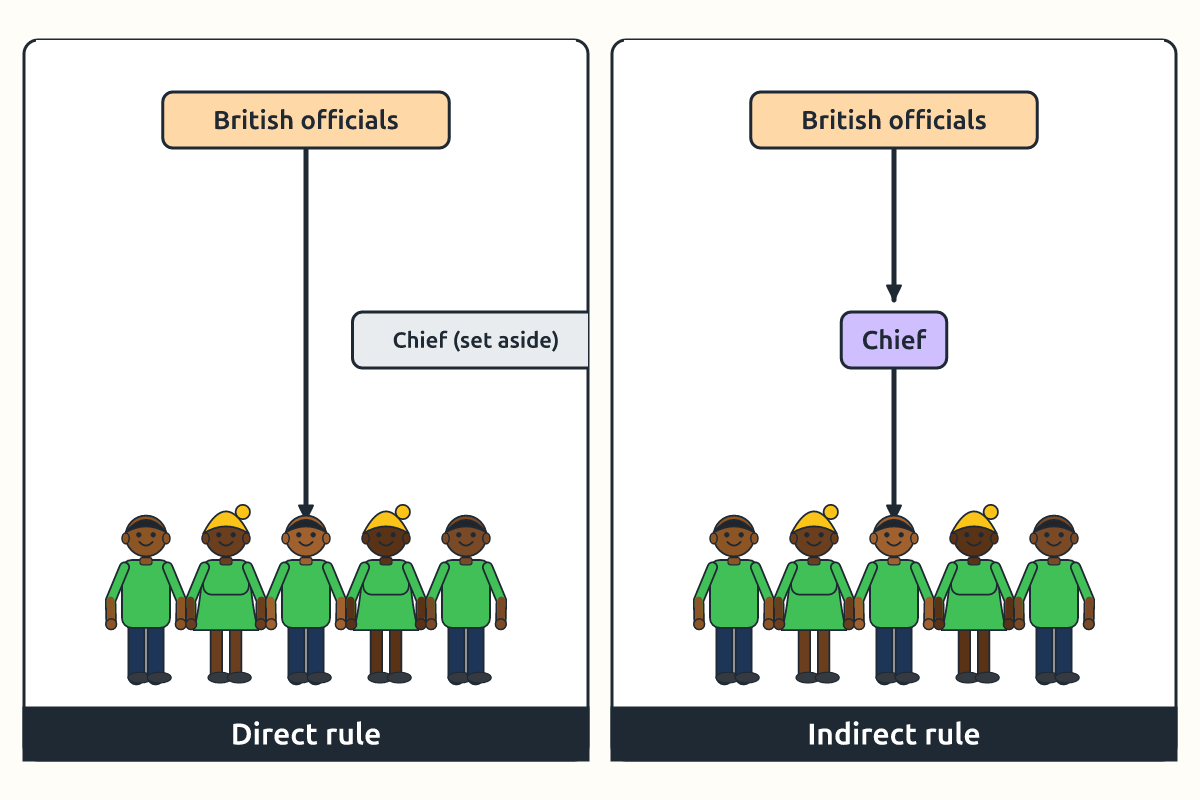
In some towns, especially on the coast, the British did not rule through chiefs but directly through their own officials. This was called direct rule.
1. What Is Direct Rule?
Direct rule: A system in which colonial officials governed the people themselves, replacing or ignoring traditional rulers.
Under direct rule, British officials and the courts they set up made and enforced decisions. Traditional rulers had little or no official power. Direct rule was used mainly in the coastal towns of the Gold Coast Colony, such as Accra, Cape Coast and Sekondi, where many educated Africans lived and town councils were created.
2. Features of Direct Rule
- British officials made and enforced laws directly.
- British courts replaced traditional courts for many cases.
- Town councils managed sanitation, markets and roads in big towns.
- Taxes such as house rates were collected by officials.
- Chiefs lost much of their authority.
3. Comparing Direct and Indirect Rule
| Feature | Direct rule | Indirect rule |
|---|---|---|
| who governs | British officials | chiefs supervised by British officials |
| role of chiefs | little or none | central |
| cost | expensive (more officials needed) | cheaper |
| where used most | coastal towns of the Colony | Asante and the Northern Territories |
| laws | British laws | customary law plus colonial laws |
| reaction | resisted by some chiefs | resented by many educated Africans |
4. Reactions of Ghanaians
Ghanaians did not accept colonial rule quietly. In 1897, the Aborigines' Rights Protection Society successfully opposed the Lands Bill, which would have given the British control of "unused" lands. Chiefs protested against taxes such as the Poll Tax Ordinance of 1852, which was later abandoned because people refused to pay. Newspapers run by educated Africans, such as the Gold Coast Methodist Times, criticised colonial policies. These protests prepared the way for the independence movement.
5. Effects of Both Systems
Both systems kept real power in British hands. Direct rule weakened chieftaincy in the towns, while indirect rule changed the relationship between chiefs and their people. Both systems excluded most Ghanaians from decision-making, which encouraged the demand for self-government.
New words
- direct rule
- Governing people through colonial officials.
- town council
- A body that manages a town's affairs.
- Lands Bill
- A colonial bill of 1897 opposed by the ARPS.
- Poll Tax
- A tax on each person, introduced in 1852.
- self-government
- A people governing themselves.
- resistance
- Opposition to those in power.
Summary
- Direct rule used British officials instead of chiefs.
- It was used mainly in coastal towns of the Colony.
- Direct rule was costly; indirect rule was cheaper and used chiefs.
- Ghanaian protests against both systems led to demands for self-government.
Class activity: Compare and Contrast
- Draw a Venn diagram for direct and indirect rule.
- Write the differences in the outer circles and similarities in the middle.
- Share with another pair.
You need: Ghana map, Locally made colonial timeline cards, Printed photographs of Ghanaian chiefs, Colonial officials
Exercises
Answer in your exercise book first, then check your answers.
1. Under direct rule, who governed?
- A. British officials
- B. chiefs only
- C. elected Ghanaians
- D. missionaries
Show answer
Answer: British officialsDirectly.2. Direct rule was used mainly in…
- A. coastal towns of the Colony
- B. the Northern Territories
- C. Asante villages
- D. Togoland only
Show answer
Answer: coastal towns of the Colonye.g. Accra, Cape Coast.3. The ARPS successfully opposed the…
- A. Lands Bill of 1897
- B. Bond of 1844
- C. Cocoa trade
- D. Railway
Show answer
Answer: Lands Bill of 1897Protecting land rights.4. Direct rule was more expensive than indirect rule.
- A. True
- B. False
Show answer
Answer: TrueMore officials were needed.5. Under direct rule, chiefs had more power.
- A. True
- B. False
Show answer
Answer: FalseThey lost authority.6. A people governing themselves is called self-______.
Show answer
Answer: governmentThe goal of nationalists.7. Give two differences between direct and indirect rule.
Show answer
Answer: Direct rule used British officials and was expensive; indirect rule used chiefs and was cheaper.Any two.8. How did colonial rule lead to demands for self-government?
Show answer
Answer: Ghanaians were excluded from decision-making, so educated people and chiefs organised to demand a voice and later independence.Cause and effect.
Homework
- Write a paragraph comparing direct and indirect rule.