Basic 6 · English Language
Speech Features, Three-Syllable Blends, Phrasal Verbs, Introducing Main Ideas and Adverbs of Degree and Reason
In this topic you will use the features of spoken language in a speech, blend three-syllable words, use phrasal verbs, introduce the main idea of a paragraph and use adverbs of degree and reason.
By the end of these notes you should be able to:
- Use features of spoken language in a short speech
- Blend sounds to produce three-syllable words
- Use common phrasal verbs
- Use key words and phrases to introduce main ideas
- Use adverbs of degree and reason
What you already know
- Thematic Stories, Main Ideas in Sequence, Regular and Irregular Verbs, Revising for Coherence and Superlatives
Copy everything that has a blue line on its left into your notebook. The other parts are for reading.
Lesson 1
- Strand
- Oral Language
- Sub-strand
- Presentation
- Indicator
- B6.1.10.1.2 – Demonstrate awareness of the features of spoken language
Introduction
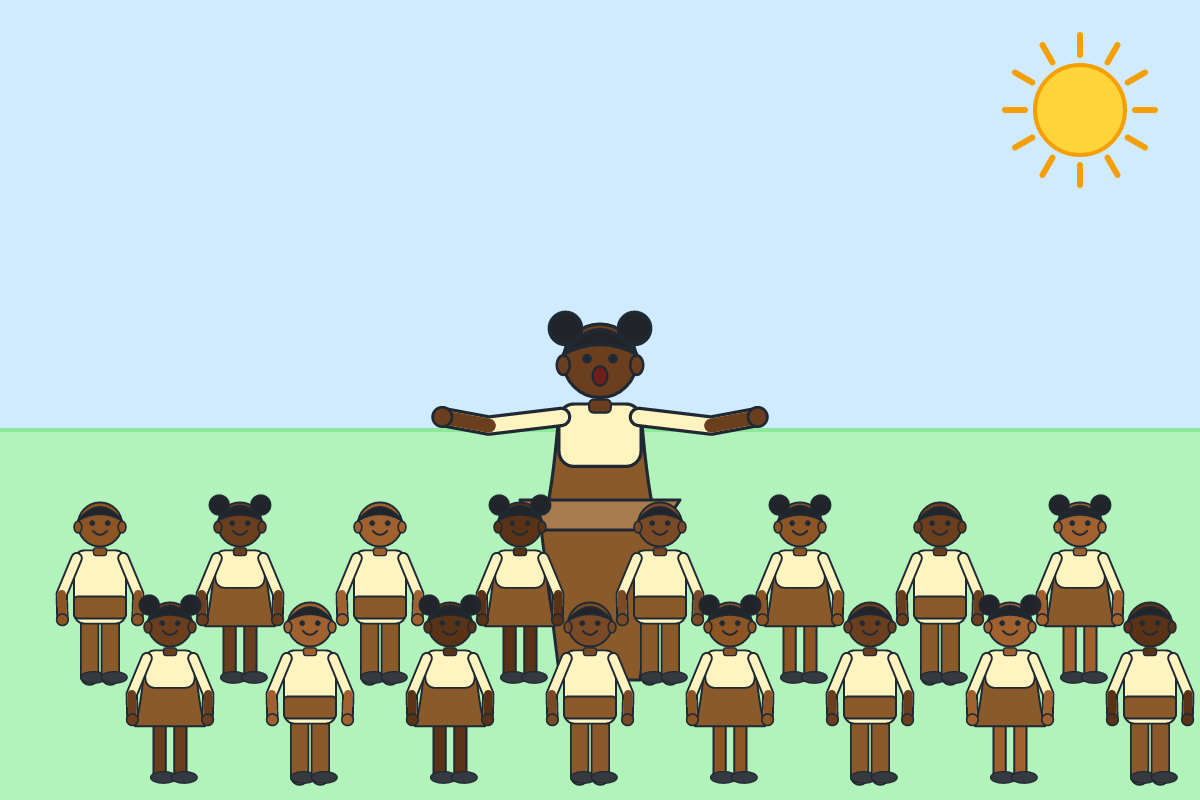
A good speech uses special spoken-language features to keep listeners following and interested.
Features of a Good Speech
| Feature | Purpose | Example |
|---|---|---|
| salutation | greet the audience politely | "The Headteacher, teachers and fellow pupils…" |
| signposting | tell listeners where you are | "First…", "My second point is…", "To conclude…" |
| repetition | emphasise key ideas | "We must act. We must act now." |
| rhetorical question | make listeners think | "Can we live without clean water?" |
| direct address | involve the audience | "You and I can make a difference." |
| pauses and stress | highlight important words | pause before a key point |
Sample opening: "The Headteacher, teachers and fellow pupils, good morning. Can we imagine a Ghana without trees? Today I will speak on three reasons why every pupil should plant a tree. First…"
New words
- signposting
- Words that guide listeners through a speech.
- rhetorical question
- A question asked for effect, not for an answer.
- salutation
- A formal greeting to an audience.
Summary
- Speeches use salutations, signposting, repetition and rhetorical questions.
- Pauses and stress highlight key points.
Exercises
Answer in your exercise book first, then check your answers.
1. "First… Secondly… To conclude…" are examples of…
- A. signposting
- B. slang
- C. rhyme
- D. fillers
Show answer
Answer: signpostingGuide listeners.2. A rhetorical question expects no answer.
- A. True
- B. False
Show answer
Answer: TrueFor effect.3. A formal greeting to an audience is a ______.
Show answer
Answer: salutationOpening.4. Write a rhetorical question for a speech on road safety.
Show answer
Answer: E.g. How many more lives must we lose before we slow down?Makes listeners think.
Lesson 2
- Strand
- Reading
- Sub-strand
- Blends and Consonant Clusters
- Indicator
- B6.2.5.1.1 – Orally produce three-syllable words by blending sounds including consonant blends
Introduction
Long words can be read by breaking them into syllables, blending the sounds in each and joining them.
Three-Syllable Words with Consonant Blends
| Syllables | Word | Blend |
|---|---|---|
| ad + ven + ture | adventure | -nt- |
| com + pu + ter | computer | -mp- |
| pro + tec + tion | protection | pr- |
| dif + fer + ent | different | -nt |
| trans + port + er | transporter | tr-, -sp- |
| blos + som + ing | blossoming | bl- |
Steps: split the word into syllables, blend each syllable, then join them smoothly. Clap once for each syllable to check.
Passage: "On an adventure to the Kakum forest, the children used a computer map. The guide explained the protection of different animals. They saw blossoming flowers and a transporter carrying timber."
New words
- syllable
- A unit of sound containing one vowel sound.
- consonant blend
- Two or three consonants sounded together, e.g. str.
- blend
- To join sounds smoothly.
Summary
- Split long words into syllables and blend each part.
- Consonant blends keep each consonant sound.
Exercises
Answer in your exercise book first, then check your answers.
1. How many syllables in "computer"?
- A. three
- B. two
- C. one
- D. four
Show answer
Answer: threecom-pu-ter.2. "Pr" in "protection" is a consonant blend.
- A. True
- B. False
Show answer
Answer: Truep + r.3. ad + ven + ture = ______
Show answer
Answer: adventureJoin syllables.4. Split into syllables: different, protection.
Show answer
Answer: dif-fer-ent, pro-tec-tionThree each.
Lesson 3
- Strand
- Grammar
- Sub-strand
- Verbs
- Indicator
- B6.3.5.1.2 – Use different types of verbs (phrasal verbs)
Introduction
A phrasal verb is a verb plus a small word (preposition or adverb) that together have a new meaning.
Phrasal Verbs
| Phrasal verb | Meaning | Example |
|---|---|---|
| give up | stop trying | Never give up on your dreams. |
| look after | take care of | She looks after her baby brother. |
| put off | postpone | The match was put off because of rain. |
| turn down | refuse | He turned down the offer. |
| find out | discover | We found out the truth. |
| run out of | have no more | We ran out of sugar. |
| set up | establish | They set up a reading club. |
| look forward to | wait with pleasure | I look forward to the holidays. |
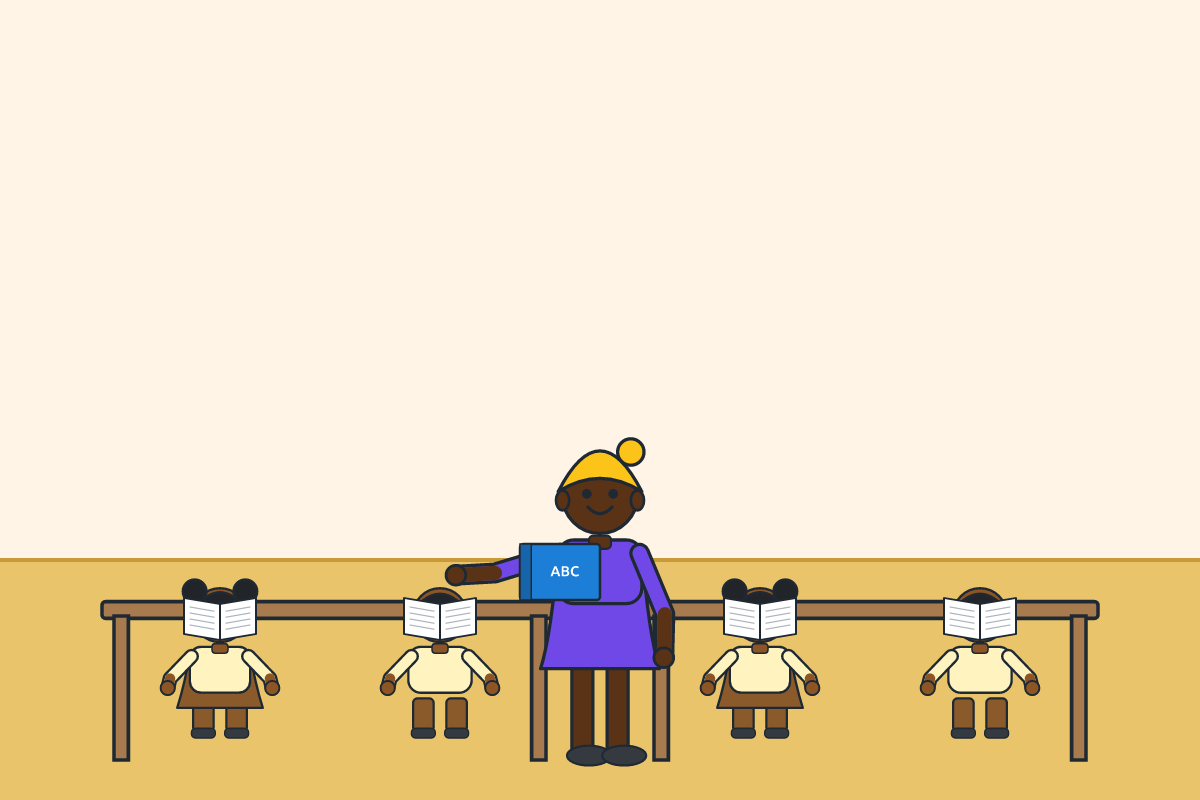
Passage: "Our class set up a reading club last term. At first, some pupils wanted to give up because the books were hard. But our teacher looked after us and helped us find out the meanings of new words. We look forward to every meeting now."
New words
- phrasal verb
- A verb plus a small word with a new meaning.
- postpone
- To move to a later time.
- establish
- To start or set up.
Summary
- Phrasal verbs combine a verb and a particle with a new meaning.
- Learn their meanings from context.
Exercises
Answer in your exercise book first, then check your answers.
1. "Give up" means…
- A. stop trying
- B. begin
- C. climb
- D. give a gift
Show answer
Answer: stop tryingPhrasal verb.2. "Put off" can mean postpone.
- A. True
- B. False
Show answer
Answer: TrueThe match was put off.3. We ran ______ of sugar.
Show answer
Answer: outrun out of.4. Use "look after" in a sentence.
Show answer
Answer: E.g. I look after my grandmother's goats.Correct use.
Lesson 4
- Strand
- Writing
- Sub-strand
- Paragraph Development
- Indicator
- B6.4.6.1.2 – Use key words phrases or clauses to introduce the main idea in the paragraph
Introduction
Writers use key words, phrases or clauses at the start of a paragraph to introduce its main idea clearly.
Introducing the Main Idea
| Method | Example |
|---|---|
| key word | "Pollution is one of the biggest problems in our city." |
| introductory phrase | "In recent years, many young people have moved to the cities." |
| introductory clause | "Although Ghana is rich in gold, many mining communities remain poor." |
| question | "Why do so many road accidents happen at night?" |
The rest of the paragraph should support this opening with details, examples and explanations.
Example paragraph: "Although Ghana is rich in gold, many mining communities remain poor. Most of the profits go to large companies. Local people often lose their farmland. In addition, rivers are polluted, so fishing and farming become difficult."
New words
- main idea
- The most important point of a paragraph.
- introductory clause
- A clause at the start of a sentence that sets up the idea.
- supporting detail
- Information that explains the main idea.
Summary
- Introduce the main idea with a key word, phrase, clause or question.
- Support it with details and examples.
Exercises
Answer in your exercise book first, then check your answers.
1. The most important point of a paragraph is its…
- A. main idea
- B. last word
- C. title
- D. full stop
Show answer
Answer: main ideaKey point.2. A question can introduce a main idea.
- A. True
- B. False
Show answer
Answer: Truee.g. Why…?3. "In recent years" is an introductory ______.
Show answer
Answer: phraseSets up the idea.4. Write an opening sentence introducing the main idea of a paragraph about education.
Show answer
Answer: E.g. Education is the key to Ghana's development.Clear main idea.
Lesson 5
- Strand
- Writing Conventions/ Extensive Reading
- Sub-strand
- Using Adverbs, Building the Love and Culture of Reading
- Indicator
- B6.5.6.1.1 – Use adverbs to express degree and reason
Introduction
Adverbs of degree tell us how much or to what extent. Adverbs and phrases of reason tell us why.
Adverbs of Degree and Reason
| Adverb | Example |
|---|---|
| very | The soup is very hot. |
| too | The box is too heavy to lift. |
| quite | The test was quite easy. |
| extremely | It was extremely cold during harmattan. |
| almost | I almost missed the bus. |
| enough | She is old enough to vote. |
| Word or phrase | Example |
|---|---|
| therefore | It rained; therefore, the match was cancelled. |
| so | I was tired, so I slept early. |
| because of | Because of the traffic, we were late. |
| consequently | He did not study; consequently, he failed. |
Reading extract: "The road was extremely bumpy, so the journey took almost five hours. Because of the heavy rain, the bridge was too dangerous to cross; therefore, we waited until morning."
New words
- adverb of degree
- An adverb showing how much.
- reason
- Why something happens.
- consequently
- As a result.
Summary
- Adverbs of degree show extent: very, too, quite, extremely.
- Words of reason show why: therefore, so, because of.
Exercises
Answer in your exercise book first, then check your answers.
1. Which is an adverb of degree?
- A. extremely
- B. quickly
- C. yesterday
- D. here
Show answer
Answer: extremelyHow much.2. "Too heavy" means heavier than is possible or acceptable.
- A. True
- B. False
Show answer
Answer: TrueToo = excessive.3. It rained; ______, the match was cancelled.
Show answer
Answer: thereforeReason.4. Use "enough" correctly in a sentence.
Show answer
Answer: E.g. She is tall enough to reach the shelf.After adjective.
Homework
- Write a short speech on a national issue using signposting and a rhetorical question.