Basic 6 · English Language
Role-Play, Building Vocabulary, Verb Forms, Free Writing on National Issues and Prepositions
In this topic you will role-play scenes, build vocabulary through reading, use different forms of verbs, write freely on national issues and use prepositions to convey meanings.
By the end of these notes you should be able to:
- Role-play parts of stories or scenes
- Develop vocabulary using roots, prefixes and suffixes
- Use the five forms of verbs, infinitives and gerunds
- Write freely on a national issue
- Use prepositions of place, time, movement and purpose
What you already know
- Speech Features, Three-Syllable Blends, Phrasal Verbs, Introducing Main Ideas and Adverbs of Degree and Reason
Copy everything that has a blue line on its left into your notebook. The other parts are for reading.
Lesson 1
- Strand
- Oral Language
- Sub-strand
- Dramatization and Role
- Indicator
- B6.1.5.1.1 – Dramatize/role-play whole/parts of stories or scenes
Introduction
Role-play means acting as a character to understand how they think and feel. It helps us practise real-life communication.
Role-Playing Scenes
| Scene | Characters | Purpose |
|---|---|---|
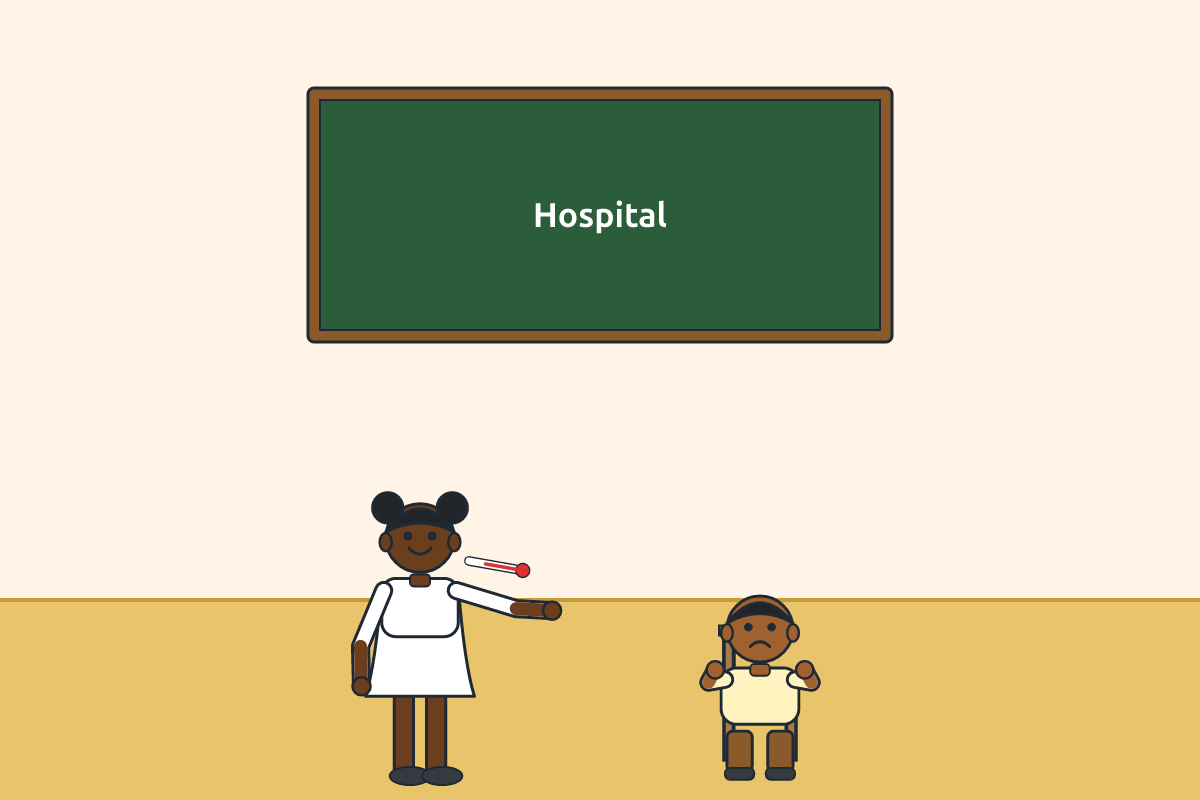
| at the hospital | patient, nurse, doctor | practise describing symptoms politely |
| at a police station | pupil, police officer | practise reporting an incident |
| at the market | buyer, seller | practise bargaining respectfully |
| a community meeting | chief, assemblyman, youth leader | practise discussing a problem |
Steps
- read or create the scene
- assign roles
- think about each character's feelings and way of speaking
- use suitable language (formal or informal)
- act out the scene, then discuss what you learnt
Sample dialogue: "Nurse: Good morning. What brings you here today? Patient: Good morning, Madam. I have had a headache and fever since yesterday. Nurse: I am sorry to hear that. Let me take your temperature."
New words
- role-play
- Acting as a character in a situation.
- scenario
- A described situation.
- symptom
- A sign of illness.
Summary
- Role-play helps practise real-life communication.
- Use language that suits the character and situation.
Exercises
Answer in your exercise book first, then check your answers.
1. Acting as a character in a situation is…
- A. role-play
- B. reading
- C. drawing
- D. singing
Show answer
Answer: role-playDrama.2. A nurse should speak politely to a patient.
- A. True
- B. False
Show answer
Answer: TrueFormal, kind.3. A sign of illness is a ______.
Show answer
Answer: symptome.g. fever.4. Write two lines of dialogue between a buyer and a seller.
Show answer
Answer: Buyer: How much is the tomato? Seller: Three for five cedis.Dialogue.
Lesson 2
- Strand
- Reading
- Sub-strand
- Vocabulary
- Indicator
- B6.2.6.2.1 – Develop a rich vocabulary stock
Introduction
Knowing word parts helps you work out the meanings of many new words you meet in reading.
Building Vocabulary with Word Parts
| Prefix | Meaning | Examples |
|---|---|---|
| un- | not | unhappy, unfair |
| re- | again | rewrite, rebuild |
| dis- | not, opposite | disagree, dishonest |
| pre- | before | preview, prepaid |
| mis- | wrongly | misspell, misunderstand |
| Suffix | Meaning | Examples |
|---|---|---|
| -ful | full of | helpful, careful |
| -less | without | careless, homeless |
| -ment | act or result | development, agreement |
| -able | can be done | readable, washable |
| -er/-or | person who | teacher, inventor |
Root example: "port" (carry): transport, import, export, portable, reporter.
Passage: "The careless driver misjudged the bend. Reporters said the government would rebuild the unsafe bridge as part of its development plan."
New words
- prefix
- Letters added to the beginning of a word.
- suffix
- Letters added to the end of a word.
- root
- The main part of a word that carries meaning.
Summary
- Prefixes, suffixes and roots help you understand new words.
- Read widely and keep a vocabulary notebook.
Exercises
Answer in your exercise book first, then check your answers.
1. "Re-" means…
- A. again
- B. not
- C. before
- D. wrongly
Show answer
Answer: againe.g. rewrite.2. "Careless" means without care.
- A. True
- B. False
Show answer
Answer: True-less = without.3. The root "port" means ______.
Show answer
Answer: carrytransport, export.4. Form two new words each with "un-" and "-ful".
Show answer
Answer: unhappy, unfair; helpful, careful.Correct words.
Lesson 3
- Strand
- Grammar
- Sub-strand
- Verbs
- Indicator
- B6.3.5.1.3 – Use different forms of verbs
Introduction
Every English verb has several forms. Using the right form makes your sentences correct.
Forms of Verbs
| Form | Example (write) | Use |
|---|---|---|
| base | write | I write every day. |
| -s form | writes | She writes neatly. |
| -ing form (present participle) | writing | They are writing. |
| simple past | wrote | We wrote a letter. |
| past participle | written | It has been written. |
| Form | Example |
|---|---|
| infinitive (to + base) | I want to write a story. |
| gerund (-ing as a noun) | Writing is my hobby. |
Some verbs are followed by infinitives (want, hope, decide, plan): "I hope to win." Others are followed by gerunds (enjoy, finish, avoid, keep): "I enjoy reading."
New words
- infinitive
- "to" + the base form of a verb.
- gerund
- An -ing verb used as a noun.
- participle
- A verb form used in tenses or as an adjective.
Summary
- Verbs have base, -s, -ing, past and past participle forms.
- Some verbs take infinitives; others take gerunds.
Exercises
Answer in your exercise book first, then check your answers.
1. "Swimming is fun." "Swimming" is a…
- A. gerund
- B. infinitive
- C. past tense
- D. adjective only
Show answer
Answer: gerund-ing as noun.2. "I enjoy to read" is correct.
- A. True
- B. False
Show answer
Answer: False"I enjoy reading."3. We decided ______ (visit) Aunt Ama.
Show answer
Answer: to visitInfinitive.4. Give the five forms of "eat".
Show answer
Answer: eat, eats, eating, ate, eatenAll forms.
Lesson 4
- Strand
- Writing
- Sub-strand
- Creative Writing
- Indicator
- B6.4.11.1.1 – Write freely about topics of choice on national issues and issues from different learning areas
Introduction
Free writing lets you express your ideas on a national issue or a topic from another subject in your own voice.
Free Writing on National Issues
Sample free writing (topic: "Should Pupils Use Smartphones in School?"): "Smartphones are everywhere in Ghana today, and many pupils carry them. Some people say phones distract pupils and encourage cheating. Others say phones help pupils research and learn faster. I believe phones can be useful if schools set clear rules. For example, phones could be kept in a box and used only during ICT lessons. In this way, pupils gain the benefits without the distractions."
Tips
- choose a topic you know about or care about
- write freely for 10–15 minutes without stopping to correct
- include your opinion and at least two reasons or examples
- link ideas from other subjects, such as science, social studies or ICT
- reread and revise for clarity and correctness
New words
- free writing
- Writing freely to express ideas.
- opinion
- What you think or believe.
- distract
- To take attention away.
Summary
- Free writing lets you express your views on national issues.
- Include opinions, reasons and examples, then revise.
Exercises
Answer in your exercise book first, then check your answers.
1. Free writing means…
- A. writing freely without stopping to correct
- B. copying
- C. drawing
- D. reading
Show answer
Answer: writing freely without stopping to correctFirst draft.2. Your free writing should include your opinion.
- A. True
- B. False
Show answer
Answer: TrueAnd reasons.3. Phones could be used only during ______ lessons.
Show answer
Answer: ICTFrom the sample.4. Give one argument for and one against pupils using phones in school.
Show answer
Answer: For: research. Against: distraction or cheating.Balance.
Lesson 5
- Strand
- Writing Conventions/ Extensive Reading
- Sub-strand
- Using Prepositions, Building the Love and Culture of Reading
- Indicator
- B6.5.7.1.1 – Use prepositions to convey a variety of meanings
Introduction
Prepositions show how things relate in place, time, movement and purpose.
Prepositions and Their Meanings
| Meaning | Prepositions | Example |
|---|---|---|
| place | in, on, at, under, between, among, beside, opposite | The shop is opposite the church. |
| time | at, on, in, since, for, during, until, by | Finish by Friday. |
| movement | into, onto, across, through, along, towards | She walked along the beach. |
| purpose/reason | for, because of, due to | This tool is for weeding. |
| agent/means | by, with | We travelled by ferry. |
"Between" is used for two; "among" for more than two: "Share the sweets among the children." "Sit between Ama and Kofi."
Reading extract: "During the holidays, we travelled by ferry across Lake Volta from Yeji to Makango. We sat among the traders, beside bags of yam. The ferry moved slowly through the calm water towards the opposite shore."
New words
- preposition
- A word showing a relationship between a noun and other words.
- among
- In the middle of more than two.
- between
- In the space separating two.
Summary
- Prepositions show place, time, movement, purpose and means.
- Use between for two and among for more than two.
Exercises
Answer in your exercise book first, then check your answers.
1. Choose: The ball is ___ the box. (inside)
- A. in
- B. on
- C. by
- D. for
Show answer
Answer: inPlace.2. "Among" is used for more than two.
- A. True
- B. False
Show answer
Answer: Truee.g. among the children.3. We travelled ______ ferry.
Show answer
Answer: byMeans.4. Find four prepositions in the extract.
Show answer
Answer: during, by, across, from, to, among, beside, through, towards (any four).Any four.
Homework
- Write a free-writing piece on a national issue and revise it.