Basic 6 · English Language
Thematic Stories, Main Ideas in Sequence, Regular and Irregular Verbs, Revising for Coherence and Superlatives
In this topic you will tell stories around themes, recall main ideas in sequence, use regular and irregular verbs, revise drafts for coherence and use superlative adjectives.
By the end of these notes you should be able to:
- Tell a story around a given theme
- Note and recall the main ideas of a passage in sequence
- Use regular and irregular verbs correctly
- Revise a draft so that it is coherent
- Use superlative forms to make comparisons
What you already know
- Formal and Informal Speech, Homophones, Comparatives, Formal Letters and Participles
Copy everything that has a blue line on its left into your notebook. The other parts are for reading.
Lesson 1
- Strand
- Oral Language
- Sub-strand
- Story Telling
- Indicator
- B6.1.4.1.2 – Tell stories around given themes
Introduction
A theme is the big idea a story is about, such as honesty, courage or friendship. Good storytellers build every part of the story around the theme.
Telling Stories Around a Theme
| Step | Example (theme: honesty) |
|---|---|
| choose the theme | honesty |
| create a character | Esi, a Basic 6 pupil |
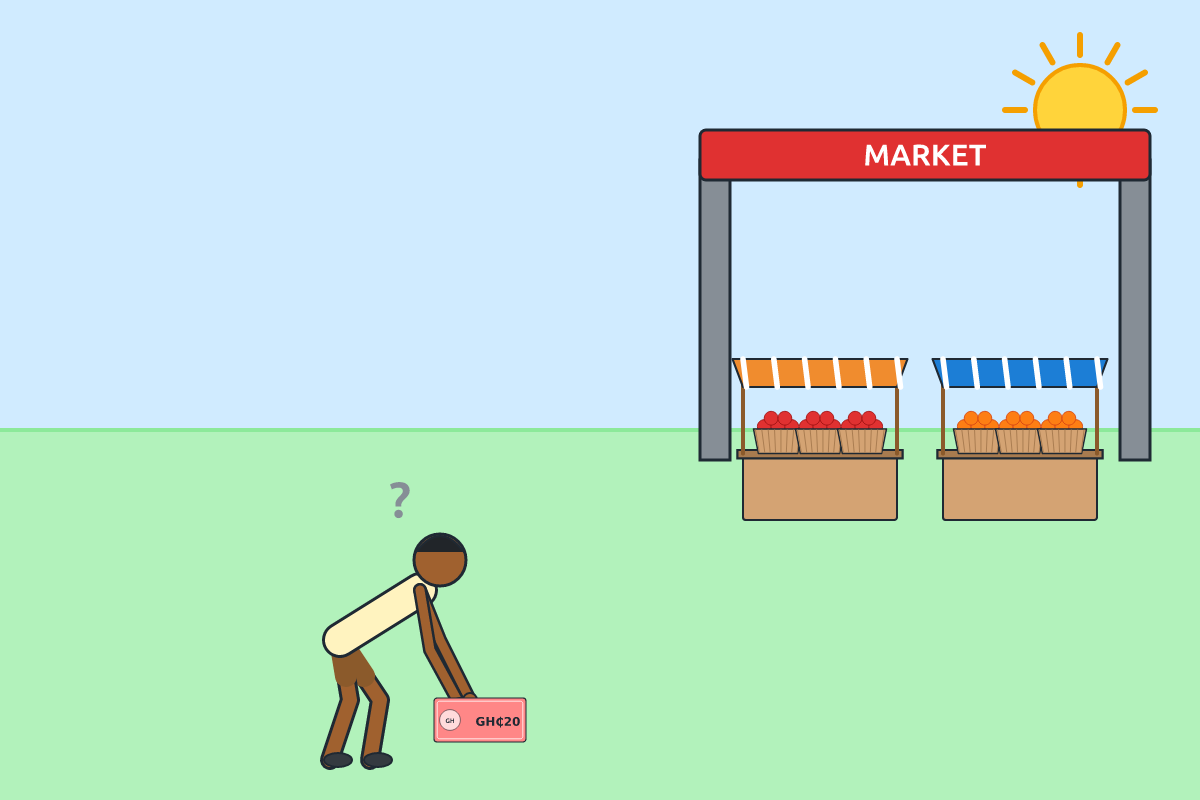
| create a problem that tests the theme | she finds GH₵200 dropped by a trader |
| show a choice | keep it or return it |
| show the result | she returns it; the trader rewards her with a school bag |
| state the lesson | honesty brings respect and reward |
Sample opening: "Esi was walking home from school when she saw a folded bundle of notes lying in the dust near the market gate. She looked around. No one was watching. Her old school bag was torn, and her mother had said they could not afford a new one this term."
New words
- theme
- The main idea or lesson of a story.
- character
- A person in a story.
- dilemma
- A difficult choice.
Summary
- Build a story around a clear theme.
- Create a problem and a choice that test the theme.
Exercises
Answer in your exercise book first, then check your answers.
1. The main idea of a story is its…
- A. theme
- B. title
- C. setting
- D. character
Show answer
Answer: themeBig idea.2. Esi's story tests the theme of honesty.
- A. True
- B. False
Show answer
Answer: TrueReturning money.3. A difficult choice is a ______.
Show answer
Answer: dilemmaEsi's choice.4. Suggest a problem for a story with the theme "courage".
Show answer
Answer: E.g. A boy must report bullying even though the bullies threaten him.Theme test.
Lesson 2
- Strand
- Reading
- Sub-strand
- Comprehension
- Indicator
- B6.2.7.1.1 – Construct meaning from texts note and recall main ideas in sequence
Introduction
Recalling main ideas in order helps you understand and summarise a passage.
Reading Passage: The Boy Who Planted a Forest
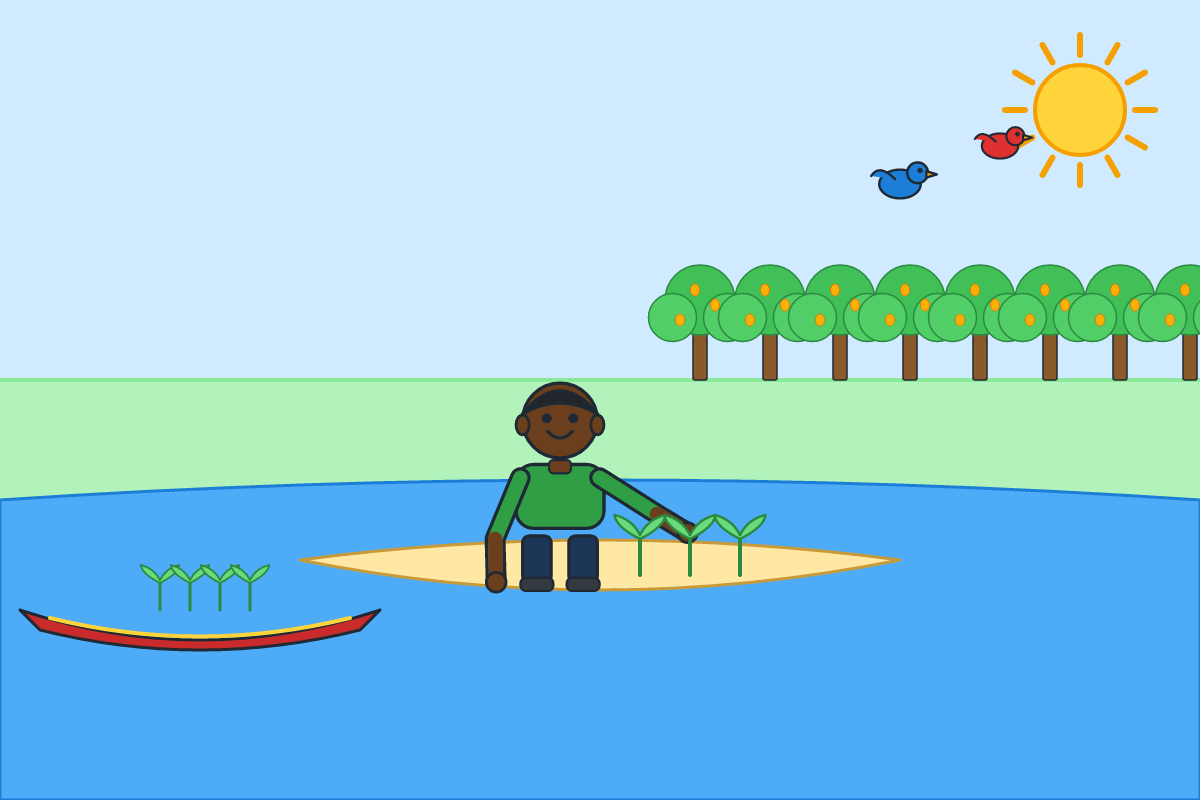
"In 1979, a sixteen-year-old boy named Jadav Payeng lived near a large river in north-east India. After a flood, he saw hundreds of snakes lying dead on a bare sandbar because there were no trees to shade them from the burning sun. He was deeply saddened.
Jadav decided to plant trees on the sandbar. Every day, he carried seedlings by boat and planted them in the sand. When there was no water, he carried it himself. People laughed at him and said nothing would grow there.
But Jadav did not give up. Year after year, he kept planting: bamboo first, then many kinds of trees. Slowly, the bare sand turned into a forest. Birds returned, then deer, rhinoceroses, tigers and elephants.
After about thirty years, the forest had grown to over 500 hectares, larger than many cities' central parks. Officials only learnt about it in 2007, when they saw elephants coming out of it. Jadav became known as 'the Forest Man of India' and received national honours.
Asked why he did it, Jadav said, 'Nature gives us everything. We must give back.'"
| Paragraph | Main idea |
|---|---|
| 1 | A flood left a bare sandbar where snakes died without shade. |
| 2 | Jadav began planting trees despite people's mockery. |
| 3 | Through years of effort, a forest grew and animals returned. |
| 4 | The forest became huge and Jadav was honoured. |
| 5 | Jadav believed we must give back to nature. |
New words
- sandbar
- A long bank of sand in a river.
- mockery
- Laughing at someone unkindly.
- hectare
- A unit of land area (10,000 square metres).
Summary
- One person's persistence created a large forest.
- Recalling main ideas in order helps summarise.
Exercises
Answer in your exercise book first, then check your answers.
1. What did Jadav plant first?
- A. bamboo
- B. maize
- C. cocoa
- D. rice
Show answer
Answer: bambooParagraph 3.2. People encouraged Jadav from the beginning.
- A. True
- B. False
Show answer
Answer: FalseThey laughed at him.3. Jadav became known as "the Forest ______ of India".
Show answer
Answer: ManParagraph 4.4. What is the main idea of paragraph 3?
Show answer
Answer: Through years of effort, the forest grew and animals returned.Main idea.
Lesson 3
- Strand
- Grammar
- Sub-strand
- Verbs
- Indicator
- B6.3.5.1.1 – Use different types of verbs
Introduction
Most verbs add -ed for the past, but many common verbs are irregular and must be learnt.
Regular and Irregular Verbs
| Base | Past | Spelling rule |
|---|---|---|
| walk | walked | add -ed |
| bake | baked | ends in e: add -d |
| stop | stopped | short vowel + consonant: double it |
| carry | carried | consonant + y: change y to i |
| Base | Past | Past participle |
|---|---|---|
| buy | bought | bought |
| catch | caught | caught |
| teach | taught | taught |
| fly | flew | flown |
| choose | chose | chosen |
| sing | sang | sung |
| come | came | come |
Passage: "Yesterday, Mother bought fish at the market. The fisherman had caught it that morning. I carried the basket, and we stopped to watch a bird that flew over the lagoon."
New words
- regular verb
- A verb that adds -ed in the past.
- irregular verb
- A verb with a special past form.
- base form
- The basic form of a verb.
Summary
- Regular verbs add -ed with spelling rules.
- Irregular verbs must be learnt.
Exercises
Answer in your exercise book first, then check your answers.
1. The past of "carry" is…
- A. carried
- B. carryed
- C. carred
- D. carries
Show answer
Answer: carriedy → i.2. "Teach" is an irregular verb.
- A. True
- B. False
Show answer
Answer: Truetaught.3. The bird ______ (fly) over the lagoon.
Show answer
Answer: flewIrregular.4. Write the past of stop, bake and buy.
Show answer
Answer: stopped, baked, boughtRules and irregular.
Lesson 4
- Strand
- Writing
- Sub-strand
- Narrative Writing
- Indicator
- B6.4.9.3.1 – Review and revise a draft to produce a coherent piece
Introduction
A coherent piece of writing flows logically. Each sentence and paragraph connects smoothly to the next.
Revising for Coherence
| Technique | Example |
|---|---|
| logical order | arrange events or ideas in time or importance order |
| topic sentences | begin each paragraph with its main idea |
| linking words | firstly, then, however, therefore, finally |
| pronouns | use he, she, it, this to refer back without repeating nouns |
| consistent tense | keep the same tense throughout |
| remove irrelevant sentences | delete sentences that do not support the topic |
Example
Make this paragraph coherent: "We cleaned the compound. The headteacher praised us. Saturday was clean-up day. My favourite food is jollof. We swept and picked up rubbish."
- Put events in order: Saturday was clean-up day → we swept → we cleaned → praised.
- Remove the irrelevant sentence about jollof.
- Add linking words.
Answer: Saturday was clean-up day. First, we swept the compound and picked up rubbish. Then we cleaned the gutters. Finally, the headteacher praised us for our hard work.
New words
- coherent
- Clear, logical and well connected.
- irrelevant
- Not connected to the topic.
- linking word
- A word that connects ideas.
Summary
- Coherent writing has logical order and clear links.
- Remove irrelevant sentences and keep the tense consistent.
Exercises
Answer in your exercise book first, then check your answers.
1. Which is a linking word?
- A. however
- B. jollof
- C. compound
- D. Saturday
Show answer
Answer: howeverConnects ideas.2. Irrelevant sentences improve coherence.
- A. True
- B. False
Show answer
Answer: FalseRemove them.3. Writing that is clear and well connected is ______.
Show answer
Answer: coherentLogical flow.4. Why should the tense be consistent?
Show answer
Answer: Changing tense confuses the reader about when events happened.Clarity.
Lesson 5
- Strand
- Writing Conventions/ Extensive Reading
- Sub-strand
- Using Adjectives, Building the Love and Culture of Reading
- Indicator
- B6.5.5.1.1 – Use superlative forms of regular and irregular adjectives to make comparison
Introduction
Superlatives compare three or more things and show the highest or lowest degree.
Superlative Adjectives
| Adjective | Superlative | Rule |
|---|---|---|
| tall | the tallest | add -est |
| large | the largest | add -st |
| big | the biggest | double the consonant |
| busy | the busiest | y → i + est |
| beautiful | the most beautiful | most + adjective |
| good / bad | the best / the worst | irregular |
| little / much | the least / the most | irregular |
Use "the" before superlatives and often "in" or "of" after: "the longest river in Ghana", "the best of all".
Reading extract: "Lake Volta is the largest man-made lake in Ghana. Mount Afadjato is often called the highest mountain in the country. Of all the regions, Greater Accra has the most people, although it is one of the smallest in land area."
New words
- superlative
- The highest or lowest degree of comparison.
- degree
- Level of comparison.
- man-made
- Made by people.
Summary
- Use -est, most or irregular forms for superlatives.
- Put "the" before superlatives.
Exercises
Answer in your exercise book first, then check your answers.
1. The superlative of "good" is…
- A. the best
- B. the goodest
- C. the better
- D. the most good
Show answer
Answer: the bestIrregular.2. We use "the" before superlatives.
- A. True
- B. False
Show answer
Answer: Truee.g. the tallest.3. Greater Accra has the ______ (many) people.
Show answer
Answer: mostIrregular superlative.4. Write a sentence using "the most beautiful".
Show answer
Answer: E.g. Wli is the most beautiful waterfall I have seen.Superlative.
Homework
- Write a story around the theme of honesty in five paragraphs.