Basic 6 · English Language
Formal and Informal Speech, Homophones, Comparatives, Formal Letters and Participles
In this topic you will compare formal and informal speech, use homophones and homonyms, use comparative adjectives, write a formal letter and use past participle forms.
By the end of these notes you should be able to:
- Distinguish formal and informal spoken language
- Use homophones and homonyms correctly
- Use comparative forms of regular and irregular adjectives
- Write a formal letter for a purpose
- Use simple past and past participle forms correctly
What you already know
- Connecting Stories to Life, Centring Diphthongs, Reflexive Pronouns, Revising Drafts and Time Expressions
Copy everything that has a blue line on its left into your notebook. The other parts are for reading.
Lesson 1
- Strand
- Oral Language
- Sub-strand
- Presentation
- Indicator
- B6.1.10.1.1 – Demonstrate awareness of the features of spoken language
Introduction
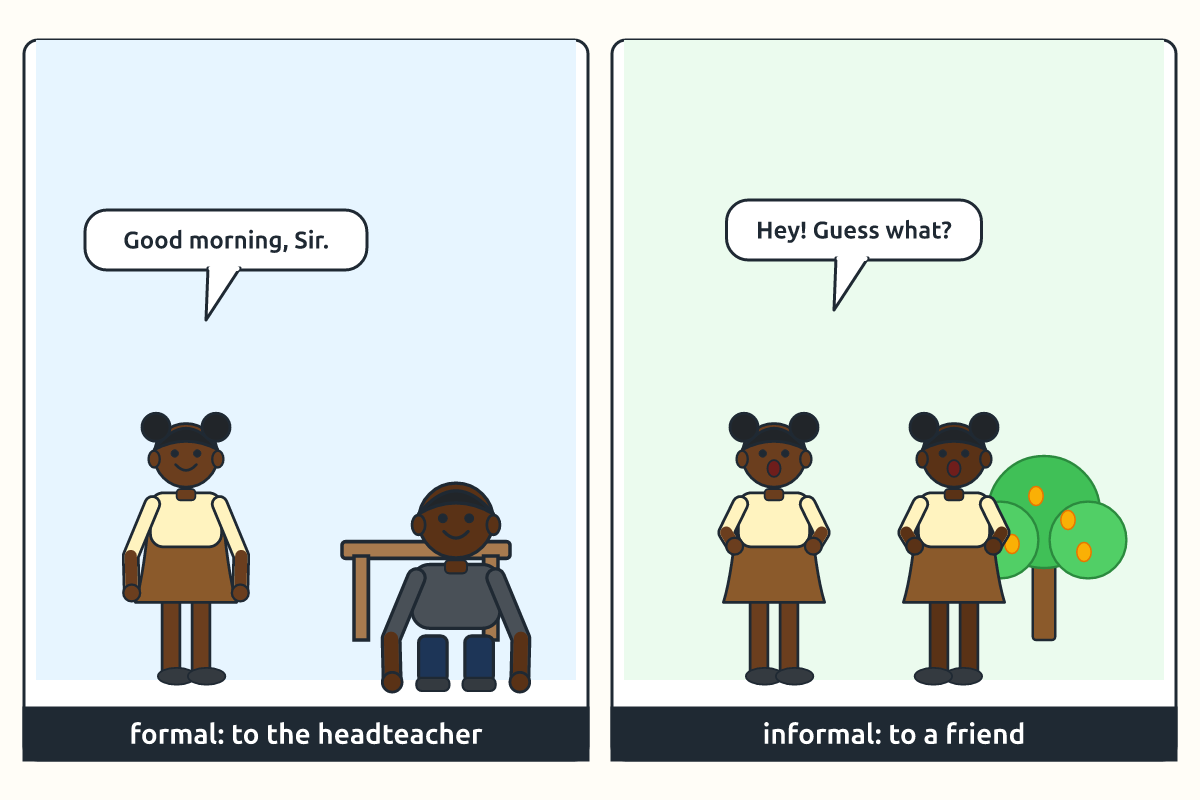
We speak differently to a headteacher than to a best friend. Choosing the right style is part of good communication.
Formal and Informal Spoken Language
| Feature | Formal | Informal |
|---|---|---|
| situation | assembly, interview, speaking to elders | chatting with friends and family |
| greetings | "Good morning, Sir." | "Hi!" "Ete sɛn?" |
| vocabulary | "I would like to request…" | "Can I…?" |
| sentences | complete | short, sometimes incomplete |
| contractions and slang | avoided | common |
| tone | polite and respectful | relaxed |
Example: Formal: "Good afternoon, Madam. Please, may I be excused to visit the nurse?" Informal: "Hey, I'm going to the nurse. See you later!"
Using informal language in a formal situation can seem disrespectful, while very formal language with friends can sound strange. Good speakers switch between the two styles easily.
New words
- formal
- Serious and respectful in style.
- informal
- Relaxed and casual in style.
- slang
- Very informal words used among friends.
Summary
- Use formal speech with elders, teachers and in public.
- Use informal speech with friends and family.
Exercises
Answer in your exercise book first, then check your answers.
1. Which is formal?
- A. "Good morning, Sir."
- B. "Hi, guy!"
- C. "Wassup?"
- D. "Yo!"
Show answer
Answer: "Good morning, Sir."Respectful.2. Slang is suitable in an interview.
- A. True
- B. False
Show answer
Answer: FalseUse formal language.3. Very informal words used among friends are ______.
Show answer
Answer: slangCasual.4. Change to formal: "Can I go out?"
Show answer
Answer: Please, may I be excused?Polite request.
Lesson 2
- Strand
- Reading
- Sub-strand
- Vocabulary
- Indicator
- B6.2.6.1.2 – Use homophones and homonyms in spoken and written expressions
Introduction
Some words sound the same but have different meanings and spellings. Others are spelt the same but have different meanings.
Homophones and Homonyms
| Pair | Meanings |
|---|---|
| there / their / they're | a place / belonging to them / they are |
| two / too / to | the number 2 / also / towards |
| write / right | put words on paper / correct or opposite of left |
| sea / see | ocean / look |
| piece / peace | a part / calm |
| Word | Meaning 1 | Meaning 2 |
|---|---|---|
| bark | sound a dog makes | covering of a tree |
| bat | flying animal | stick used in cricket |
| bank | place for money | side of a river |
| fair | just and honest | a market or festival |
Passage: "Their dog began to bark at the bark of the old tree near the river bank. 'I think it's right,' said Kofi, 'to write a letter to the bank about the fair.'"
New words
- homophone
- A word that sounds the same as another but differs in spelling and meaning.
- homonym
- A word spelt the same as another but with a different meaning.
- context
- The surrounding words that show meaning.
Summary
- Homophones sound the same but are spelt differently.
- Homonyms are spelt the same; context shows the meaning.
Exercises
Answer in your exercise book first, then check your answers.
1. Choose: ___ going to school.
- A. They're
- B. Their
- C. There
- D. Theirs
Show answer
Answer: They'reThey are.2. "Bank" can mean the side of a river.
- A. True
- B. False
Show answer
Answer: TrueHomonym.3. I want ______ eat rice too. (to/too/two)
Show answer
Answer: toInfinitive.4. Use "peace" and "piece" in one sentence.
Show answer
Answer: E.g. For peace at home, give your brother a piece of cake.Both words.
Lesson 3
- Strand
- Grammar
- Sub-strand
- Adjectives
- Indicator
- B6.3.4.1.1 – Use comparatives forms of regular and irregular adjectives
Introduction
Comparative adjectives compare two things. In Basic 6 you will use them in longer sentences and with modifiers.
Comparatives with Modifiers
| Adjective | Comparative |
|---|---|
| short words | add -er: fast → faster |
| words ending in -y | change y to i, add -er: easy → easier |
| long words | use more: important → more important |
| irregular | good → better; bad → worse; far → farther/further; little → less; much/many → more |
Modifiers show how big the difference is: "much bigger", "far better", "a little taller", "slightly more expensive", "a lot easier".
"Less" is used before long adjectives to show a lower degree: "This road is less dangerous than that one."
Examples: "Accra is much busier than Ho." "The second test was a little easier than the first." "Cassava is far cheaper than imported rice."
New words
- comparative
- The form used to compare two things.
- modifier
- A word that changes the strength of another word.
- irregular
- Not following the usual pattern.
Summary
- Form comparatives with -er, more, or irregular forms.
- Use modifiers such as much, far and a little to show degree.
Exercises
Answer in your exercise book first, then check your answers.
1. The comparative of "bad" is…
- A. worse
- B. badder
- C. more bad
- D. worst
Show answer
Answer: worseIrregular.2. "Much busier" shows a big difference.
- A. True
- B. False
Show answer
Answer: TrueModifier "much".3. This bag is ______ (slightly/more) heavier than that one.
Show answer
Answer: slightlyModifier.4. Compare two places using a modifier.
Show answer
Answer: E.g. Kumasi is much bigger than Konongo.Modifier + comparative.
Lesson 4
- Strand
- Writing
- Sub-strand
- Paragraph Development
- Indicator
- B6.4.6.1.1 – Choose appropriate ways and modes of writing for a variety of purposes
Introduction
A formal letter is written to an official person or organisation for a serious purpose.
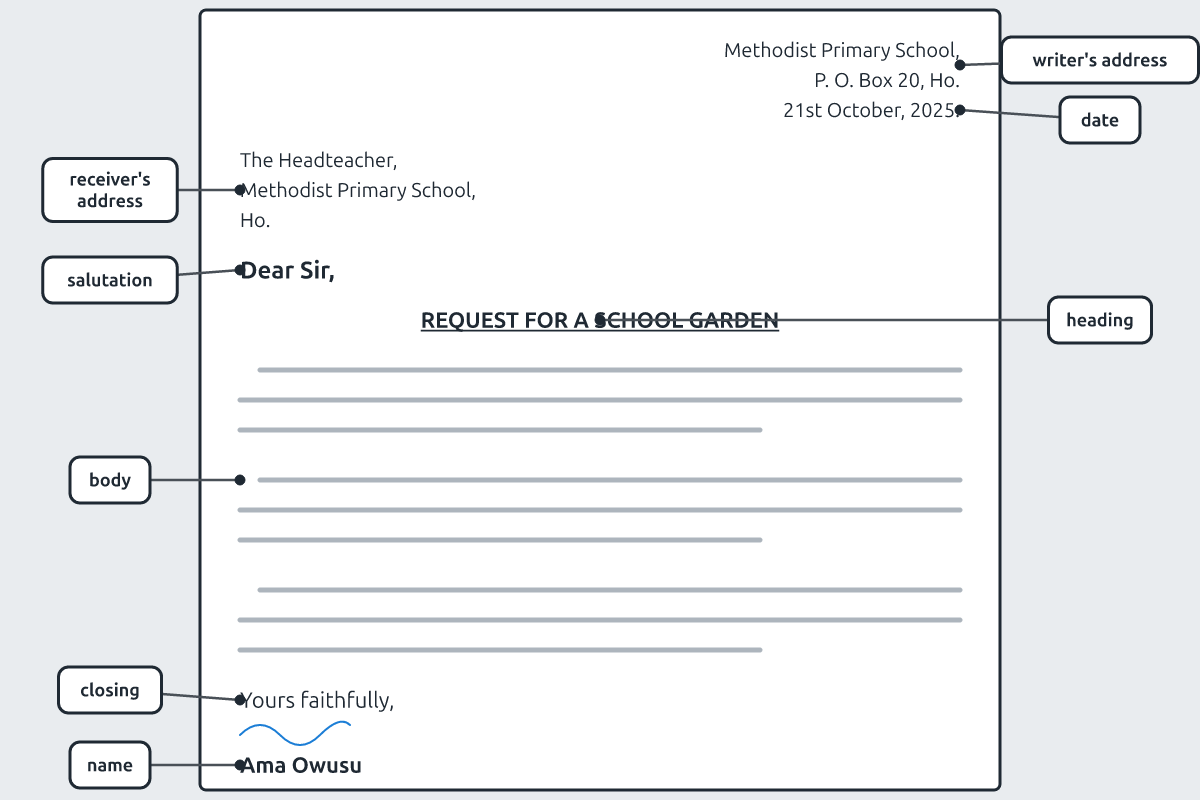
Writing a Formal Letter
| Part | Position | Example |
|---|---|---|
| writer's address and date | top right | Nkwanta M/A Basic School, P.O. Box 15, Nkwanta; 20th October 2026 |
| receiver's title and address | left, below | The District Chief Executive, Nkwanta District Assembly, Nkwanta |
| salutation | left | Dear Sir/Madam, |
| heading | centred or left, underlined | REQUEST FOR A FOOTBRIDGE NEAR OUR SCHOOL |
| body | paragraphs | reason, details, request |
| closing | right or left | Yours faithfully, |
| signature and full name | below closing | (signature) Akosua Mensah, School Prefect |
Use formal language, no contractions or slang, and keep paragraphs short and clear. Use "Yours faithfully" when you begin "Dear Sir/Madam", and "Yours sincerely" when you use the person's name.
New words
- formal letter
- A letter to an official for a serious purpose.
- salutation
- The greeting, e.g. "Dear Sir".
- Yours faithfully
- A closing used when the receiver's name is not used.
Summary
- A formal letter has two addresses, a date, salutation, heading, body and closing.
- Use formal language and the correct closing.
Exercises
Answer in your exercise book first, then check your answers.
1. A formal letter to an unnamed official ends with…
- A. Yours faithfully
- B. Your friend
- C. Bye
- D. Love
Show answer
Answer: Yours faithfullyFormal closing.2. Formal letters avoid slang.
- A. True
- B. False
Show answer
Answer: TrueSerious tone.3. "Dear Sir" is called the ______.
Show answer
Answer: salutationGreeting.4. Write a suitable heading for a letter requesting a school library.
Show answer
Answer: REQUEST FOR A SCHOOL LIBRARYClear heading.
Lesson 5
- Strand
- Writing Conventions/ Extensive Reading
- Sub-strand
- Using Action Words, Building the Love and Culture of Reading
- Indicator
- B6.5.4.1.2 – Explore the use of the simple past verb form and the past participle form
Introduction
Many verbs have different forms for the simple past and the past participle. Knowing them prevents common mistakes.
Simple Past and Past Participle
| Base | Simple past | Past participle |
|---|---|---|
| go | went | gone |
| eat | ate | eaten |
| write | wrote | written |
| begin | began | begun |
| swim | swam | swum |
| break | broke | broken |
| bring | brought | brought |
| play | played | played |
Use the simple past alone: "She wrote a letter." Use the past participle after has/have/had or in the passive: "She has written a letter." "The letter was written yesterday."
Common mistake: Say "I have gone", not "I have went"; say "It was broken", not "It was broke".
Reading extract: "By the time the rain began, the farmers had already brought in the harvest. The children swam in the river, and the old bridge, which had broken last year, was finally repaired."
New words
- simple past
- The verb form for finished actions.
- past participle
- The form used after has/have/had or in the passive.
- passive
- A sentence where the subject receives the action.
Summary
- Simple past stands alone; past participles follow has/have/had or be.
- Learn irregular forms carefully.
Exercises
Answer in your exercise book first, then check your answers.
1. The past participle of "go" is…
- A. gone
- B. went
- C. goed
- D. going
Show answer
Answer: goneIrregular.2. "I have went" is correct.
- A. True
- B. False
Show answer
Answer: False"I have gone".3. The window was ______ (break).
Show answer
Answer: brokenPassive.4. Write the three forms of "begin" and use the participle in a sentence.
Show answer
Answer: begin, began, begun; The match has begun.Forms and use.
Homework
- Write a formal letter to your District Chief Executive about a problem in your community.