Basic 6 · English Language
Connecting Stories to Life, Centring Diphthongs, Reflexive Pronouns, Revising Drafts and Time Expressions
In this topic you will connect stories to personal experiences, use centring diphthongs, use reflexive pronouns, revise a draft and use the simple past and present perfect with time expressions.
By the end of these notes you should be able to:
- Make connections between stories and personal experiences
- Use words with centring diphthongs
- Identify and use reflexive pronouns
- Review and revise a draft for grammar and vocabulary
- Choose between the simple past and present perfect using time expressions
What you already know
- Values in Poems, Reading for Meaning, Quantifiers, Organising Ideas and Proper Nouns in Titles
Copy everything that has a blue line on its left into your notebook. The other parts are for reading.
Lesson 1
- Strand
- Oral Language
- Sub-strand
- Story Telling
- Indicator
- B6.1.4.1.1 – Make connections between texts or stories and personal experiences
Introduction
Good readers make connections: story to self, story to another story and story to the world.
Making Connections
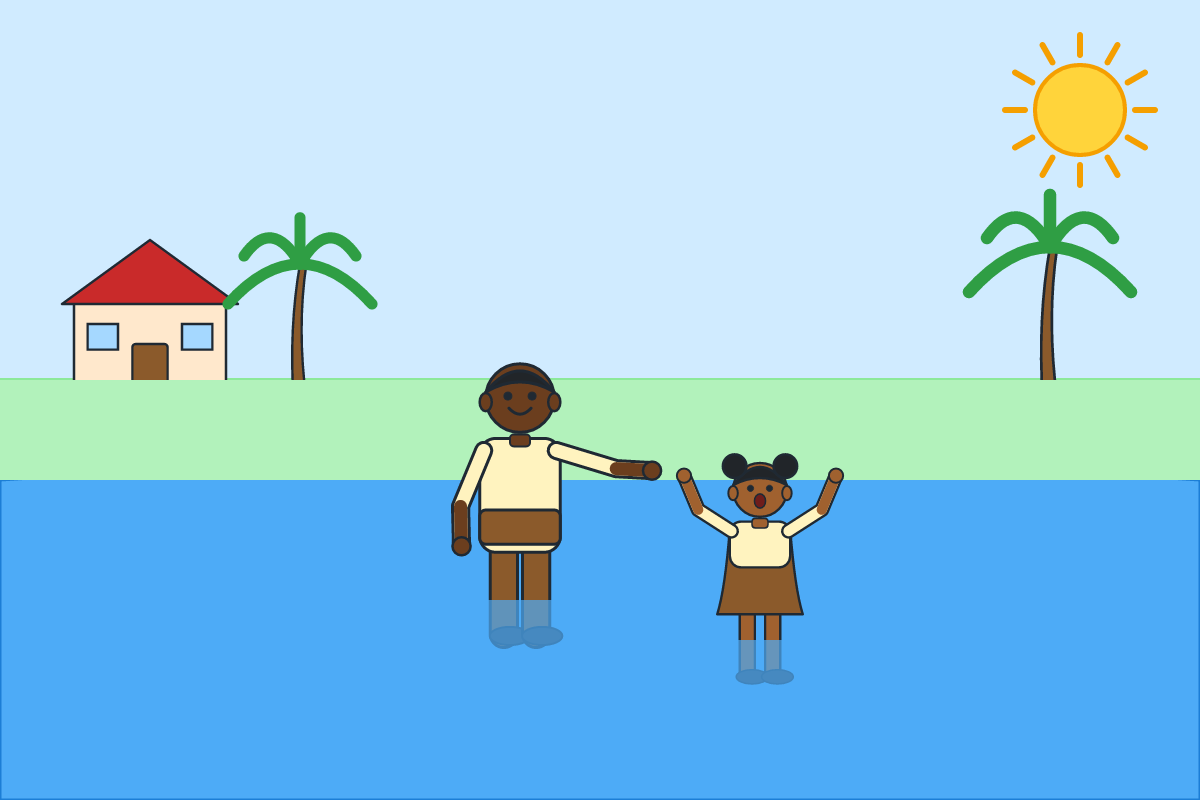
Story summary: "Kwaku was afraid of water and never learnt to swim. One day his younger sister fell into the river. Without thinking, Kwaku waded in, grabbed her hand and pulled her out. Later, he asked his uncle to teach him to swim, saying, 'Fear almost cost me my sister.'"
| Connection | Question | Example |
|---|---|---|
| text-to-self | Does this remind me of my life? | I was once afraid of dogs until I had to rescue a puppy. |
| text-to-text | Does it remind me of another story? | It is like the story of the brave fisher girl. |
| text-to-world | Does it remind me of something in the world? | Many children in riverside communities cannot swim. |
New words
- connection
- A link between two things.
- text-to-self
- Linking a story to your own life.
- text-to-world
- Linking a story to events in the world.
Summary
- Make text-to-self, text-to-text and text-to-world connections.
- Connections deepen understanding.
Exercises
Answer in your exercise book first, then check your answers.
1. Linking a story to your own life is a…
- A. text-to-self connection
- B. text-to-world connection
- C. title
- D. summary
Show answer
Answer: text-to-self connectionPersonal link.2. Kwaku learnt to swim after the rescue.
- A. True
- B. False
Show answer
Answer: TrueHe asked his uncle.3. "Fear almost cost me my ______."
Show answer
Answer: sisterFrom the story.4. Make a text-to-world connection with Kwaku's story.
Show answer
Answer: E.g. Many children drown each year because they cannot swim.Link to the world.
Lesson 2
- Strand
- Reading
- Sub-strand
- Diphthongs
- Indicator
- B6.2.3.1.1 – Use words with centering diphthongs
Introduction
Centring diphthongs are sounds in which the voice glides towards a central "uh" sound (/ə/).
Centring Diphthongs
| Diphthong | Example words |
|---|---|
| /ɪə/ as in ear | ear, here, near, fear, cheer, idea, beer |
| /eə/ as in hair | hair, air, there, where, care, wear, chair |
| /ʊə/ as in tour | tour, poor, sure, cure, pure |
Sentences: "Here is the chair near the stairs." "Where did you wear that pair of shoes?" "Are you sure the cure is pure?"
Passage: "On our school tour to Kakum, we climbed the stairs to the canopy walkway. The air was fresh, and we could hear birds near and far. Some pupils had fear in their eyes, but the guide said, 'Take care; you are safe here.' What a clear, wonderful idea it was to go there!"
New words
- diphthong
- A gliding vowel sound in one syllable.
- centring
- Moving towards the central vowel sound.
- glide
- To move smoothly from one sound to another.
Summary
- Centring diphthongs glide towards /ə/.
- They appear in words such as ear, hair and tour.
Exercises
Answer in your exercise book first, then check your answers.
1. Which word has the /eə/ sound?
- A. chair
- B. cheer
- C. tour
- D. cat
Show answer
Answer: chairAs in hair.2. "Here" and "near" share the same diphthong.
- A. True
- B. False
Show answer
Answer: True/ɪə/.3. We climbed the s______ to the walkway. (stairs)
Show answer
Answer: stairs/eə/.4. Find four centring diphthong words in the passage.
Show answer
Answer: tour, stairs, air, hear (or near, fear, care, here, clear, idea, there).Any four.
Lesson 3
- Strand
- Grammar
- Sub-strand
- Pronouns
- Indicator
- B6.3.3.1.1 – Identify and use reflexive pronouns
Introduction
Reflexive pronouns end in -self or -selves. They are used when the subject and object are the same person.
Reflexive Pronouns
| Subject | Reflexive pronoun | Example |
|---|---|---|
| I | myself | I taught myself to type. |
| you (one) | yourself | Did you hurt yourself? |
| he | himself | Kofi washed himself. |
| she | herself | Esi made herself a dress. |
| it | itself | The cat cleaned itself. |
| we | ourselves | We enjoyed ourselves. |
| you (many) | yourselves | Help yourselves to the food. |
| they | themselves | They prepared themselves for the exam. |
Reflexive pronouns can also add emphasis: "The headteacher herself welcomed us."
Common mistake: Do not use "hisself" or "theirselves". The correct forms are "himself" and "themselves".
New words
- reflexive pronoun
- A pronoun ending in -self or -selves.
- emphasis
- Special importance.
- subject
- The doer of the action.
Summary
- Use reflexive pronouns when the subject and object are the same.
- They can also add emphasis.
Exercises
Answer in your exercise book first, then check your answers.
1. Complete: She made ___ a cup of tea.
- A. herself
- B. himself
- C. myself
- D. itself
Show answer
Answer: herselfShe = herself.2. "Hisself" is correct English.
- A. True
- B. False
Show answer
Answer: FalseUse "himself".3. We enjoyed ______ at the party.
Show answer
Answer: ourselvesWe = ourselves.4. Use "themselves" in a sentence.
Show answer
Answer: E.g. The pupils prepared themselves for the exam.Correct use.
Lesson 4
- Strand
- Writing
- Sub-strand
- Narrative Writing
- Indicator
- B6.4.9.3.1 – Review and revise the draft to produce a coherent piece by proposing grammar and vocabulary for improvement
Introduction
A first draft is never perfect. Good writers review and revise to make their writing clear and correct.
Reviewing and Revising a Draft
| Area | Questions |
|---|---|
| content | Is the main idea clear? Are there enough details? |
| organisation | Is there a clear beginning, middle and end? Are paragraphs in order? |
| vocabulary | Are words precise and varied? Can I replace weak words (good, nice, bad)? |
| grammar | Do subjects and verbs agree? Are tenses consistent? |
| mechanics | Are spelling, capitals and punctuation correct? |
Example
Revise: "Me and my friend goes to the market. It was very nice. We buyed many things."
- "Me and my friend" → "My friend and I" (subject pronoun)
- "goes" → "went" (agreement and past tense)
- "very nice" → "lively and colourful" (better vocabulary)
- "buyed" → "bought" (irregular verb)
Answer: My friend and I went to the market. It was lively and colourful. We bought many things.
New words
- draft
- An early version of writing.
- revise
- To improve content, organisation and language.
- precise
- Exact and clear.
Summary
- Review content, organisation, vocabulary, grammar and mechanics.
- Replace weak words and correct errors.
Exercises
Answer in your exercise book first, then check your answers.
1. An early version of writing is a…
- A. draft
- B. summary
- C. title
- D. headline
Show answer
Answer: draftNeeds revising.2. Revising can include choosing better words.
- A. True
- B. False
Show answer
Answer: TrueVocabulary.3. "We buyed" should be "We ______".
Show answer
Answer: boughtIrregular verb.4. Improve: "The food was nice."
Show answer
Answer: E.g. The food was delicious and spicy.Precise vocabulary.
Lesson 5
- Strand
- Writing Conventions/ Extensive Reading
- Sub-strand
- Using Action Words, Building the Love and Culture of Reading
- Indicator
- B6.5.4.1.1 – Differentiate between the simple past and the present perfect in speech and writing
Introduction
Time expressions help us choose between the simple past and the present perfect.
Time Expressions with the Simple Past and Present Perfect
| Simple past (finished time) | Present perfect (up to now) |
|---|---|
| yesterday, last year, in 2020, two days ago, when I was young | since Monday, for three years, already, yet, just, ever, never, so far |
"Since" gives a starting point: "I have lived here since 2019." "For" gives a length of time: "I have lived here for five years."
Reading extract: "Kofi has played football since he was six. Last year, he joined the district team. He has already scored ten goals this season, but he has never played at the national stadium. He visited Accra two months ago and saw it from the outside."
New words
- time expression
- Words showing when something happened.
- since
- From a point in time until now.
- for
- During a length of time.
Summary
- Use the simple past with finished time expressions.
- Use the present perfect with since, for, already, yet, ever and never.
Exercises
Answer in your exercise book first, then check your answers.
1. Choose: I ___ here since 2019.
- A. have lived
- B. lived
- C. live
- D. living
Show answer
Answer: have lived"Since" + present perfect.2. "He visited Accra two months ago" uses the simple past.
- A. True
- B. False
Show answer
Answer: TrueFinished time.3. We have known each other ______ five years. (for/since)
Show answer
Answer: forLength of time.4. Correct: "I have seen him yesterday."
Show answer
Answer: I saw him yesterday.Finished time.
Homework
- Revise a piece of writing you did earlier using the revision checklist.