Basic 6 · English Language
Values in Poems, Reading for Meaning, Quantifiers, Organising Ideas and Proper Nouns in Titles
In this topic you will discuss values in poems, read a passage and construct meaning, use quantifiers, organise ideas into an outline and use proper nouns for titles and organisations.
By the end of these notes you should be able to:
- Discuss values in poems and their importance in society
- Construct meaning from a passage
- Use quantifiers correctly
- Organise brainstormed ideas into an essay outline
- Use proper nouns for titles of works and organisations
What you already know
- Poems and Experience, Content and Function Words, Articles, Brainstorming National Issues and Noun Phrases for Conditions
Copy everything that has a blue line on its left into your notebook. The other parts are for reading.
Lesson 1
- Strand
- Oral Language
- Sub-strand
- Poems
- Indicator
- B6.1.3.1.2 – Discuss values in poems and talk about the importance of these values in society
Introduction
Poems often teach values that hold society together. When we discuss these values, we see why they matter to everyone.
Values in Poems and Society
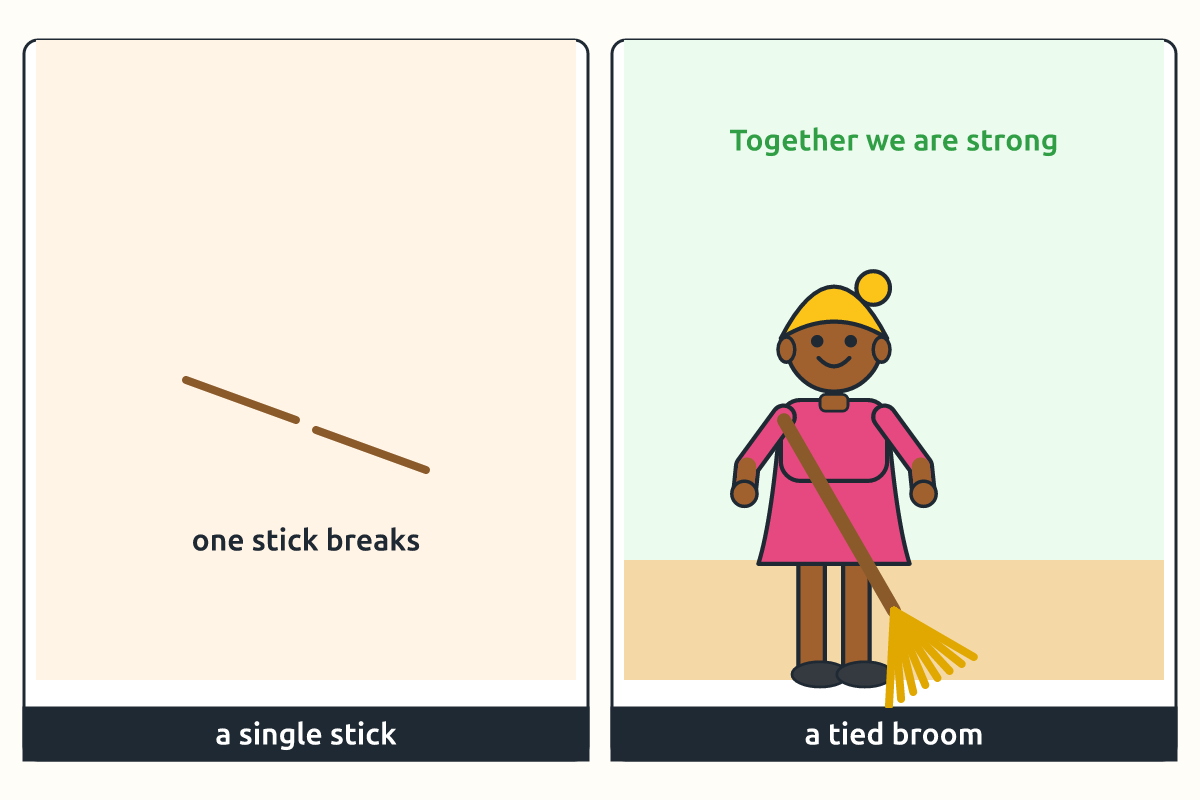
"The Broom"
"One stick alone is easy to break,
A child can snap it, make no mistake;
But tie the sticks into a broom,
And they can sweep the largest room.
So it is with every land,
When people work hand in hand;
Divided, we are weak and small,
United, we can sweep it all."
| Value | In the poem | Importance in society |
|---|---|---|
| unity | sticks tied into a broom | communities achieve more together |
| cooperation | "work hand in hand" | projects like clean-ups succeed |
| strength in numbers | united sticks cannot be broken | a united nation can overcome problems |
New words
- value
- A belief about what is important.
- unity
- Being joined together as one.
- cooperation
- Working together.
Summary
- "The Broom" teaches unity and cooperation.
- These values help communities and nations succeed.
Exercises
Answer in your exercise book first, then check your answers.
1. What value does "The Broom" teach?
- A. unity
- B. greed
- C. laziness
- D. pride
Show answer
Answer: unitySticks together.2. One stick alone is easy to break.
- A. True
- B. False
Show answer
Answer: TrueLine 1.3. "United, we can ______ it all."
Show answer
Answer: sweepLast line.4. Why is unity important in a nation?
Show answer
Answer: People working together can solve problems and develop faster.Importance in society.
Lesson 2
- Strand
- Reading
- Sub-strand
- Comprehension
- Indicator
- B6.2.7.1.1 – Construct meaning from texts
Introduction
To construct meaning, read carefully, link ideas and think about what the writer wants you to understand.
Reading Passage: The Water Seller of Nima
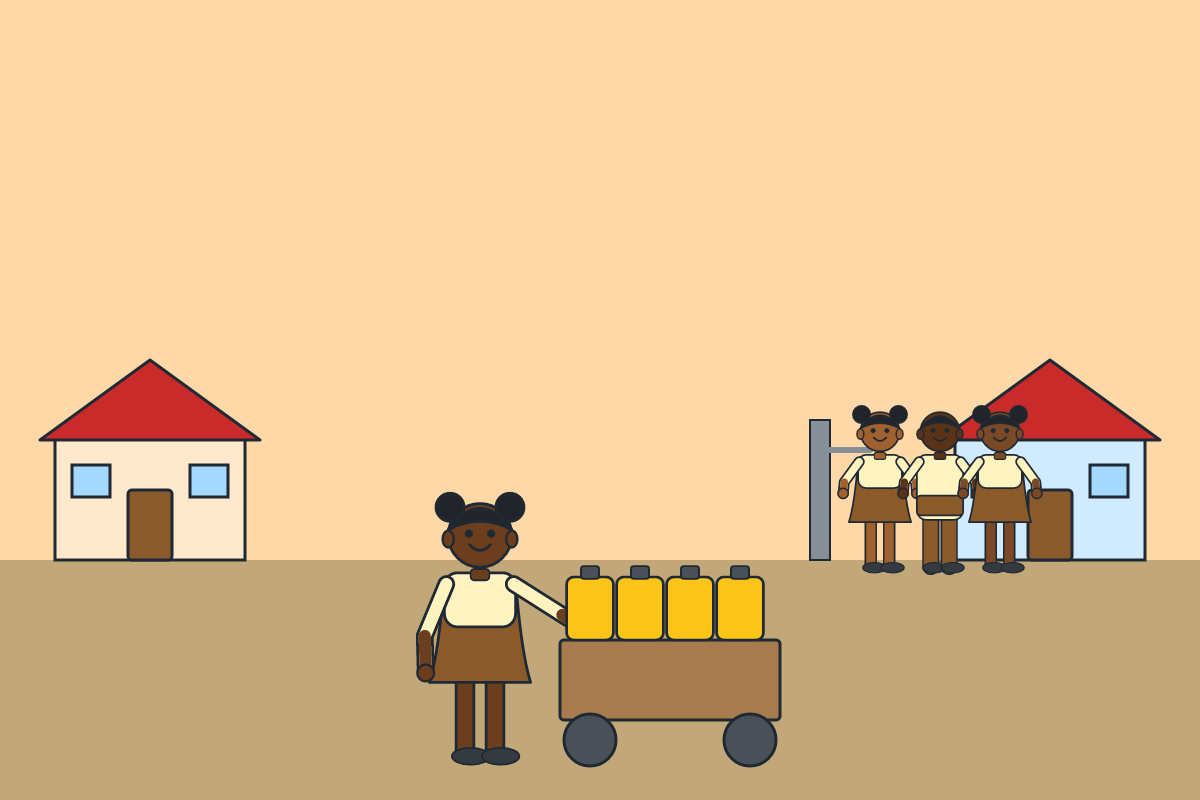
"Every morning before dawn, Ramatu pushed her wooden cart through the narrow lanes of Nima. On it sat twelve yellow gallons of water she had filled at the public standpipe. The pipe only flowed between four and six in the morning, so she had to be first in the queue.
Ramatu was thirteen. Her mother sold the water to households who had no taps, and the money paid for Ramatu's school fees and her little brother's medicine. By seven o'clock, Ramatu had delivered all twelve gallons, washed her face and put on her uniform.
One morning, the standpipe was dry. A crowd gathered, and people began to quarrel. Ramatu remembered a lesson from school about the Water Company's emergency line. She borrowed a phone and reported the problem. By noon, a water tanker arrived, and the assemblyman thanked her in front of everyone.
That evening, her teacher asked her to tell the class what had happened. 'I was only thinking of the people who had no water,' Ramatu said. 'But I also learnt that knowledge is useful only when you use it.'"
| Question | Answer |
|---|---|
| Why did Ramatu go out before dawn? | the standpipe only flowed between 4 and 6 a.m. |
| How did her work help her family? | the money paid school fees and medicine |
| What problem happened one morning? | the standpipe was dry and people quarrelled |
| How did she solve it? | she reported it to the Water Company's emergency line |
| What lesson did she learn? | knowledge is useful only when you use it |
New words
- standpipe
- A public tap in a community.
- tanker
- A vehicle that carries water or fuel.
- construct meaning
- To understand a text by linking its ideas.
Summary
- Ramatu worked hard to support her family and school.
- She used what she learnt at school to solve a community problem.
Exercises
Answer in your exercise book first, then check your answers.
1. How many gallons did Ramatu carry?
- A. twelve
- B. two
- C. twenty
- D. six
Show answer
Answer: twelveParagraph 1.2. The standpipe flowed all day.
- A. True
- B. False
Show answer
Answer: FalseOnly 4–6 a.m.3. A water ______ arrived by noon.
Show answer
Answer: tankerParagraph 3.4. What does "knowledge is useful only when you use it" mean?
Show answer
Answer: Learning has value only when we apply it to solve real problems.Inference.
Lesson 3
- Strand
- Grammar
- Sub-strand
- Determiners
- Indicator
- B6.3.2.1.2 – Identify and use quantifiers
Introduction
Quantifiers tell us how much or how many. In Basic 6 you will use them with more precision.
Quantifiers
| Countable (how many) | Uncountable (how much) | Both |
|---|---|---|
| many, a few, few, several, a number of, each, every | much, a little, little, a great deal of, an amount of | some, any, a lot of, plenty of, enough, all, no, most |
"Each" and "every" take singular nouns and verbs: "Each pupil has a book." "Every house needs water."
"A number of" takes a plural verb: "A number of pupils were absent." "The number of" takes a singular verb: "The number of pupils is 40."
Common mistake: Say "fewer people" (countable) and "less water" (uncountable), not "less people".
New words
- quantifier
- A word showing quantity.
- countable noun
- A noun that can be counted.
- uncountable noun
- A noun that cannot be counted one by one.
Summary
- Use many/few with countable nouns; much/little with uncountable nouns.
- "Each" and "every" take singular verbs.
Exercises
Answer in your exercise book first, then check your answers.
1. Choose: There is ___ sugar left.
- A. a little
- B. a few
- C. many
- D. several
Show answer
Answer: a littleUncountable.2. "Each pupil has a book" is correct.
- A. True
- B. False
Show answer
Answer: TrueSingular.3. There were ______ (less/fewer) people at the meeting.
Show answer
Answer: fewerCountable.4. Correct: "A number of pupils was absent."
Show answer
Answer: A number of pupils were absent.Plural verb.
Lesson 4
- Strand
- Writing
- Sub-strand
- Writing As a Process
- Indicator
- B6.4.9.1.1 – Select a topic of choice on a national issue brainstorm ideas and organize them before writing
Introduction
After brainstorming, organise your ideas into an outline so your essay is clear and logical.
Organising Ideas into an Outline
| Part | Content |
|---|---|
| introduction | define galamsey; state your opinion that it must stop |
| paragraph 1 | it pollutes rivers and kills fish (evidence: brown rivers such as the Pra) |
| paragraph 2 | it destroys farmland and forests |
| paragraph 3 | it endangers lives: open pits, mercury poisoning |
| paragraph 4 | solutions: enforce laws, give youth alternative jobs, educate communities |
| conclusion | restate the opinion and call for action |
Put the strongest point first or last. Each paragraph should have a topic sentence and supporting details. Use linking words: firstly, furthermore, however, therefore, in conclusion.
New words
- outline
- A plan of the main points.
- topic sentence
- The sentence stating a paragraph's main idea.
- evidence
- Facts that support a point.
Summary
- An outline arranges ideas into introduction, body paragraphs and conclusion.
- Each paragraph needs a topic sentence and evidence.
Exercises
Answer in your exercise book first, then check your answers.
1. A plan of the main points is an…
- A. outline
- B. poem
- C. letter
- D. headline
Show answer
Answer: outlineBefore drafting.2. Each paragraph should have a topic sentence.
- A. True
- B. False
Show answer
Answer: TrueMain idea.3. The final part of an essay is the ______.
Show answer
Answer: conclusionRestates the opinion.4. Write a topic sentence for a paragraph on galamsey and rivers.
Show answer
Answer: E.g. Galamsey has polluted many of Ghana's rivers.Main idea.
Lesson 5
- Strand
- Writing Conventions/ Extensive Reading
- Sub-strand
- Using Naming Words, Building the Love and Culture of Reading
- Indicator
- B6.5.3.1.2 – Identify and use proper nouns (titles of works organisations and events)
Introduction
The names of books, newspapers, films, organisations and events are proper nouns and need capital letters.
Proper Nouns in Titles and Organisations
| Type | Example |
|---|---|
| book | "The Boy Who Harnessed the Wind" |
| newspaper | the "Daily Graphic", the "Junior Graphic" |
| organisation | the Ghana Red Cross Society, the Environmental Protection Agency |
| school | Wesley Girls' High School |
| event | the National Science and Maths Quiz |
In titles, capitalise the first word and all important words. Small words such as "a", "the", "of", "and" and "in" stay in lower case unless they are the first word.
Reading extract: "Our school won the regional round of the National Science and Maths Quiz. The 'Junior Graphic' reported the victory, and the Ghana Education Service sent a letter of congratulations."
New words
- title
- The name of a book, film or event.
- organisation
- An official group.
- lower case
- Small letters.
Summary
- Titles, organisations and events are proper nouns.
- Capitalise the first and important words in titles.
Exercises
Answer in your exercise book first, then check your answers.
1. Which is correctly capitalised?
- A. the Daily Graphic
- B. The daily graphic
- C. the daily Graphic
- D. THE daily graphic
Show answer
Answer: the Daily GraphicImportant words.2. Small words like "of" stay lower case in the middle of titles.
- A. True
- B. False
Show answer
Answer: TrueUnless first.3. Our school won the National Science and ______ Quiz.
Show answer
Answer: MathsProper noun.4. Capitalise: "the boy who harnessed the wind"
Show answer
Answer: The Boy Who Harnessed the WindTitle rules.
Homework
- Write an outline for an essay on a national issue of your choice.