Basic 6 · English Language
Composing Songs, Minimal Pairs, Proper Nouns, Modes of Writing and Quotation Marks
In this topic you will compose songs around values, decode words with minimal pairs, use proper nouns, choose modes of writing for national issues and use commas and quotation marks.
By the end of these notes you should be able to:
- Compose a short song around a value
- Use minimal pairs to decode words
- Identify and use proper nouns correctly
- Choose the right mode of writing for a purpose
- Use commas and quotation marks in direct speech
What you already know
- Songs and Experiences, -sure/-ture/-tch Endings, Nouns for Conditions, Personal Handwriting and Mechanics
Copy everything that has a blue line on its left into your notebook. The other parts are for reading.
Lesson 1
- Strand
- Oral Language
- Sub-strand
- Songs
- Indicator
- B6.1.1.1.2 – Compose songs around values discussed
Introduction
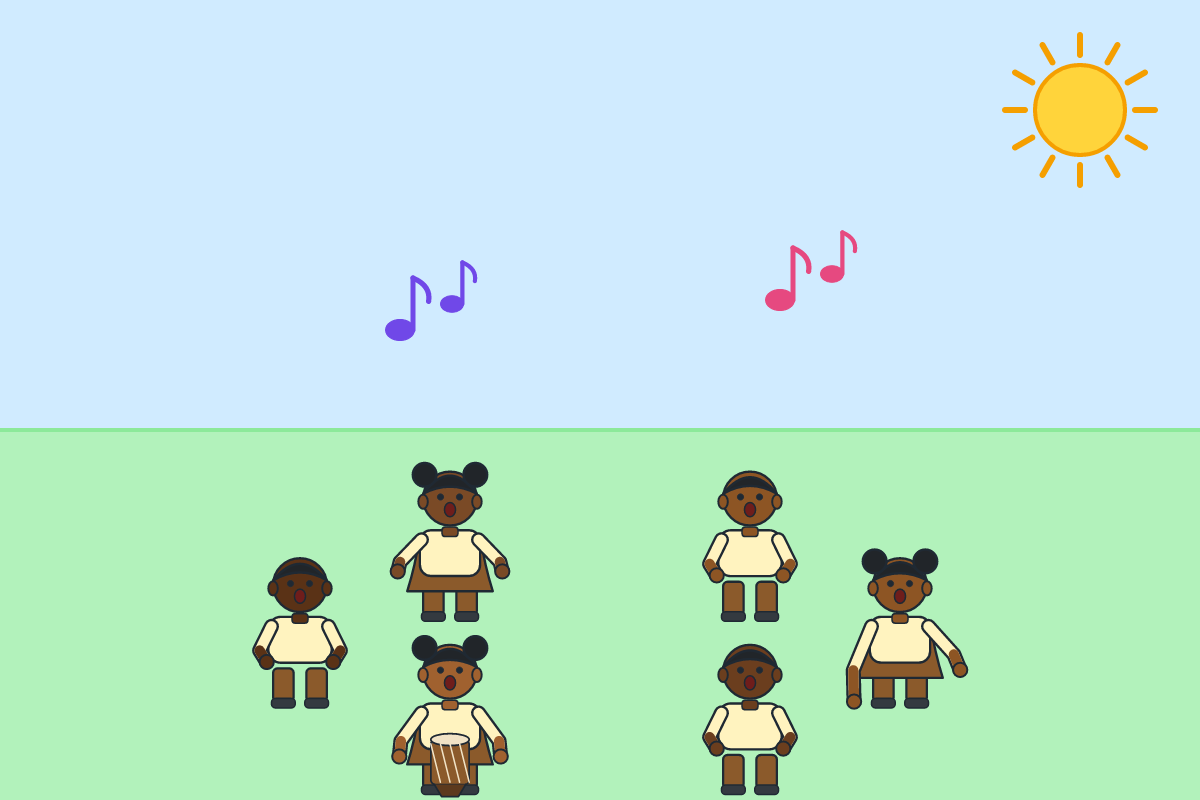
You have studied the values in many songs. Now you will compose your own song to teach a value.
Composing a Song Around a Value
Steps
- choose a value, such as honesty, unity or respect
- think of a simple message about the value
- write a verse of four lines and a chorus that repeats
- use rhyme and repetition so it is easy to remember
- fit the words to a simple tune or a familiar rhythm
- practise and perform with clapping or drumming
Sample song (value: honesty):
"Tell the truth, tell the truth,
Even when it's hard to do;
A lie may hide for just a day,
But truth will always find its way.
Chorus: Honest hands and honest hearts,
That is where a good life starts."
New words
- compose
- To create music or writing.
- verse
- A section of a song that tells part of the message.
- chorus
- The repeated part of a song.
Summary
- Choose a value and a clear message for your song.
- Use verses, a chorus, rhyme and repetition.
Exercises
Answer in your exercise book first, then check your answers.
1. The repeated part of a song is the…
- A. chorus
- B. verse
- C. title
- D. tune
Show answer
Answer: chorusRepeated.2. Rhyme makes a song easier to remember.
- A. True
- B. False
Show answer
Answer: TrueSound patterns.3. "A lie may hide for just a ______."
Show answer
Answer: dayFrom the song.4. Suggest a value and a title for a song you could compose.
Show answer
Answer: E.g. Unity – "One Ghana, One People".Any value.
Lesson 2
- Strand
- Reading
- Sub-strand
- Word Families
- Indicator
- B6.2.3.1.1 – Use common minimal pairs to decode words
Introduction
Minimal pairs are words that differ by one sound. In Basic 6 we focus on sounds that are often confused.
Minimal Pairs
| Sounds | Pair | Example sentence |
|---|---|---|
| /ɪ/ and /iː/ | live / leave | We live in Tema, but we will leave tomorrow. |
| /θ/ and /t/ | thin / tin | The thin boy opened the tin. |
| /ð/ and /d/ | they / day | They came on the day of the party. |
| /ʃ/ and /tʃ/ | sheep / cheap | The sheep was cheap at the market. |
| /v/ and /b/ | vote / boat | They vote on the boat. |
| /æ/ and /ʌ/ | cap / cup | He put his cap beside the cup. |
Practice: Read aloud carefully and say which word fits: "Please (sit/seat) on that (sit/seat)." Answer: sit; seat.
New words
- minimal pair
- Two words that differ by one sound.
- decode
- To work out a word from its sounds.
- vowel length
- Whether a vowel sound is short or long.
Summary
- Minimal pairs train us to hear and say sounds correctly.
- Short and long vowels, th/t and sh/ch are often confused.
Exercises
Answer in your exercise book first, then check your answers.
1. Which is a minimal pair?
- A. thin / tin
- B. book / pen
- C. sun / moon
- D. tree / car
Show answer
Answer: thin / tinOne sound differs.2. "Sheep" and "cheap" differ in their first sound.
- A. True
- B. False
Show answer
Answer: True/ʃ/ and /tʃ/.3. Please ______ (sit/seat) down.
Show answer
Answer: sitShort vowel.4. Write a sentence using "live" and "leave".
Show answer
Answer: E.g. I live in Ho, but I will leave for Accra tomorrow.Both words.
Lesson 3
- Strand
- Grammar
- Sub-strand
- Nouns
- Indicator
- B6.3.1.1.2 – Identify and use Proper nouns
Introduction
Proper nouns name particular people, places, organisations, events and titles.
Proper Nouns
| Kind | Examples |
|---|---|
| people and titles | Nana Akufo-Addo, Dr Kwame Nkrumah, Madam Akosua |
| places | Kumasi, Lake Bosomtwe, the Volta Region |
| organisations | Ghana Education Service, the United Nations, Accra Hearts of Oak |
| events and holidays | Independence Day, Eid al-Adha, Homowo |
| titles of works | "Things Fall Apart", the "Daily Graphic" |
| days and months | Saturday, December |
Passage: "On Independence Day, pupils from schools across the Greater Accra Region marched at the Black Star Square. The President, the Chief of Defence Staff and members of the Ghana Education Service watched proudly."

New words
- proper noun
- The particular name of a person, place, thing or event.
- organisation
- A group set up for a purpose.
- capitalise
- To begin with a capital letter.
Summary
- Proper nouns name particular people, places, organisations, events and titles.
- They always begin with capital letters.
Exercises
Answer in your exercise book first, then check your answers.
1. Which is a proper noun?
- A. Kumasi
- B. city
- C. school
- D. river
Show answer
Answer: KumasiParticular place.2. "Ghana Education Service" is a proper noun.
- A. True
- B. False
Show answer
Answer: TrueName of an organisation.3. We celebrate ______ Day on 6th March.
Show answer
Answer: IndependenceProper noun.4. Find five proper nouns in the passage.
Show answer
Answer: Independence Day, Greater Accra Region, Black Star Square, President, Ghana Education Service.Any five.
Lesson 4
- Strand
- Writing
- Sub-strand
- Paragraph Development
- Indicator
- B6.4.6.1.1 – Choose appropriate ways and modes of writing for a variety of purposes
Introduction
When writing about national issues, you must choose the right mode for your purpose and audience.
Modes of Writing for National Issues
| Mode | Purpose | Example title |
|---|---|---|
| narrative | tell a story | "The Day the Floods Came to Accra" |
| descriptive | paint a picture | "Our Polluted River Before and After Galamsey" |
| expository | explain or inform | "How Mobile Money Works" |
| argumentative | persuade with reasons | "Galamsey Must Stop Now" |
Ask three questions before writing: What is my purpose? Who are my readers? What do they need to know or feel? A letter to the Minister needs formal, persuasive language; a story for classmates can be lively and descriptive.
New words
- mode
- A type of writing.
- national issue
- A matter that affects the whole country.
- audience
- The readers of your writing.
Summary
- Choose narrative, descriptive, expository or argumentative mode to suit your purpose.
- Consider your audience before writing.
Exercises
Answer in your exercise book first, then check your answers.
1. Which mode persuades?
- A. argumentative
- B. narrative
- C. descriptive
- D. expository
Show answer
Answer: argumentativeGives reasons.2. "How Mobile Money Works" is expository writing.
- A. True
- B. False
Show answer
Answer: TrueIt explains.3. Writing that paints a picture is ______.
Show answer
Answer: descriptiveUses senses.4. Which mode would you use for "Why Ghanaians Should Plant Trees"? Why?
Show answer
Answer: Argumentative, because it gives reasons to persuade.Purpose.
Lesson 5
- Strand
- Writing Conventions/ Extensive Reading
- Sub-strand
- Using Punctuation, Building the Love and Culture of Reading
- Indicator
- B6.5.2.1.1 – Use the comma and quotation marks appropriately in writing
Introduction
In stories and reports, we often quote people's exact words. Commas and quotation marks show where the words begin and end.
Commas and Quotation Marks in Direct Speech
| Rule | Example |
|---|---|
| put the spoken words inside quotation marks | "I am ready," said Esi. |
| use a comma between the speech and the reporting clause | Kofi said, "Let's go." |
| put the end punctuation inside the closing quotation mark | "Are you coming?" asked Ama. |
| start a new paragraph for a new speaker | (in stories) |
| a split quotation uses commas on both sides | "If you hurry," said Mother, "you will catch the bus." |
Reading extract: "'Who left the gate open?' shouted Mr Badu. Nobody answered. Then little Akua raised her hand. 'I did, sir,' she said quietly, 'but I was chasing the goat.'"
New words
- direct speech
- The exact words someone says.
- quotation marks
- Marks that enclose spoken words.
- reporting clause
- Words that tell who spoke, e.g. "she said".
Summary
- Place spoken words inside quotation marks.
- Use commas to separate speech from the reporting clause.
Exercises
Answer in your exercise book first, then check your answers.
1. Which is correctly punctuated?
- A. "I am ready," said Esi.
- B. "I am ready" said Esi.
- C. I am ready, "said Esi."
- D. "I am ready said Esi."
Show answer
Answer: "I am ready," said Esi.Comma inside.2. A new speaker starts a new paragraph in a story.
- A. True
- B. False
Show answer
Answer: TrueClarity.3. "If you hurry___" said Mother, "you will catch the bus."
Show answer
Answer: ,Split quotation.4. Punctuate: who is there asked the guard
Show answer
Answer: "Who is there?" asked the guard.Question inside quotes.
Homework
- Compose a four-line song about a value and write it neatly.