Basic 6 · English Language
Songs and Experiences, -sure/-ture/-tch Endings, Nouns for Conditions, Personal Handwriting and Mechanics
In this topic you will relate songs to your experiences, read words ending in -sure, -ture and -tch, use nouns that describe conditions, develop a personal handwriting style and follow writing conventions.
By the end of these notes you should be able to:
- Relate the message of a song to personal experience
- Read words ending in -sure, -ture and -tch
- Use nouns and noun phrases that describe conditions
- Write in a legible, fluent personal style
- Follow mechanical conventions in writing
What you already know
- English Basic 5
Copy everything that has a blue line on its left into your notebook. The other parts are for reading.
Lesson 1
- Strand
- Oral Language
- Sub-strand
- Songs
- Indicator
- B6.1.1.1.1 – Relate the central messages in songs to personal experiences
Introduction
A song becomes meaningful when it reminds us of something in our own lives. Good listeners connect songs to their experiences.
Relating Songs to Experience
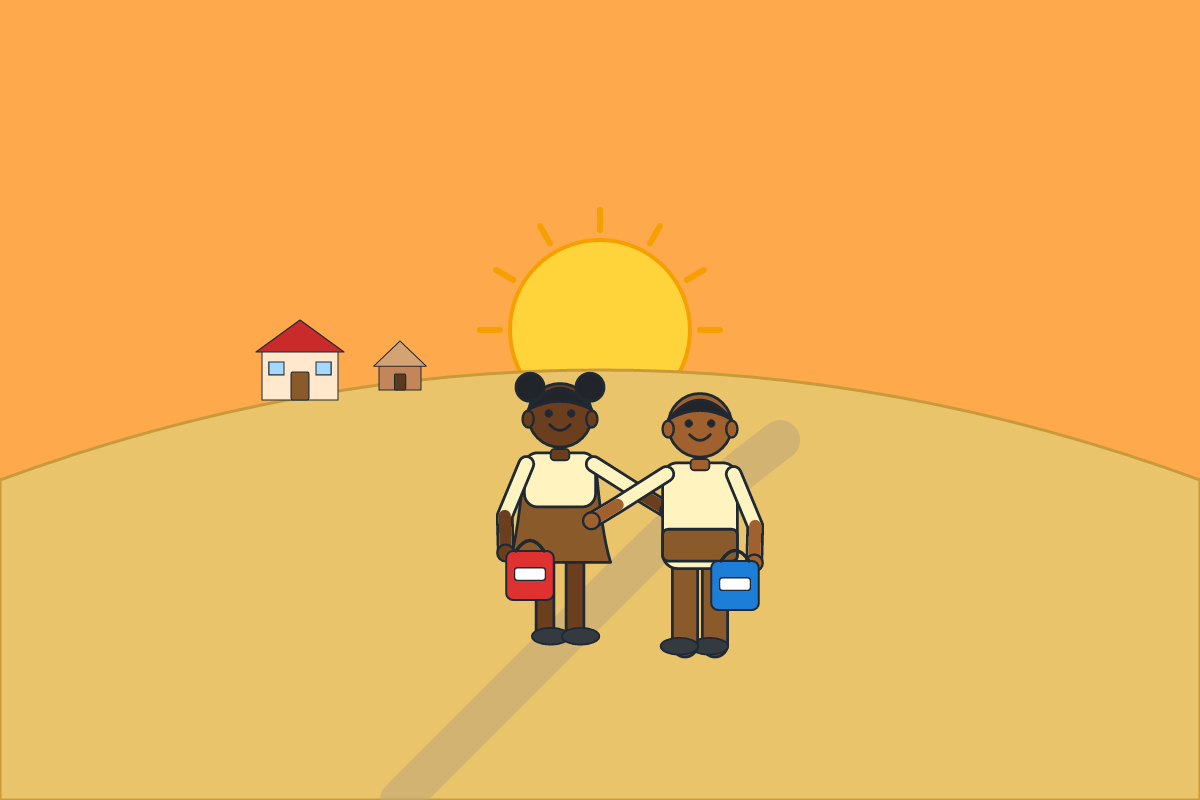
"When the road is long and the load is heavy,
When the sun is hot and your feet are weary,
Do not stop, my friend, do not cry,
Lift your head and keep your eyes on the sky.
For every hill has another side,
And every river has a bridge to cross;
Hold my hand and walk with pride,
Together we will never be lost."
| Line | Message | My experience (example) |
|---|---|---|
| "the load is heavy" | life can be hard | studying for a difficult test |
| "every hill has another side" | difficulties end | after weeks of practice, I passed |
| "Hold my hand" | support from friends | my friend helped me with fractions |
New words
- central message
- The main idea of a song.
- experience
- Something that has happened to you.
- weary
- Very tired.
Summary
- Songs carry messages about life.
- Relating a song to your own experience deepens its meaning.
Exercises
Answer in your exercise book first, then check your answers.
1. What is the central message of the song?
- A. Keep going and support each other
- B. Stop when tired
- C. Walk alone
- D. Cry often
Show answer
Answer: Keep going and support each otherPerseverance and friendship.2. "Weary" means very tired.
- A. True
- B. False
Show answer
Answer: TrueFrom context.3. "Every hill has another ______."
Show answer
Answer: sideFrom the song.4. Relate one line of the song to your own experience.
Show answer
Answer: Answers will vary, e.g. "Hold my hand" reminds me of my sister helping me learn to read.Personal link.
Lesson 2
- Strand
- Reading
- Sub-strand
- Phonics
- Indicator
- B6.2.2.1.1 – Read words with ending sounds like "sure" as in measure; "ture" as in creature and "tch" as in Stretch
Introduction
Some word endings look different from how they sound. Learning them helps you read and spell longer words.
Endings -sure, -ture and -tch
| Ending | Sound | Examples |
|---|---|---|
| -sure | /ʒə/ as in measure | measure, treasure, pleasure, leisure, enclosure |
| -sure (after n or s) | /ʃə/ | pressure, ensure, assure |
| -ture | /tʃə/ | creature, picture, nature, future, adventure, furniture |
| -tch | /tʃ/ | stretch, watch, catch, kitchen, match, ditch |
Read this passage: "In the future, I want to be a scientist who studies the creatures of nature. I measure the leaves I catch in the ditch behind our kitchen and draw pictures of them. It is a pleasure to watch them grow."
The -tch spelling usually follows a short vowel: catch, fetch, stitch, notch, hutch. After a long vowel or a consonant, we write -ch instead: coach, bench, peach.
New words
- ending
- The last part of a word.
- digraph
- Two letters making one sound.
- trigraph
- Three letters making one sound, such as tch.
Summary
- -sure often sounds like /ʒə/; -ture sounds like /tʃə/.
- -tch follows a short vowel; -ch follows long vowels or consonants.
Exercises
Answer in your exercise book first, then check your answers.
1. Which word ends with -ture?
- A. picture
- B. measure
- C. catch
- D. pressure
Show answer
Answer: picture/tʃə/.2. "Stretch" ends with the trigraph tch.
- A. True
- B. False
Show answer
Answer: TrueThree letters, one sound.3. I want to find buried trea______.
Show answer
Answer: suretreasure.4. Write two words with each ending: -sure, -ture, -tch.
Show answer
Answer: E.g. measure, pleasure; nature, future; catch, watch.Any correct.
Lesson 3
- Strand
- Grammar
- Sub-strand
- Nouns
- Indicator
- B6.3.1.1.1 – Identify and use nouns or noun phrases to describe conditions
Introduction
Some nouns describe conditions, such as states of health, weather, feelings or situations.
Nouns for Conditions
| Type | Nouns | Example sentence |
|---|---|---|
| health | illness, fever, fatigue, recovery | Her recovery was quick. |
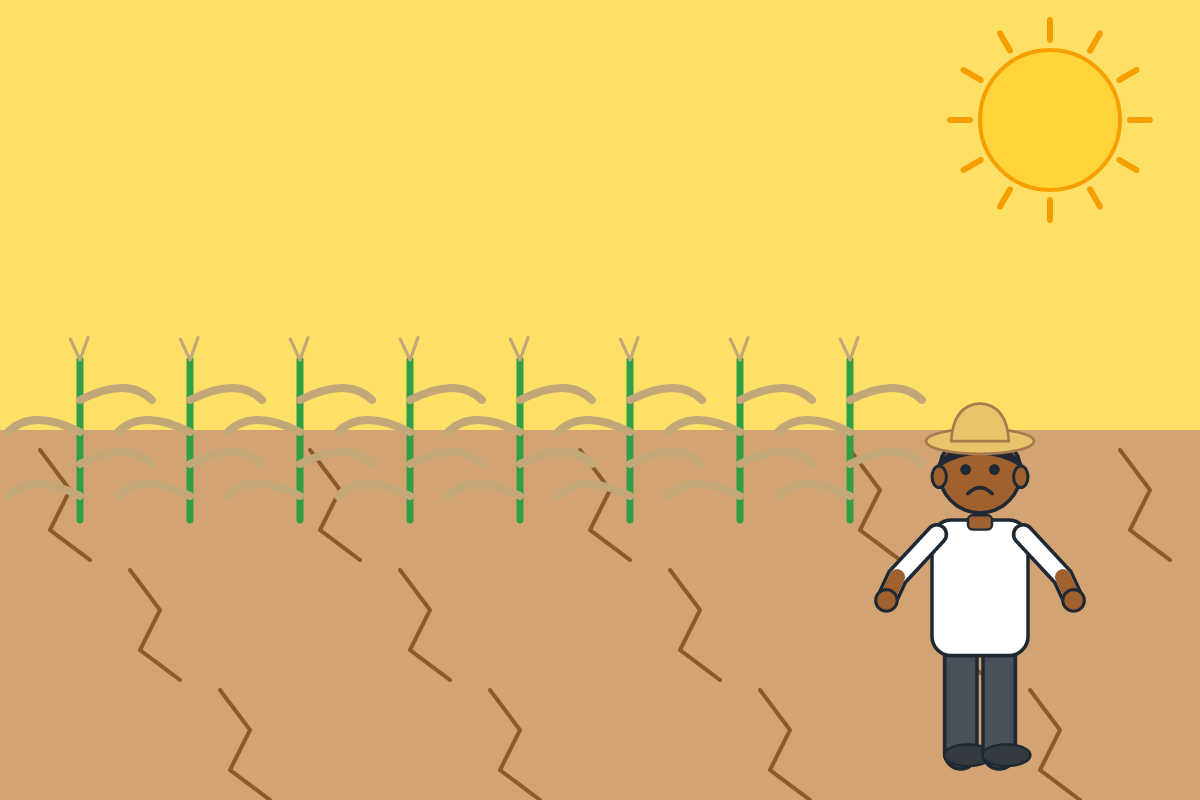
| weather | drought, flood, heat, harmattan | The drought destroyed the crops. |
| feelings | happiness, sorrow, anxiety, fear | Anxiety filled the room before the results. |
| social | poverty, peace, hunger, unemployment | Peace returned to the town. |
| state of things | damage, decay, disorder, neatness | The damage to the road was serious. |
Many of these nouns are formed from adjectives or verbs by adding suffixes: happy → happiness, poor → poverty, recover → recovery, anxious → anxiety, dry → drought (irregular).
New words
- condition
- A state of being.
- abstract noun
- A noun for something you cannot touch.
- suffix
- Letters added to the end of a word.
Summary
- Nouns can describe conditions of health, weather, feelings and society.
- Many are abstract nouns formed with suffixes such as -ness, -ty and -ery.
Exercises
Answer in your exercise book first, then check your answers.
1. Which noun describes weather?
- A. drought
- B. happiness
- C. poverty
- D. recovery
Show answer
Answer: droughtLack of rain.2. "Happiness" is formed from "happy".
- A. True
- B. False
Show answer
Answer: True-ness suffix.3. The ______ (poor) in the village made life hard.
Show answer
Answer: povertyNoun form.4. Change into nouns: anxious, ill, peaceful.
Show answer
Answer: anxiety, illness, peaceNoun forms.
Lesson 4
- Strand
- Writing
- Sub-strand
- Penmanship
- Indicator
- B6.4.2.1.1 – Write with a legible fluent and personal handwriting style
Introduction
By Basic 6, your handwriting should be clear, quick and your own. A personal style is fine as long as it remains legible.
Developing a Personal Handwriting Style
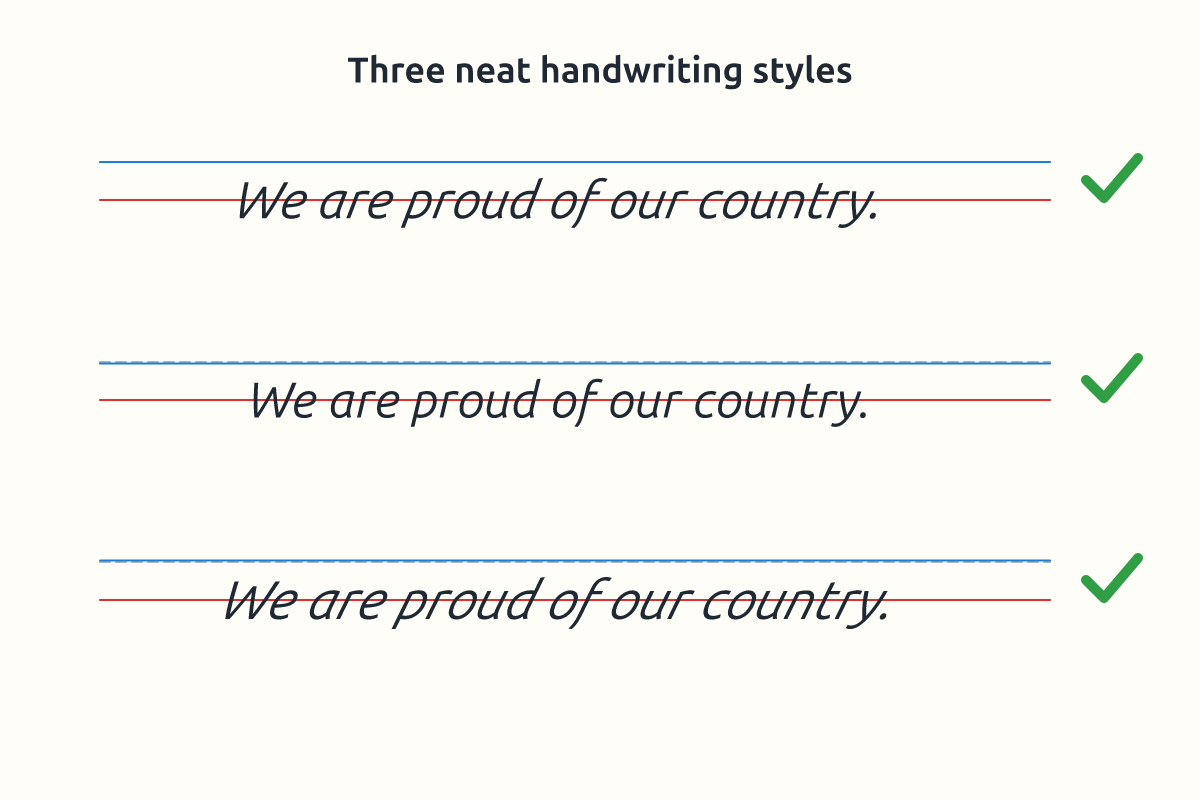
Features of good handwriting
- legible: every letter can be read
- fluent: written smoothly and quickly without stopping
- consistent: same slope, size and spacing throughout
- personal: small features of your own style, such as how you loop letters
Practise with this sentence, which contains every letter of the alphabet: "Six big juicy steaks sizzled in a pan as five workmen left the quarry."
Time yourself writing it three times. Then check: Is it still neat at speed? Are your letters joined consistently?
New words
- legible
- Easy to read.
- fluent
- Smooth and quick.
- pangram
- A sentence containing every letter of the alphabet.
Summary
- Good handwriting is legible, fluent and consistent.
- A personal style is acceptable if it stays clear.
Exercises
Answer in your exercise book first, then check your answers.
1. Handwriting that is easy to read is…
- A. legible
- B. fluent
- C. messy
- D. tiny
Show answer
Answer: legibleClear.2. A personal handwriting style is acceptable if it is legible.
- A. True
- B. False
Show answer
Answer: TrueClarity matters.3. A sentence with every letter of the alphabet is a ______.
Show answer
Answer: pangrame.g. "Six big juicy steaks…".4. State three features of good handwriting.
Show answer
Answer: Legible, fluent, consistent.Key features.
Lesson 5
- Strand
- Writing Conventions/ Extensive Reading
- Sub-strand
- Using Capitalization, Building the Love and Culture of Reading
- Indicator
- B6.5.1.1.1 – Follow appropriate mechanical convention
Introduction
Mechanical conventions are the rules for capital letters, punctuation and spelling. Careful readers notice them; careful writers follow them.
Mechanical Conventions
| Convention | Rule | Example |
|---|---|---|
| capital letters | sentence starts, names, titles | "Things Fall Apart" by Chinua Achebe |
| full stops | end statements | The class read quietly. |
| commas | lists, pauses, after introductory words | First, open your book. |
| apostrophes | ownership, contractions | Kofi's book; can't |
| spelling | check difficult words | necessary, separate, receive |
Reading extract: "On Wednesday, Mrs Mensah's class visited the National Museum in Accra. They saw kente cloths, gold weights and Ashanti stools. 'Don't touch the glass cases,' the guide warned."
Notice the capital letters for days, names and places, the apostrophe in "Mrs Mensah's" and "Don't", and the commas after the introductory phrase.
New words
- convention
- An agreed rule.
- contraction
- A shortened form with an apostrophe, e.g. can't.
- title
- The name of a book, film or song.
Summary
- Follow rules for capitals, punctuation and spelling.
- Notice conventions when reading to improve your writing.
Exercises
Answer in your exercise book first, then check your answers.
1. Which is a contraction?
- A. can't
- B. cannot
- C. can
- D. canned
Show answer
Answer: can'tShortened with an apostrophe.2. Book titles begin with capital letters.
- A. True
- B. False
Show answer
Answer: TrueImportant words are capitalised.3. "Don't touch the glass cases," the ______ warned.
Show answer
Answer: guideFrom the extract.4. Correct: "on friday kofis class visited cape coast castle."
Show answer
Answer: On Friday, Kofi's class visited Cape Coast Castle.Capitals, comma, apostrophe.
Homework
- Write a paragraph about a song that reminds you of a personal experience.