Basic 6 · Creative Arts · Displaying and Sharing
Staging a Display of Performing Artworks
In this topic you will stage a display of your own performing artworks to share creative experiences with an audience.
By the end of these notes you should be able to:
- Plan a programme of performances
- Prepare the stage, costumes, props and sound
- Perform confidently and receive feedback
What you already know
- Experimenting with performing arts techniques
Copy everything that has a blue line on its left into your notebook. The other parts are for reading.
- Strand
- Performing Arts
- Sub-strand
- Displaying and Sharing
- Indicator
- B6.2.3.4.1 – Stage a display of own performing artworks to share creative experiences
Introduction
A performance becomes complete when it is shared with an audience. Now you will stage a show of the songs, dances and dramas your class has created.
1. Planning the Show
| Area | Task |
|---|---|
| programme | list the items in order with times |
| roles | director, MC, performers, stage managers, ushers, sound person |
| venue | classroom, hall or open space with good visibility |
| costumes and props | prepare and label them |
| sound | arrange instruments; test microphones if used |
| publicity | posters, announcements at assembly |
| rehearsal | at least one full dress rehearsal |
2. Sample Programme
| Time | Item | Performers |
|---|---|---|
| 2:00 | welcome by MC | Abena |
| 2:05 | call-and-response opening song | whole class |
| 2:10 | "Rainstorm" body percussion | Group A |
| 2:15 | mime: "Market Day" | Group B |
| 2:20 | short scene from "Julius Caesar" (adapted) | Group C |
| 2:30 | dance: Kpanlogo | Group D |
| 2:40 | vote of thanks and closing song | all |
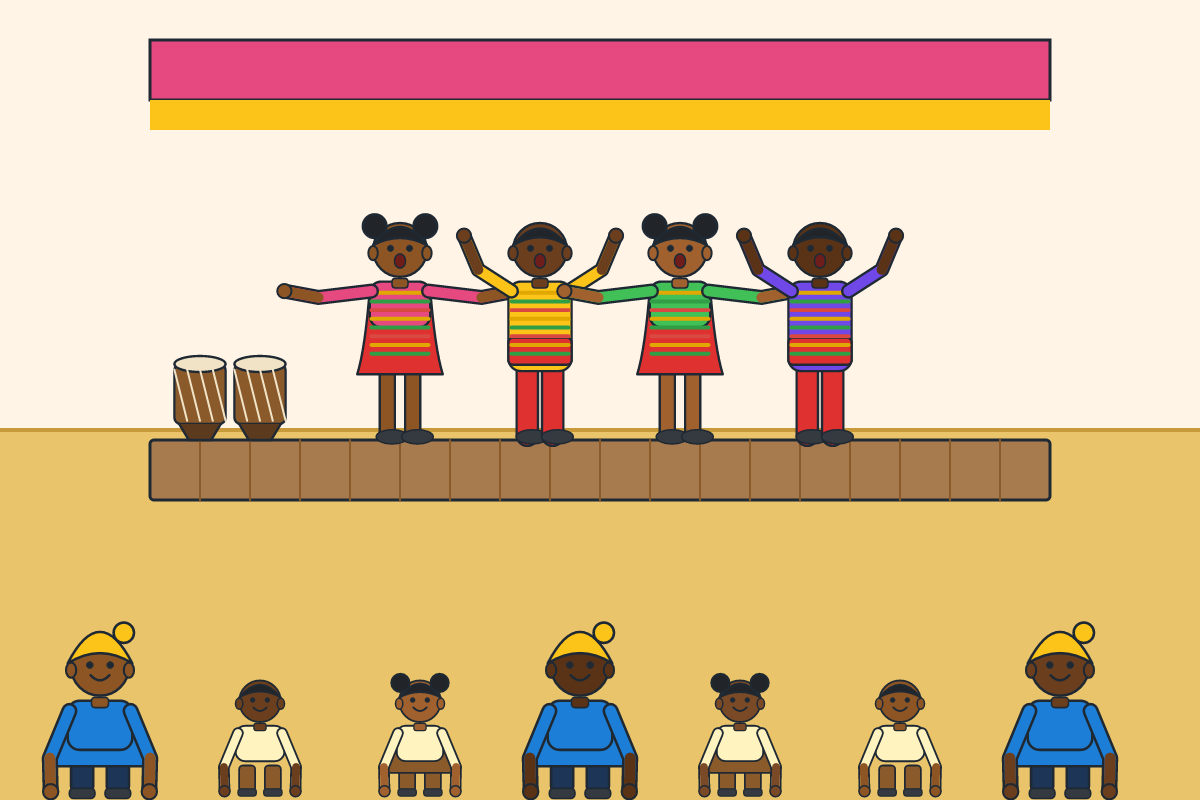
3. Stage Etiquette
- Enter and exit quietly and on time.
- Face the audience and project your voice.
- Stay in character even if something goes wrong.
- Bow together at the end.
- Respect other performers; do not talk backstage during performances.
4. Receiving Feedback
After the show, invite the audience to share comments. Use a feedback form with questions such as: "What did you enjoy most?", "Which item had the clearest message?" and "What could be improved?" Use the feedback to improve future performances.
Record the show on a phone (with permission) so performers can watch themselves later and see what to improve. Thank everyone who helped, including teachers, parents and audience members.
New words
- stage
- The area where performers perform.
- programme
- The order of items in a show.
- etiquette
- Polite rules of behaviour.
- project (voice)
- To speak loudly and clearly so all can hear.
- dress rehearsal
- A full practice with costumes.
- feedback
- Comments that help improvement.
Summary
- Plan the programme, roles, venue, costumes, sound and publicity.
- Rehearse fully before the show.
- Follow stage etiquette and stay in character.
- Collect feedback to improve.
Class activity: Class Show
- Stage a 30-minute show of your class's performing artworks.
- Assign all roles and hold a dress rehearsal.
- Collect audience feedback and discuss it.
You need: Locally made drum, Gourd shaker, Kente cloth sample
Exercises
Answer in your exercise book first, then check your answers.
1. A full practice with costumes is a…
- A. dress rehearsal
- B. exhibition
- C. catalogue
- D. audition
Show answer
Answer: dress rehearsalBefore the show.2. To project your voice means to…
- A. speak loudly and clearly
- B. whisper
- C. sing off-key
- D. stay silent
Show answer
Answer: speak loudly and clearlySo all can hear.3. Who introduces items in a show?
- A. MC
- B. usher
- C. sound person
- D. audience
Show answer
Answer: MCMaster of ceremonies.4. Performers should stay in character if something goes wrong.
- A. True
- B. False
Show answer
Answer: TrueKeep going.5. Talking backstage during a performance is good etiquette.
- A. True
- B. False
Show answer
Answer: FalseIt disturbs the show.6. Polite rules of behaviour are called ______.
Show answer
Answer: etiquetteStage etiquette.7. List four roles needed to stage a show.
Show answer
Answer: Director, MC, performers, ushers (or stage managers, sound person).Any four.8. How can audience feedback improve future performances?
Show answer
Answer: It shows what worked and what did not, so performers can strengthen good parts and fix weak ones.Improvement.
Homework
- Write a short review of your class show.