Basic 6 · Creative Arts · Displaying and Sharing
Planning an Exhibition of Functional and Decorative Artworks
In this topic you will plan an exhibition of your own functional and decorative artworks, including a catalogue and pricing.
By the end of these notes you should be able to:
- Select and prepare functional and decorative works for display
- Prepare labels and a simple catalogue
- Plan display, publicity and sales
What you already know
- Creating functional and decorative artworks
Copy everything that has a blue line on its left into your notebook. The other parts are for reading.
- Strand
- Visual Arts
- Sub-strand
- Displaying and Sharing
- Indicator
- B6.1.3.4.1 – Plan an exhibition of own functional and decorative visual artworks
Introduction
Craft fairs and exhibitions let artists show and sell their work. Planning carefully helps visitors understand, enjoy and buy artworks.
1. Steps in Planning
- Choose a theme, such as "Made in Ghana: Useful and Beautiful".
- Select the best functional and decorative works.
- Finish, clean and repair artworks.
- Prepare labels and a catalogue.
- Plan the layout and display methods.
- Decide on prices if items will be sold.
- Advertise the exhibition.
- Share roles: guides, sellers, security, cleaners.
2. Labels and Catalogue
| Item | Example |
|---|---|
| title | "Rainbow Basket" |
| artist | Kwesi Boateng, Basic 6 |
| medium | dyed raffia |
| type | functional |
| price (if for sale) | GH₵20 |
A catalogue is a small booklet or sheet listing all the artworks with their numbers, titles, artists, media and prices. It helps visitors find and remember works.
3. Displaying Functional and Decorative Works
| Artwork | Display |
|---|---|
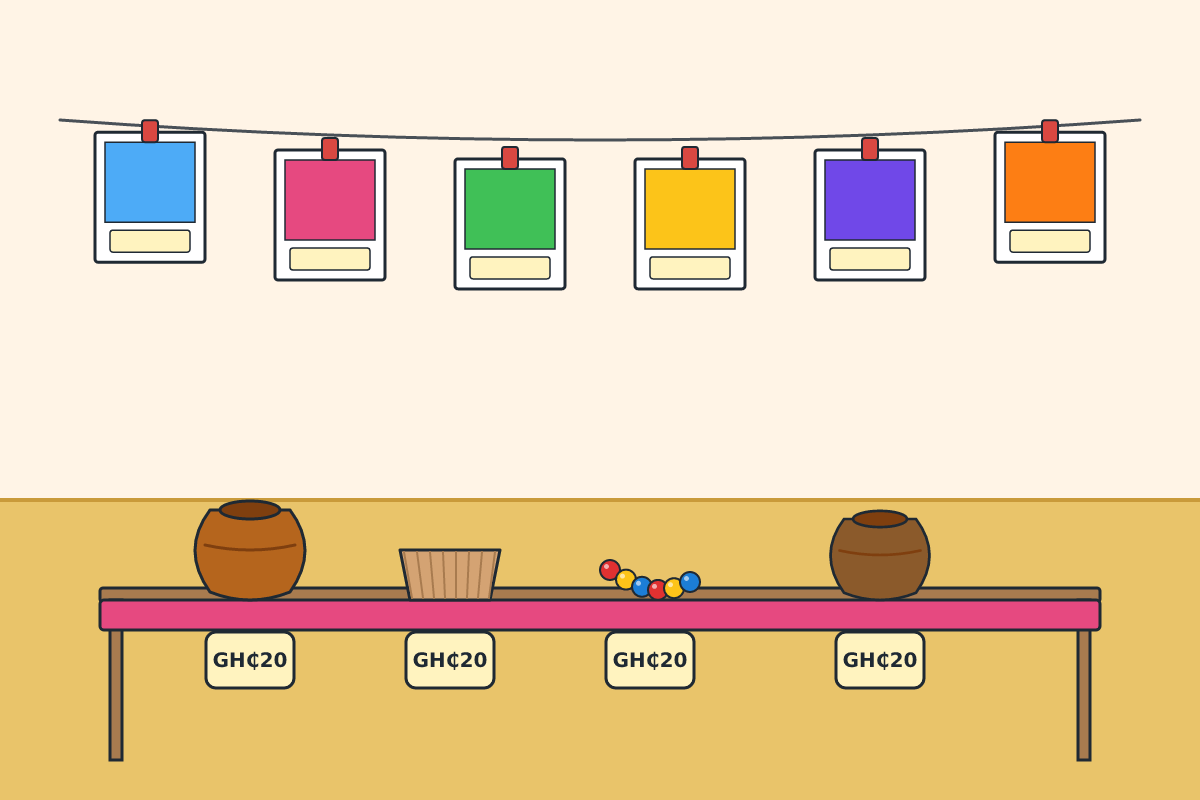
| pots and baskets | on tables covered with cloth, at different heights |
| beads and jewellery | on boards or stands |
| fabrics (tie-dye, batik) | hung on lines or draped over frames |
| paintings and wall hangings | hung at eye level |
4. Pricing Artworks
To set a fair price, add the cost of materials, the time spent and a small profit. Compare prices of similar items in the market. Keep a record of all sales.
Money raised can buy materials for future projects or support a class charity. Be honest with buyers about what each item is made of.
Example
A basket used raffia costing GH₵8 and dye costing GH₵2. You add GH₵10 for your time and effort. What is the price?
- Materials: 8 + 2 = GH₵10
- Add time and effort: 10 + 10
Answer: Price = GH₵20
New words
- exhibition
- A public display of artworks.
- catalogue
- A list of artworks with details.
- functional
- Made to be used.
- decorative
- Made to beautify.
- pricing
- Deciding how much to sell an item for.
- profit
- Money earned after costs are paid.
Summary
- Plan the theme, works, labels, catalogue and layout.
- Display items according to their type.
- Price by adding materials, time and profit.
- Share roles to run the exhibition smoothly.
Class activity: Exhibition Plan
- Prepare labels for five artworks.
- Make a one-page catalogue.
- Calculate a fair price for each item.
You need: Learners’ own artworks, Label cards cut from manila paper, String, Clothes pegs
Exercises
Answer in your exercise book first, then check your answers.
1. A list of artworks with details is a…
- A. catalogue
- B. poem
- C. timetable
- D. register
Show answer
Answer: catalogueHelps visitors.2. Pots and baskets are best displayed…
- A. on cloth-covered tables
- B. hanging from the ceiling
- C. on the floor in a pile
- D. outside in the rain
Show answer
Answer: on cloth-covered tablesAt different heights.3. Materials cost GH₵15 and you add GH₵10 for time. The price is…
- A. GH₵25
- B. GH₵15
- C. GH₵10
- D. GH₵5
Show answer
Answer: GH₵2515 + 10.4. A label should include the artist's name.
- A. True
- B. False
Show answer
Answer: TrueAnd title, medium.5. Prices should ignore the cost of materials.
- A. True
- B. False
Show answer
Answer: FalseMaterials must be included.6. Money earned after costs are paid is ______.
Show answer
Answer: profitReward for work.7. List four items of information on an artwork label.
Show answer
Answer: Title, artist, medium, type (or price).Any four.8. Explain how to set a fair price for an artwork.
Show answer
Answer: Add the cost of materials and time, include a small profit, and compare with similar market prices.Pricing steps.
Homework
- Design an invitation card for your class exhibition.