Basic 6 · Creative Arts · Appreciating and Appraising
Analysing Visual Artworks Using Elements and Principles of Design
In this topic you will analyse and appreciate your own and others' visual artworks using the elements and principles of design.
By the end of these notes you should be able to:
- Identify the elements of art
- Explain the principles of design
- Use them to analyse an artwork
What you already know
- Guidelines for appreciating art (Basic 5)
Copy everything that has a blue line on its left into your notebook. The other parts are for reading.
- Strand
- Visual Arts
- Sub-strand
- Appreciating and Appraising
- Indicator
- B6.1.4.6.1 – Analyze and appreciate own or others’ artworks
Introduction
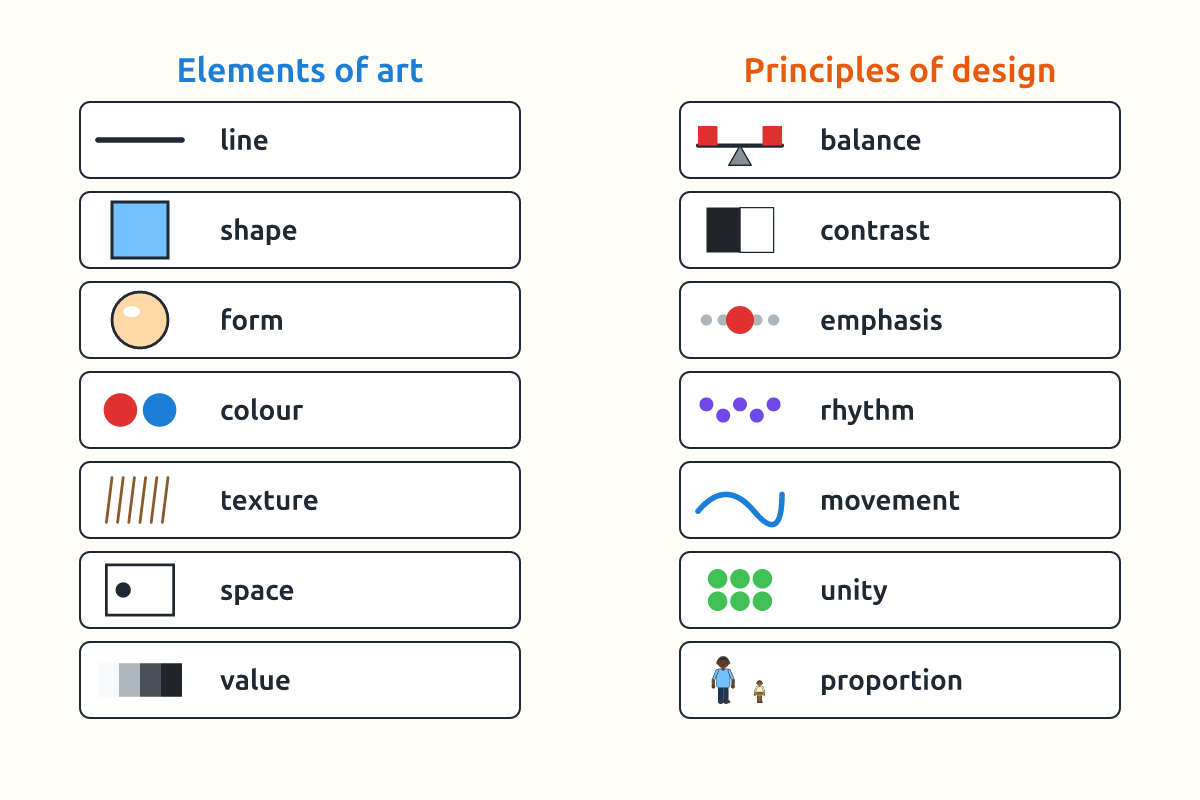
When people say a painting is "well balanced" or "full of movement", they are using the language of art. The elements and principles of design help us talk about artworks clearly.
1. Elements of Art
| Element | Meaning |
|---|---|
| line | a mark made by a moving point: straight, curved, thick, thin |
| shape | a flat area: circle, square, natural shapes |
| form | a three-dimensional shape: sphere, cube |
| colour | hues such as red, yellow, blue; warm and cool |
| texture | how a surface feels or looks like it feels |
| space | the area around and between objects |
| value | lightness or darkness of a colour |
2. Principles of Design
| Principle | Meaning |
|---|---|
| balance | equal visual weight (symmetrical or asymmetrical) |
| contrast | strong differences, e.g. dark and light |
| emphasis | the main point of interest |
| rhythm and pattern | repeated elements |
| movement | the path the eye follows |
| unity | all parts working together |
| proportion | the size relationship between parts |
3. Analysing an Artwork
Example
Analyse a kente cloth.
- Elements: bright colours (gold, green, red), straight lines, rectangular shapes.
- Principles: repeated patterns create rhythm; strips joined edge to edge create unity; gold against black creates contrast.
- Interpretation: colours carry meaning (gold for wealth, green for growth).
Answer: The kente is balanced, rhythmic and full of meaning.
4. Appreciating Respectfully
Appreciation means valuing the strengths of an artwork. Start with what works well, then suggest improvements politely. Remember that artworks from different cultures may follow different ideas of beauty.
Using the correct art words also makes your comments more useful. Instead of "I like it", say "The warm colours and repeated shapes create a lively rhythm."
New words
- elements of art
- The basic parts used to make art.
- principles of design
- Rules for arranging elements.
- balance
- Even distribution of visual weight.
- contrast
- Strong differences between elements.
- emphasis
- The focal point of an artwork.
- unity
- A sense that everything belongs together.
Summary
- The elements of art are line, shape, form, colour, texture, space and value.
- The principles include balance, contrast, emphasis, rhythm, movement, unity and proportion.
- Use them to analyse and appreciate artworks.
- Give respectful, specific feedback.
Class activity: Analysis Gallery
- Display pupils' artworks around the room.
- Each pupil analyses two artworks using three elements and two principles.
- Share your analysis with the artist.
You need: Learners’ own artworks, Label cards cut from manila paper, String, Clothes pegs
Exercises
Answer in your exercise book first, then check your answers.
1. Which is an element of art?
- A. Colour
- B. Balance
- C. Unity
- D. Emphasis
Show answer
Answer: ColourA building block.2. The focal point of an artwork is its…
- A. emphasis
- B. texture
- C. value
- D. line
Show answer
Answer: emphasisIt draws attention.3. Repeated patterns in kente create…
- A. rhythm
- B. silence
- C. imbalance
- D. emptiness
Show answer
Answer: rhythmRepetition.4. Texture is how a surface feels or looks like it feels.
- A. True
- B. False
Show answer
Answer: TrueRough or smooth.5. Balance is an element of art.
- A. True
- B. False
Show answer
Answer: FalseIt is a principle of design.6. Lightness or darkness of a colour is its ______.
Show answer
Answer: valueAn element.7. Name four elements of art.
Show answer
Answer: Line, shape, colour, texture (or form, space, value).Any four.8. Explain how contrast can make an artwork stronger.
Show answer
Answer: Strong differences such as dark and light make important parts stand out and add interest.Visual impact.
Homework
- Analyse a cloth design or painting at home using two elements and two principles.