Basic 6 · Computing · Data, Sources and Usage
Types and Sources of Data and Information
In this topic you will identify types of data and information and their sources.
By the end of these notes you should be able to:
- Distinguish between data and information
- Identify types of data (text, numbers, images, audio, video)
- Classify sources of data as primary or secondary
What you already know
- Primary and secondary sources (Basic 5)
Copy everything that has a blue line on its left into your notebook. The other parts are for reading.
- Strand
- Introduction To Computers
- Sub-strand
- Data, Sources and Usage
- Indicator
- B6.1.3.1.1-3 – Identify types and sources of data and information of data
Introduction
A list of scores such as 45, 78, 62 means little on its own. But when we arrange them and find that most pupils scored above 60, we have useful information.
1. Data and Information
| Data | Information |
|---|---|
| raw facts and figures | processed, organised data with meaning |
| 45, 78, 62, 90 | "The class average is 68.75" |
| "Ama, 11, Basic 6" | "Ama is an 11-year-old Basic 6 pupil" |
Computers process data into information. Input (data) → processing → output (information).
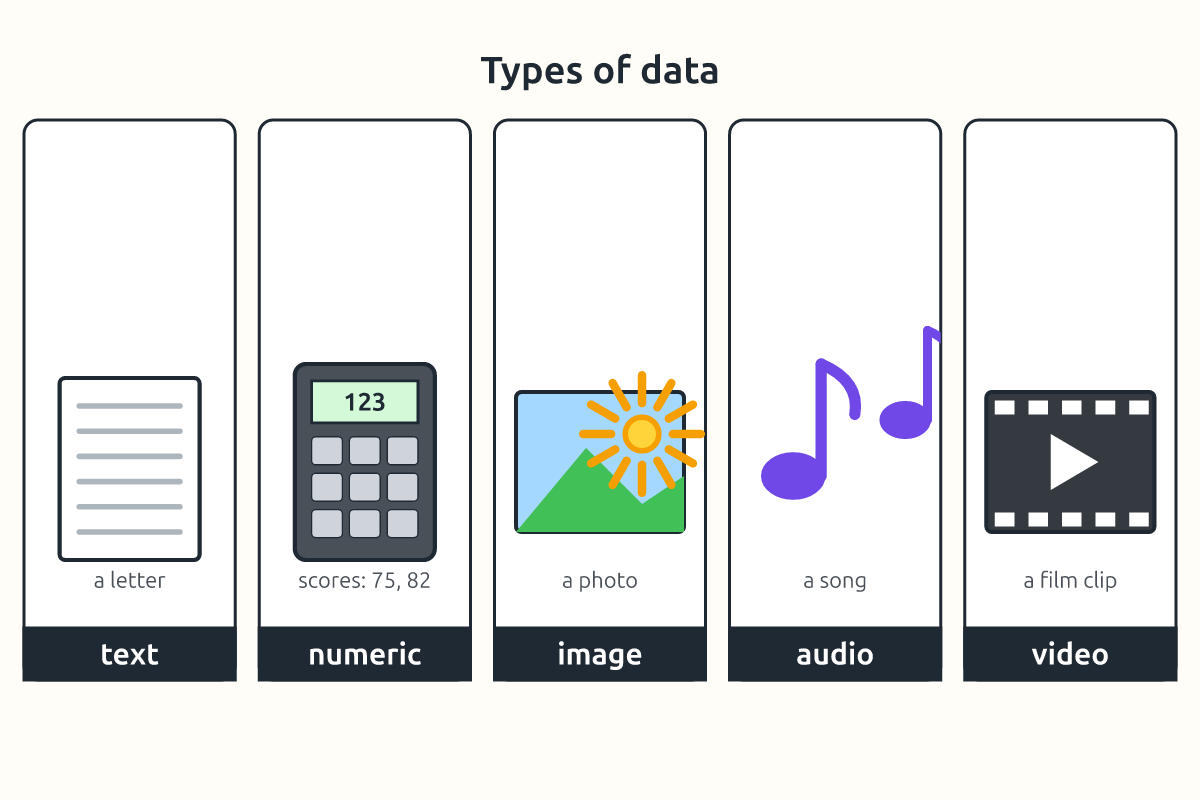
2. Types of Data
| Type | Examples |
|---|---|
| text (alphanumeric) | names, addresses, messages |
| numeric | scores, prices, ages, temperatures |
| image | photos, drawings, scanned documents |
| audio | songs, voice recordings, radio programmes |
| video | films, recorded lessons |
| date and time | 23/10/2026, 10:30 a.m. |
3. Sources of Data
| Primary sources (first-hand) | Secondary sources (from others) |
|---|---|
| interviews and questionnaires | books and newspapers |
| observation | websites and online databases |
| experiments and measurements | radio and TV reports |
| sensors (thermometers, rain gauges) | government statistics reports |
| photographs you take | encyclopedias |
4. Qualities of Good Information
- Accurate: correct and free from errors.
- Relevant: useful for the purpose.
- Timely: up to date.
- Complete: nothing important missing.
- Reliable: from a trusted source.
The Ghana Statistical Service collects and publishes data such as population census figures, which many people use as a secondary source.
When you use data, always ask where it came from, when it was collected and who collected it. A weather report from the Ghana Meteorological Agency is more reliable than a rumour on social media. Comparing two or more sources helps you check whether information is accurate. In school projects, write down your sources so that others can check them too.
New words
- data
- Raw facts and figures.
- information
- Processed data with meaning.
- numeric
- Made of numbers.
- primary source
- First-hand data.
- secondary source
- Data collected by someone else.
- reliable
- Trustworthy.
Summary
- Data is raw; information is processed and meaningful.
- Data can be text, numbers, images, audio, video or dates.
- Sources are primary (first-hand) or secondary (from others).
- Good information is accurate, relevant, timely, complete and reliable.
Class activity: Data to Information
- Collect the ages of ten classmates (data).
- Find the youngest, oldest and most common age (information).
- Present your information in a sentence and a table.
You need: Printed local survey forms, Locally made data-source cards, Manila paper
Exercises
Answer in your exercise book first, then check your answers.
1. Raw facts and figures are called…
- A. data
- B. information
- C. software
- D. hardware
Show answer
Answer: dataUnprocessed.2. A recorded song is which type of data?
- A. Audio
- B. Numeric
- C. Text
- D. Date
Show answer
Answer: AudioSound.3. Which is a primary source?
- A. An interview you carry out
- B. A textbook
- C. A newspaper
- D. A website
Show answer
Answer: An interview you carry outFirst-hand.4. Information is processed data.
- A. True
- B. False
Show answer
Answer: TrueIt has meaning.5. Out-of-date information is timely.
- A. True
- B. False
Show answer
Answer: FalseTimely means up to date.6. Data that is made of numbers is ______ data.
Show answer
Answer: numerice.g. scores.7. Give two differences between data and information.
Show answer
Answer: Data is raw and has little meaning; information is processed, organised and meaningful.Two points.8. Why is it important that information is reliable?
Show answer
Answer: Decisions based on unreliable information may be wrong and cause harm.Trust.
Homework
- Collect data on the favourite foods of five family members and turn it into information.