Basic 5 · Science · Life Cycle of Organism
Parts of a Plant and Their Functions
In this topic you will relate the structure of each part of a plant to the job it performs.
By the end of these notes you should be able to:
- Identify the main parts of a flowering plant
- Describe the structure of each part
- Explain how each part's structure suits its function
What you already know
- Photosynthesis
Copy everything that has a blue line on its left into your notebook. The other parts are for reading.
- Strand
- Cycles
- Sub-strand
- Life Cycle of Organism
- Indicator
- B5.2.2.1.1 – Relate structure of the parts of a plant to the functions they perform
Introduction
Every part of a plant has a special shape that helps it do its job. The roots are long and thin to reach water, and the leaves are broad and flat to catch sunlight.
1. The Main Parts
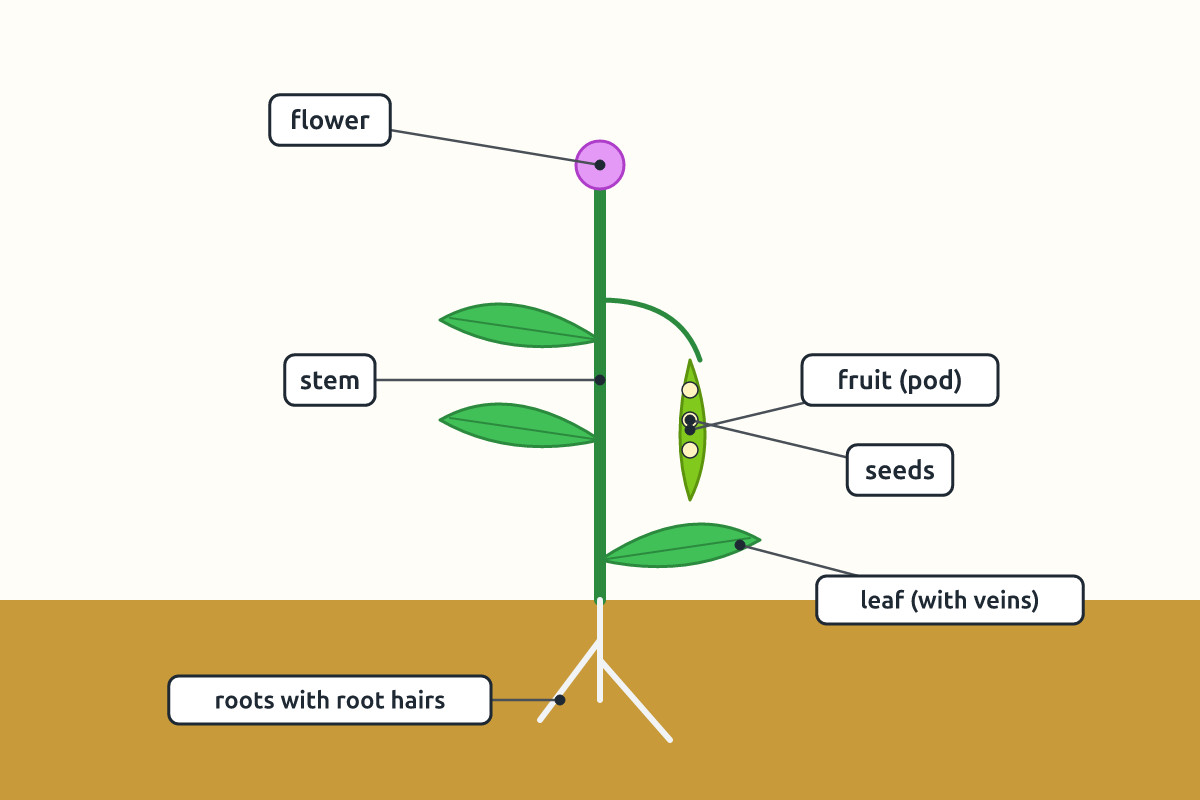
2. Roots
Roots grow down into the soil. They hold the plant firmly in the ground and absorb water and mineral salts. Roots have many tiny root hairs, which give them a large surface for taking in water. Some roots store food, such as cassava and carrot. There are two main types: a tap root, which has one main root with side branches (bean, mango), and fibrous roots, which are many thin roots of the same size (maize, grass).
3. Stem
The stem holds up the leaves, flowers and fruits so that they get sunlight and air. Inside the stem are tubes that carry water up from the roots to the leaves, and food down from the leaves to other parts. Stems are strong and upright. Some stems store food (sugarcane, yam tuber) and some can grow into new plants (cassava cuttings).
4. Leaves
Leaves are broad and flat to catch as much sunlight as possible. They are green because they contain chlorophyll. Leaves make food by photosynthesis. Tiny holes called stomata on the underside let carbon dioxide in and oxygen and water vapour out. The veins carry water into the leaf and food out of it.
5. Flower, Fruit and Seed
The flower is the part used for reproduction. Bright colours and scent attract insects which carry pollen from flower to flower. After pollination, the flower forms a fruit containing seeds. The fruit protects the seeds and helps to spread them. Each seed can grow into a new plant.
| Part | Structure | Function |
|---|---|---|
| root | long, branched, with root hairs | holds plant; absorbs water and minerals |
| stem | strong, upright, with tubes | supports plant; transports water and food |
| leaf | broad, flat, green, with stomata | makes food; exchanges gases |
| flower | colourful, scented | attracts insects; reproduction |
| fruit | covers the seeds | protects and spreads seeds |
New words
- root hair
- Tiny hair on a root that absorbs water.
- tap root
- One main root with side branches.
- fibrous roots
- Many thin roots of similar size.
- stomata
- Tiny pores on a leaf.
- pollination
- Moving pollen from one flower to another.
- function
- The job something does.
Summary
- Roots hold the plant and absorb water through root hairs.
- The stem supports the plant and carries water and food.
- Leaves are broad and green to make food.
- Flowers make fruits and seeds for reproduction.
Class activity: Plant Dissection
- Uproot a bean plant and a grass plant carefully.
- Use a hand lens to look at the roots, stem and leaves.
- Draw both and compare tap and fibrous roots.
You need: Uprooted bean, Grass plants, Cassava cutting, Hand lens
Exercises
Answer in your exercise book first, then check your answers.
1. Which part makes food?
- A. Leaf
- B. Root
- C. Flower
- D. Seed
Show answer
Answer: LeafBy photosynthesis.2. Maize has…
- A. fibrous roots
- B. tap root
- C. no roots
- D. aerial roots only
Show answer
Answer: fibrous rootsMany thin roots.3. Why are leaves broad and flat?
- A. To catch more sunlight
- B. To hold water
- C. To attract insects
- D. To store food
Show answer
Answer: To catch more sunlightMore light means more food.4. Root hairs absorb water.
- A. True
- B. False
Show answer
Answer: TrueThey give a large surface.5. Cassava stores food in its stem only.
- A. True
- B. False
Show answer
Answer: FalseCassava stores food in its roots.6. Tiny pores on a leaf are called ______.
Show answer
Answer: stomataThey let gases in and out.7. State two functions of the stem.
Show answer
Answer: Supports the plant and carries water and food.Also stores food in some plants.8. Explain how the structure of the root suits its function.
Show answer
Answer: It is long and branched with many root hairs, giving a large surface to absorb water and anchor the plant.Structure fits function.
Homework
- Collect a plant with a tap root and one with fibrous roots. Draw and label both.