Basic 5 · Science · Life Cycle of Organism
Germination of Bean and Maize Seeds
In this topic you will compare how bean and maize seeds germinate.
By the end of these notes you should be able to:
- State the conditions needed for germination
- Describe the germination of bean and maize seeds
- Compare epigeal and hypogeal germination
What you already know
- Parts of a plant
Copy everything that has a blue line on its left into your notebook. The other parts are for reading.
- Strand
- Cycles
- Sub-strand
- Life Cycle of Organism
- Indicator
- B5.2.2.1.2 – Compare the differences in germination of bean and maize seeds
Introduction
Farmers in Ghana plant beans and maize every rainy season. Both seeds grow into plants, but if you watch closely, they come out of the soil in different ways.
1. What Is Germination?
Germination: The process by which a seed begins to grow into a young plant (seedling).
A seed has three main parts: the seed coat (testa) which protects it, the embryo which grows into the new plant, and the food store (cotyledon). A bean seed has two cotyledons (a dicot), while a maize grain has one cotyledon (a monocot) and its food is stored in a part called the endosperm.
| Condition | Why it is needed |
|---|---|
| water | softens the seed coat and starts growth |
| air (oxygen) | for respiration to release energy |
| warmth | helps the seed's chemical processes work |
Light is not needed for germination because the seed uses its stored food. Light is needed later, when the seedling starts to make its own food.
2. Germination of the Bean Seed
The bean seed absorbs water and swells. The seed coat splits and the radicle (young root) grows down. The hypocotyl (part below the cotyledons) grows and forms a hook that pushes up through the soil, pulling the cotyledons above the ground. The cotyledons turn green, and the first leaves open. Because the cotyledons come above the soil, this is called epigeal germination.
3. Germination of the Maize Grain
The maize grain also absorbs water and swells. The radicle grows down, and the plumule (young shoot) grows straight up, protected by a sheath called the coleoptile. The cotyledon stays below the ground. Because the food store stays under the soil, this is called hypogeal germination.
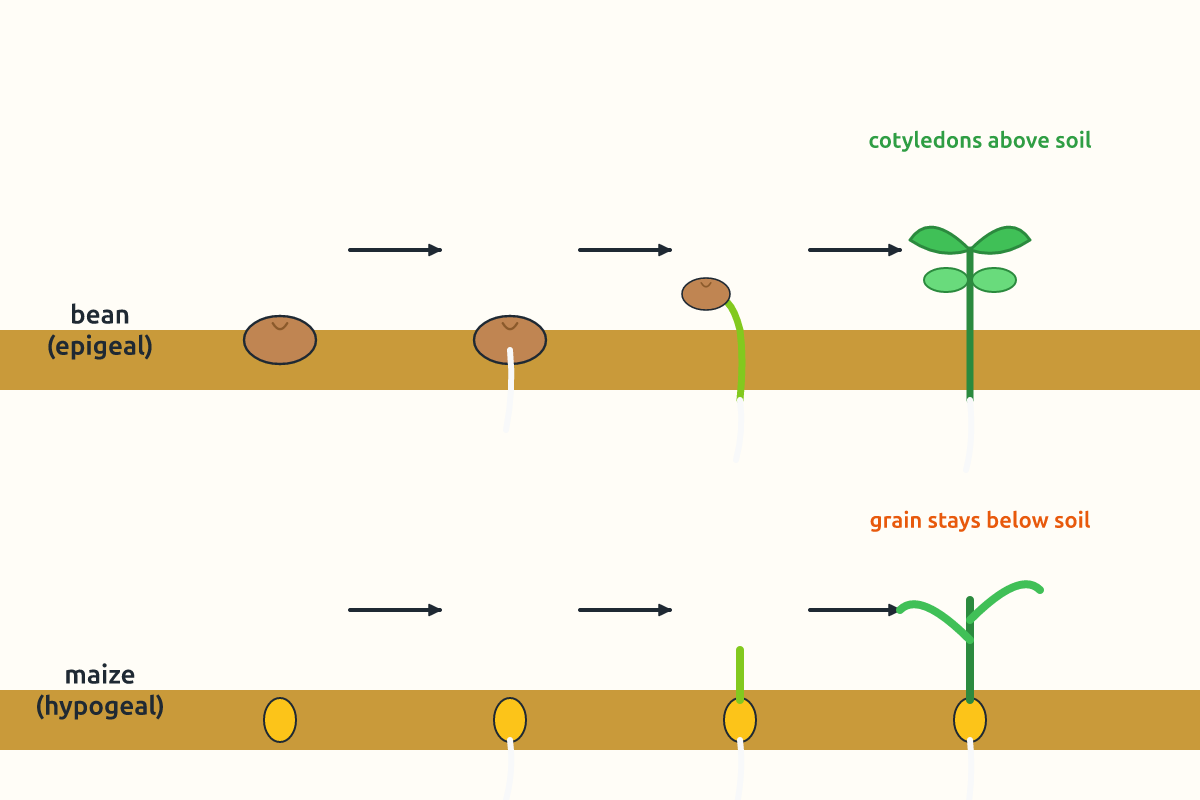
| Feature | Bean | Maize |
|---|---|---|
| type of germination | epigeal | hypogeal |
| cotyledons | two, come above the soil | one, stays below the soil |
| food store | cotyledons | endosperm |
| young shoot | comes out in a hook | comes out straight in a sheath |
| roots | tap root | fibrous roots |
New words
- germination
- A seed beginning to grow.
- radicle
- The first young root.
- plumule
- The first young shoot.
- cotyledon
- The seed leaf that stores food.
- epigeal
- Germination with cotyledons above the soil.
- hypogeal
- Germination with cotyledons below the soil.
Summary
- Seeds need water, air and warmth to germinate.
- Bean germination is epigeal: cotyledons come above the soil.
- Maize germination is hypogeal: the grain stays below the soil.
- Beans have two cotyledons; maize has one.
Class activity: Seed Jars
- Line two clear jars with damp cotton wool.
- Place bean seeds in one jar and maize grains in the other, against the glass.
- Water daily and draw what you see every two days for ten days.
You need: Bean, Maize seeds, Cotton wool in clear jars, Cup of water
Exercises
Answer in your exercise book first, then check your answers.
1. Which is NOT needed for germination?
- A. Light
- B. Water
- C. Air
- D. Warmth
Show answer
Answer: LightThe seed uses stored food.2. Bean germination is…
- A. epigeal
- B. hypogeal
- C. vegetative
- D. fibrous
Show answer
Answer: epigealCotyledons come above the soil.3. The first young root is called the…
- A. radicle
- B. plumule
- C. testa
- D. endosperm
Show answer
Answer: radicleIt grows down first.4. Maize has one cotyledon.
- A. True
- B. False
Show answer
Answer: TrueIt is a monocot.5. In maize germination, the cotyledon comes above the soil.
- A. True
- B. False
Show answer
Answer: FalseMaize germination is hypogeal.6. The protective outer layer of a seed is the seed ______.
Show answer
Answer: coatAlso called the testa.7. State the three conditions needed for germination.
Show answer
Answer: Water, air (oxygen) and warmth.Light is not needed.8. Give two differences between bean and maize germination.
Show answer
Answer: Bean is epigeal with two cotyledons above the soil; maize is hypogeal with one cotyledon below the soil (also hooked vs straight shoot).Any two.
Homework
- Set up a seed jar at home with beans and maize. Keep a diary of what you observe.