Basic 5 · Science · Earth Science
Evaporation and Condensation in the Water Cycle
In this topic you will demonstrate evaporation and condensation and explain their roles in the water cycle.
By the end of these notes you should be able to:
- Explain evaporation and condensation
- Demonstrate both processes with a simple experiment
- Describe the stages of the water cycle
What you already know
- Benefits of the sun
Copy everything that has a blue line on its left into your notebook. The other parts are for reading.
- Strand
- Cycles
- Sub-strand
- Earth Science
- Indicator
- B5.2.1.3.1 – Demonstrate evaporation and condensation as important processes of the hydrological (water) cycle
Introduction
Rainwater falls into the sea, rivers and lakes. Yet the sea never overflows and the rain never stops completely. Water moves round and round between the land, the sea and the sky. This movement is the water cycle.
1. Evaporation
Evaporation: The change of liquid water into water vapour (a gas) when it is heated.
When the sun heats water in seas, rivers, lakes and puddles, some of it turns into invisible water vapour and rises into the air. Water also evaporates from wet clothes, the soil and the leaves of plants. Evaporation is faster when it is hot, windy and the air is dry. This is why clothes dry quickly during the harmattan.
2. Condensation
Condensation: The change of water vapour back into liquid water when it is cooled.
When water vapour rises high into the sky, the air is cooler. The vapour cools and condenses into tiny water droplets, which gather to form clouds. You can see condensation at home: drops of water form on the outside of a cold bottle from the fridge, and on the lid of a pot of boiling soup.
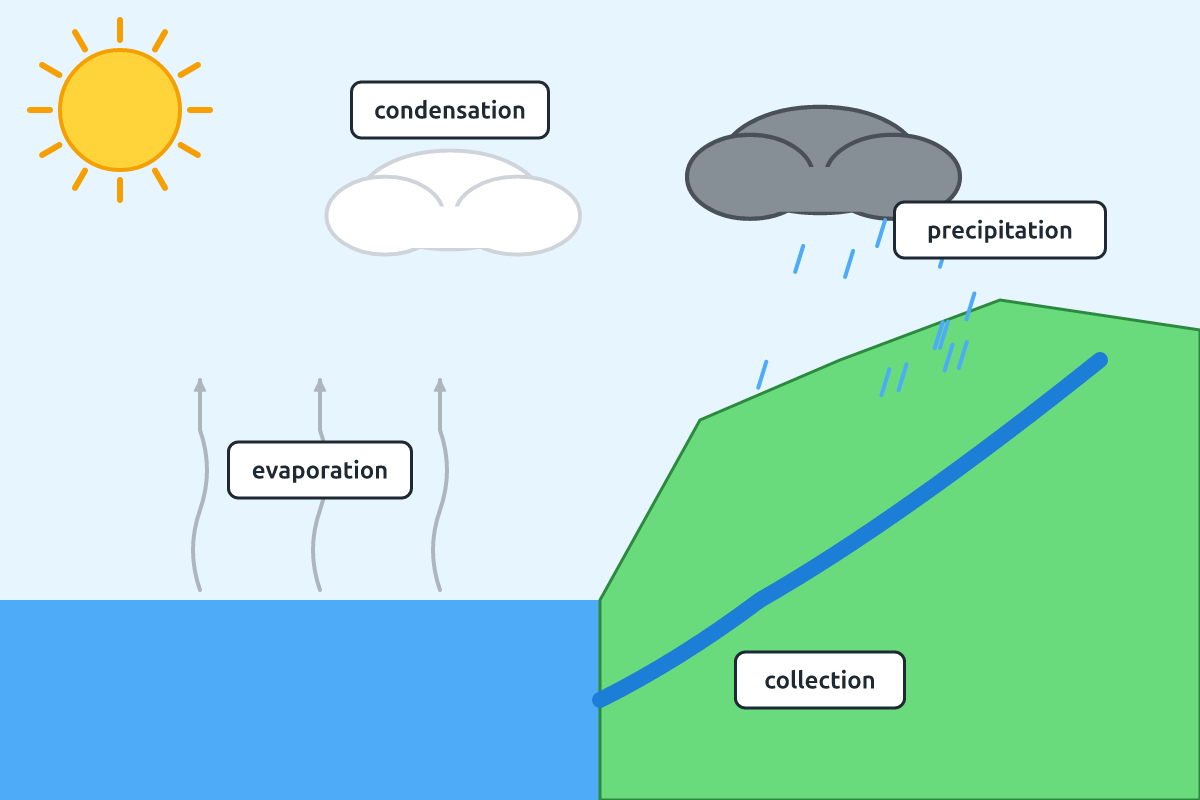
3. The Water Cycle
- Evaporation: the sun heats water, which rises as vapour.
- Condensation: the vapour cools high up and forms clouds.
- Precipitation: the droplets join, become heavy and fall as rain.
- Collection: rainwater flows into rivers, lakes, the sea and the ground, and the cycle begins again.
4. Demonstrating the Processes
Experiment
How can we show evaporation and condensation?
- Pour warm water into a clear bowl.
- Hold a cool metal lid a short distance above the bowl.
- Watch the underside of the lid for one to two minutes.
Answer: Water vapour from the warm water (evaporation) forms droplets on the cool lid (condensation). The drops falling back are like rain.
The water cycle is important because it supplies fresh water. When seawater evaporates, the salt is left behind, so the rain that falls is fresh water that people, animals and plants can use.
Safety: Use only warm water, not boiling water, and let your teacher handle hot containers.
New words
- evaporation
- Liquid water changing into vapour.
- condensation
- Vapour changing back into liquid.
- water vapour
- Water in the form of a gas.
- precipitation
- Water falling from clouds as rain.
- collection
- Water gathering in rivers, lakes and seas.
- water cycle
- The continuous movement of water around the earth.
Summary
- Evaporation turns liquid water into vapour using heat.
- Condensation turns vapour into droplets when it cools.
- The water cycle has four stages: evaporation, condensation, precipitation, collection.
- The water cycle gives us fresh water.
Class activity: Cycle in a Bag
- Put a little water in a clear plastic bag and seal it.
- Tape it to a sunny window and draw the water cycle on the bag.
- Observe it over two days and record what happens.
You need: Clear bowl of teacher-provided warm water, Cool metal lid, Printed water-cycle chart
Exercises
Answer in your exercise book first, then check your answers.
1. Water changing into vapour is called…
- A. evaporation
- B. condensation
- C. freezing
- D. precipitation
Show answer
Answer: evaporationHeat turns liquid into gas.2. Clouds are formed by…
- A. condensation
- B. evaporation
- C. collection
- D. filtration
Show answer
Answer: condensationVapour cools into droplets.3. Rain is part of which stage?
- A. Precipitation
- B. Evaporation
- C. Condensation
- D. Collection
Show answer
Answer: PrecipitationWater falls from clouds.4. Wet clothes dry faster on a hot, windy day.
- A. True
- B. False
Show answer
Answer: TrueEvaporation is faster.5. Rain from evaporated seawater is salty.
- A. True
- B. False
Show answer
Answer: FalseThe salt is left behind.6. Droplets on a cold bottle are formed by ______.
Show answer
Answer: condensationVapour in the air cools.7. Name the four stages of the water cycle in order.
Show answer
Answer: Evaporation, condensation, precipitation, collection.The cycle repeats.8. Explain why clothes dry quickly during the harmattan.
Show answer
Answer: The air is dry and windy, so water evaporates from the clothes faster.Dry, moving air speeds evaporation.
Homework
- Find two examples of evaporation and two of condensation in your home.