Basic 5 · Religious and Moral Education · Religious Worship
Religious Songs and Their Moral Lessons
In this topic you will explain the moral significance of religious songs in Christianity, Islam and Traditional Religion.
By the end of these notes you should be able to:
- Identify types of religious songs
- Explain what religious songs teach
- Sing or recite a religious song with understanding
What you already know
- The moral importance of worship
Copy everything that has a blue line on its left into your notebook. The other parts are for reading.
- Strand
- Religious Practices
- Sub-strand
- Religious Worship
- Indicator
- B5.2.1.1.2 – Explain the moral significance of religious songs and recitations
Introduction
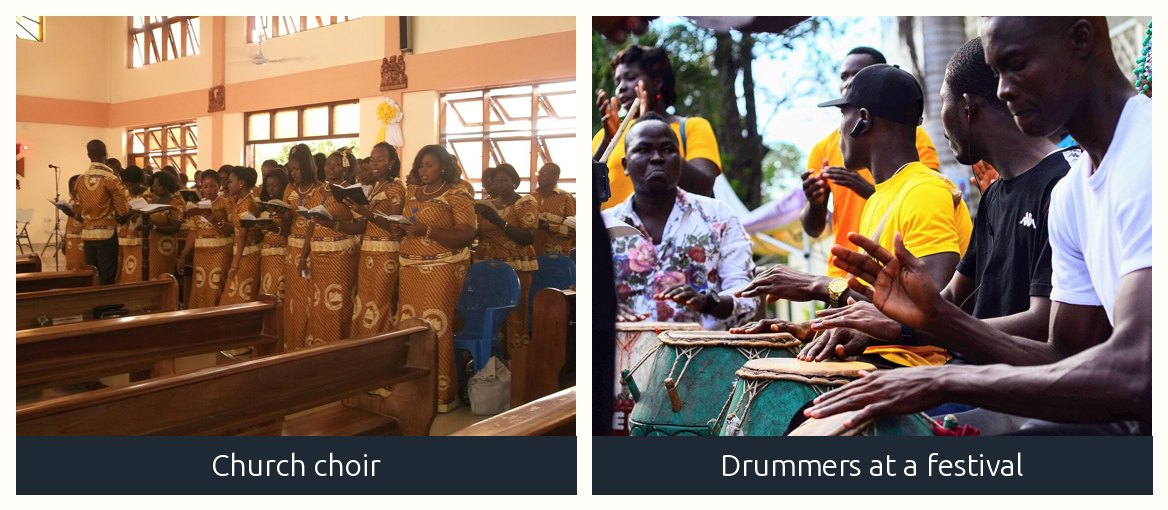
Music is an important part of worship in Ghana. Church choirs sing hymns, Muslims chant praises of Allah, and traditional worshippers sing and drum at festivals. These songs carry messages that teach how to live.
1. Types of Religious Songs
| Religion | Types | Examples |
|---|---|---|
| Christianity | hymns, choruses, anthems, gospel songs | "Amazing Grace"; "What a Friend We Have in Jesus"; local gospel songs |
| Islam | nasheed (songs of praise), qasida (praise poems), recitation of the Qur'an | songs praising Allah and the Prophet, sung at Maulid and Eid |
| Traditional | festival songs, dirges, war songs, praise songs | songs at Homowo, Aboakyer and Adae; dirges at funerals |
2. What Religious Songs Teach
Religious songs teach about God's love, power and care. "Amazing Grace" was written by John Newton, a former slave-ship captain who repented and later fought against the slave trade. The song teaches that God forgives people who turn from evil. Islamic nasheeds praise Allah and the Prophet and teach patience, kindness and gratitude. Traditional songs praise God (Onyankopɔn), honour the ancestors and remind people of the history and values of their community.
| Theme of song | Lesson |
|---|---|
| thanksgiving | be grateful for what you have |
| forgiveness and repentance | turn from wrongdoing and forgive others |
| God's protection | trust God and do not fear |
| unity | live peacefully together |
| praise of ancestors and heroes | be brave and hardworking like them |
| dirges (funeral songs) | life is short, so live well |
3. Why Songs Are Powerful
Songs are easy to remember. Children and adults sing them at work, at home and on the way to school, and the messages stay in their hearts. Songs comfort people in sorrow, give courage in difficult times and bring people together in joy. Many Ghanaian songs use proverbs, which carry deep wisdom.
We should sing religious songs with respect and understanding. Learn what the words mean and try to live by them. We should also respect songs from other religions.
New words
- hymn
- A religious song of praise, usually in church.
- chorus
- A short, lively religious song.
- nasheed
- An Islamic song of praise.
- dirge
- A funeral song.
- repentance
- Being sorry and turning from wrongdoing.
- gratitude
- Being thankful.
Summary
- All three religions use songs in worship.
- Religious songs teach gratitude, forgiveness, trust and unity.
- Songs are easy to remember and comfort people.
- We should sing with understanding and respect other religions' songs.
Class activity: Song Meanings
- Choose a religious song your group knows.
- Write its words (or part of them) and explain its message.
- Perform it for the class and state the lesson it teaches.
You need: Bible, Qur’an, Locally made religious song cards, Local drum
Exercises
Answer in your exercise book first, then check your answers.
1. A funeral song is called a…
- A. dirge
- B. hymn
- C. chorus
- D. nasheed
Show answer
Answer: dirgeIt is sung in mourning.2. An Islamic song of praise is a…
- A. nasheed
- B. hymn
- C. dirge
- D. libation
Show answer
Answer: nasheedSung at festivals like Maulid.3. Who wrote "Amazing Grace"?
- A. John Newton
- B. Kwame Nkrumah
- C. Ephraim Amu
- D. William Wilberforce
Show answer
Answer: John NewtonA former slave-ship captain.4. Religious songs can teach good values.
- A. True
- B. False
Show answer
Answer: TrueThrough their messages.5. Traditional religion has no songs.
- A. True
- B. False
Show answer
Answer: FalseIt has festival songs, dirges and praise songs.6. A religious song of praise sung in church is a ______.
Show answer
Answer: hymne.g. "Amazing Grace".7. State two lessons taught by religious songs.
Show answer
Answer: Gratitude and forgiveness (or trust in God, unity).Any two.8. Why are songs a powerful way to teach morals?
Show answer
Answer: They are easy to remember, are sung often and touch people's feelings, so the messages stay with them.Songs stay in the heart.
Homework
- Write down a religious song from your home and explain its message.