Basic 5 · Religious and Moral Education · Religious Worship
Religious Recitations and Their Moral Lessons
In this topic you will explain the moral significance of important religious recitations such as the Lord's Prayer, Al-Fatiha and traditional libation prayers.
By the end of these notes you should be able to:
- Recite and explain a well-known prayer from each religion
- Identify the moral lessons in each recitation
- Show respect when others recite prayers
What you already know
- Religious songs
Copy everything that has a blue line on its left into your notebook. The other parts are for reading.
- Strand
- Religious Practices
- Sub-strand
- Religious Worship
- Indicator
- B5.2.1.1.2 – Explain the moral significance of religious songs and recitations
Introduction
Some prayers are recited by heart by millions of people. Christians recite the Lord's Prayer, Muslims recite Al-Fatiha in every prayer, and traditional leaders recite prayers during libation. Each carries important lessons.
1. The Lord's Prayer (Christianity)
Jesus taught His disciples this prayer (Matthew 6:9–13). It begins, "Our Father in heaven, hallowed be your name, your kingdom come, your will be done, on earth as it is in heaven. Give us today our daily bread. And forgive us our debts, as we also have forgiven our debtors. And lead us not into temptation, but deliver us from the evil one."
Lessons: God is our Father, so all people are brothers and sisters. We should depend on God for our needs. We must forgive others if we want to be forgiven. We should ask God to help us avoid temptation.
2. Al-Fatiha (Islam)
Al-Fatiha is the first chapter of the Qur'an. It is recited in every unit of salat. Its meaning is: "In the name of Allah, the Most Gracious, the Most Merciful. All praise is due to Allah, Lord of the worlds, the Most Gracious, the Most Merciful, Master of the Day of Judgement. You alone we worship, and You alone we ask for help. Guide us to the straight path, the path of those You have blessed, not of those who have earned Your anger, nor of those who go astray."
Lessons: Begin everything in God's name. Be thankful. Remember that we will be judged for our actions. Ask God for guidance to live rightly.
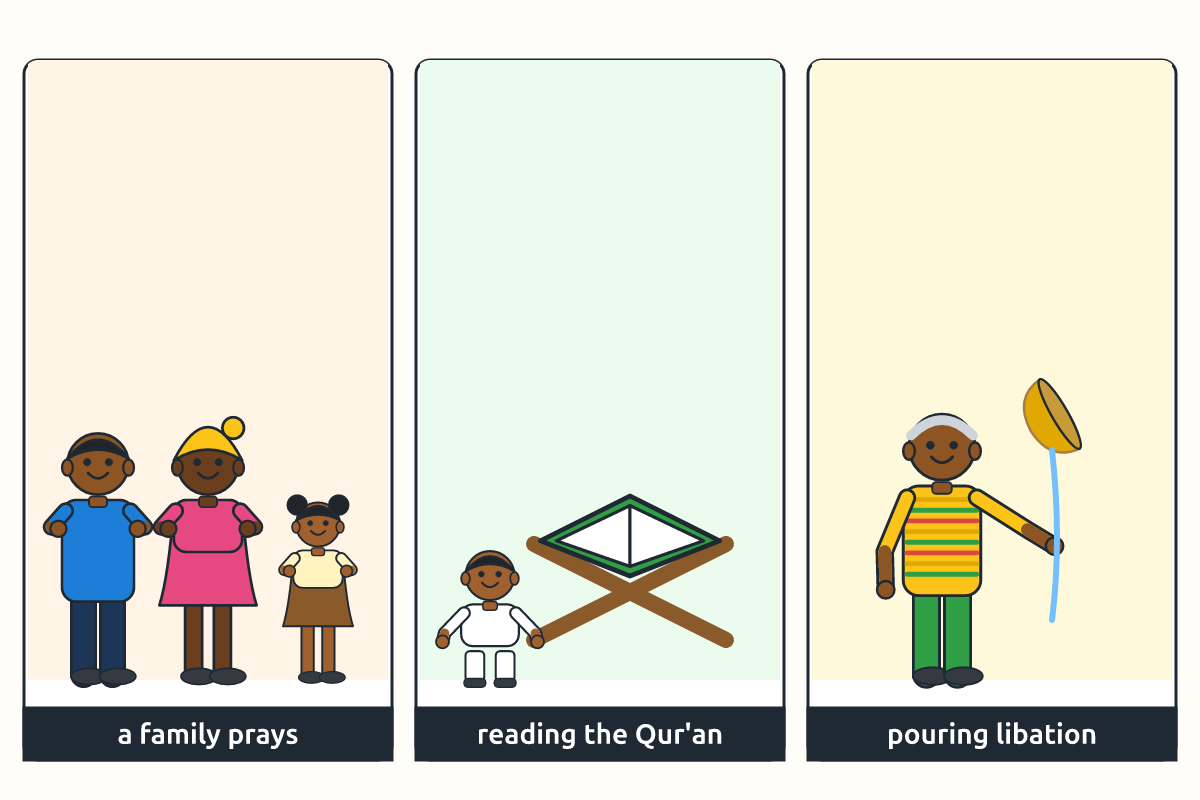
3. Libation Prayer (Traditional Religion)
At festivals, naming ceremonies and other important events, an elder pours water or drink on the ground and recites a prayer. He calls first on the Supreme Being (Onyankopɔn), then on the earth (Asase Yaa), then on the ancestors. He asks for life, health, rain, good harvest and peace, and asks that evil be kept away.
Lessons: Respect God, the earth and the ancestors. Ask for blessings for the whole community, not only for yourself. Wish good for others and peace in the land.
4. The Moral Significance of Recitations
| Recitation | Main lessons |
|---|---|
| Lord's Prayer | forgiveness, dependence on God, brotherhood |
| Al-Fatiha | gratitude, worship of God alone, seeking guidance |
| Libation prayer | respect for God and ancestors, unity, peace |
Reciting prayers often helps people remember their duties to God and others. But the words must be lived out. A person who prays "forgive us as we forgive" must truly forgive others.
New words
- recitation
- Saying words from memory.
- Lord's Prayer
- The prayer Jesus taught His disciples.
- Al-Fatiha
- The opening chapter of the Qur'an.
- libation
- Pouring a drink as an offering with prayer.
- temptation
- Something that pulls a person to do wrong.
- guidance
- Direction on the right way to live.
Summary
- The Lord's Prayer teaches forgiveness and dependence on God.
- Al-Fatiha teaches gratitude and seeking God's guidance.
- Libation prayers ask for blessings for the whole community.
- Recited words must be lived out in our behaviour.
Class activity: Recitation Lessons
- Each group studies one recitation.
- Write it out (or its meaning) on manila paper.
- Underline the parts that teach a moral lesson and explain them.
You need: Bible, Qur’an, Locally made religious song cards, Local drum
Exercises
Answer in your exercise book first, then check your answers.
1. Who taught the Lord's Prayer?
- A. Jesus
- B. Moses
- C. Abraham
- D. Paul
Show answer
Answer: JesusMatthew 6:9–13.2. Al-Fatiha is…
- A. the first chapter of the Qur'an
- B. the last chapter of the Bible
- C. a festival song
- D. a hymn
Show answer
Answer: the first chapter of the Qur'anRecited in every prayer.3. In libation, the elder first calls on…
- A. the Supreme Being
- B. the youngest child
- C. a visitor
- D. a market woman
Show answer
Answer: the Supreme BeingThen the earth and ancestors.4. The Lord's Prayer teaches forgiveness.
- A. True
- B. False
Show answer
Answer: True"Forgive us as we forgive."5. Libation prayers ask blessings only for the elder pouring it.
- A. True
- B. False
Show answer
Answer: FalseThey are for the whole community.6. Al-Fatiha asks Allah to guide us to the ______ path.
Show answer
Answer: straightThe right way of life.7. State two lessons from Al-Fatiha.
Show answer
Answer: Be grateful to God and ask Him for guidance (or worship God alone).Any two.8. Why must the words of prayers be lived out?
Show answer
Answer: Prayers commit us to values such as forgiveness; saying them without acting on them is not sincere.Faith and action.
Homework
- Learn the Lord's Prayer, Al-Fatiha (meaning) or a libation prayer by heart and explain one lesson to your family.