Basic 5 · Physical Education · Fitness Programme
Monitoring Heart Rate During Activity
In this topic you will measure and monitor your heart rate to check the intensity of physical activity.
By the end of these notes you should be able to:
- Find and count your pulse
- Calculate heart rate in beats per minute
- Use heart rate to judge exercise intensity
What you already know
- Jogging and aerobic fitness
Copy everything that has a blue line on its left into your notebook. The other parts are for reading.
- Strand
- Physical Fitness Concepts
- Sub-strand
- Fitness Programme
- Indicator
- B5.4.1.4.1 – Monitor the intensity of one’s heart rate during physical activity
Introduction
When you run, your heart beats faster to send more oxygen to your muscles. By measuring your heart rate, you can tell how hard your body is working.
1. Heart Rate and Pulse
Heart rate: The number of times the heart beats in one minute (beats per minute, bpm).
Each heartbeat pushes blood through the arteries, causing a beat you can feel called the pulse. You can feel it at the wrist (radial pulse) or at the side of the neck (carotid pulse).
2. How to Measure Your Pulse
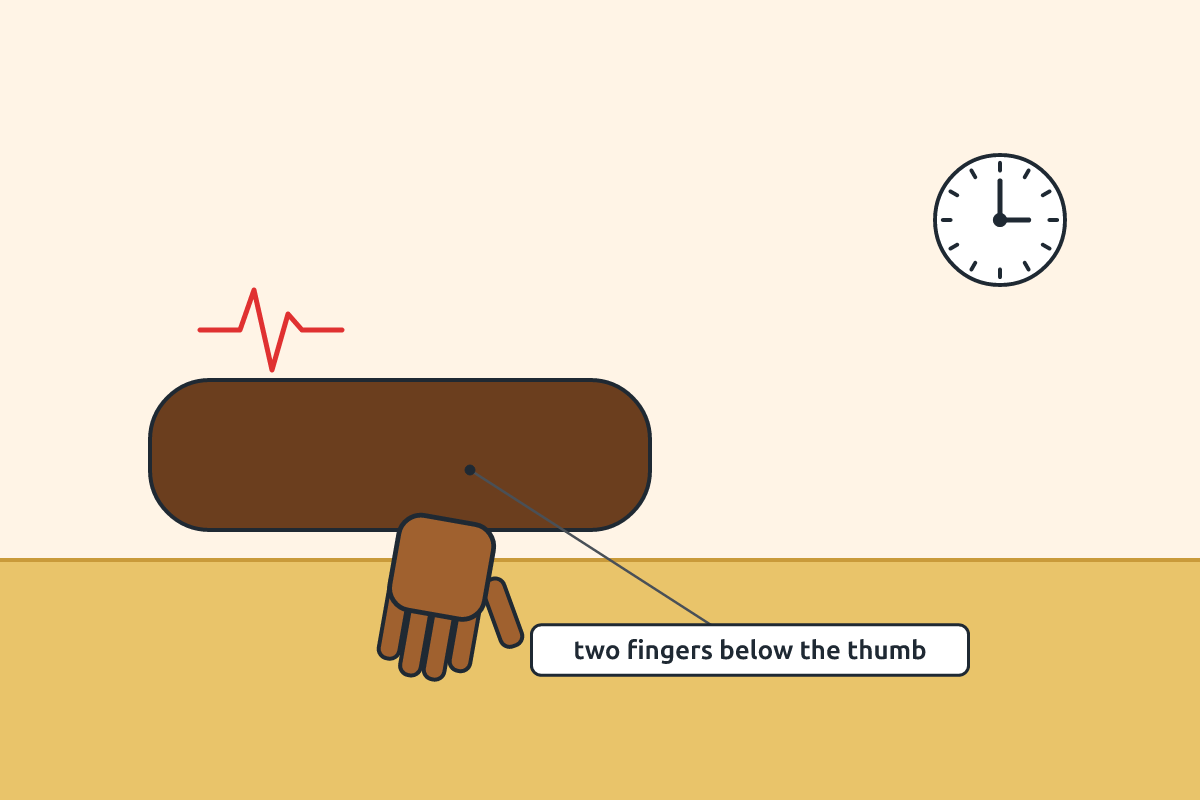
- Place your index and middle fingers (not your thumb) on the inside of your wrist below the thumb, or gently on the side of your neck.
- Press lightly until you feel the beat.
- Count the beats for 15 seconds using a clock or watch.
- Multiply by 4 to get beats per minute.
Example
Ama counts 22 beats in 15 seconds. What is her heart rate?
- Heart rate = 22 × 4
Answer: 88 beats per minute
3. Heart Rate and Intensity
| Situation | Approximate heart rate |
|---|---|
| resting (sitting quietly) | 70–100 bpm |
| light activity (walking) | 100–120 bpm |
| moderate activity (jogging) | 120–150 bpm |
| vigorous activity (sprinting) | 150–180 bpm |
A simple estimate of maximum heart rate is 220 minus your age. For a 10-year-old, this is about 210 bpm. For fitness, children should spend time at moderate to vigorous intensity, but never push to the maximum for long.
4. Monitoring During Activity
Measure your heart rate at rest, immediately after exercise and two minutes after stopping. The faster your heart returns to its resting rate (recovery), the fitter you are. As fitness improves, your resting heart rate becomes lower.
Safety: If your heart races and you feel dizzy, faint or have chest pain, stop and tell your teacher at once.
New words
- heart rate
- Heartbeats per minute.
- pulse
- The beat felt in arteries.
- bpm
- Beats per minute.
- intensity
- How hard you are working.
- resting heart rate
- Heart rate when sitting quietly.
- recovery
- Returning to resting rate after exercise.
Summary
- Heart rate is measured in beats per minute.
- Find the pulse at the wrist or neck with two fingers.
- Count for 15 seconds and multiply by 4.
- Higher heart rate shows higher intensity; fast recovery shows fitness.
Class activity: Pulse Record
- Measure your resting heart rate.
- Skip for one minute and measure again.
- Measure after two minutes of rest and record all three in a table.
You need: Skipping rope, Locally made ball, Personal activity record cards
Exercises
Answer in your exercise book first, then check your answers.
1. Where can you feel your pulse?
- A. Wrist
- B. Knee
- C. Elbow
- D. Toe
Show answer
Answer: WristRadial pulse.2. You count 25 beats in 15 seconds. Your heart rate is…
- A. 100 bpm
- B. 25 bpm
- C. 50 bpm
- D. 75 bpm
Show answer
Answer: 100 bpm25 × 4.3. Which fingers should you use to take a pulse?
- A. Index and middle
- B. Thumb only
- C. Little finger
- D. All five
Show answer
Answer: Index and middleThe thumb has its own pulse.4. Heart rate increases during exercise.
- A. True
- B. False
Show answer
Answer: TrueMuscles need more oxygen.5. A fit person's heart takes longer to recover.
- A. True
- B. False
Show answer
Answer: FalseFit people recover faster.6. Heart rate is measured in beats per ______.
Show answer
Answer: minutebpm.7. Explain how to calculate heart rate from a 15-second count.
Show answer
Answer: Count the beats for 15 seconds and multiply by 4.Gives bpm.8. Estimate the maximum heart rate of an 11-year-old.
Show answer
Answer: 220 − 11 = 209 bpm.Simple formula.
Homework
- Measure your resting heart rate each morning for five days and find the average.