Basic 5 · Physical Education · Strength
Pull-Ups for Upper-Body Strength
In this topic you will perform continuous pull-ups to build upper-body strength.
By the end of these notes you should be able to:
- Explain muscular strength
- Perform pull-ups with correct technique
- Use modified pull-ups to build strength
What you already know
- Fitness activities
Copy everything that has a blue line on its left into your notebook. The other parts are for reading.
- Strand
- Physical Fitness
- Sub-strand
- Strength
- Indicator
- B5.3.2.3.2 – Perform continuous pull-ups
Introduction
Climbing a tree, lifting a bucket of water and pulling yourself onto a wall all need upper-body strength. Pull-ups are a simple exercise to build it.
1. Muscular Strength
Muscular strength: The ability of a muscle to exert force against resistance.
Pull-ups strengthen the muscles of the back (latissimus dorsi), the arms (biceps) and the shoulders. Strong upper-body muscles help in climbing, throwing, swimming and gymnastics, and protect the body from injury.
2. Technique for a Pull-Up
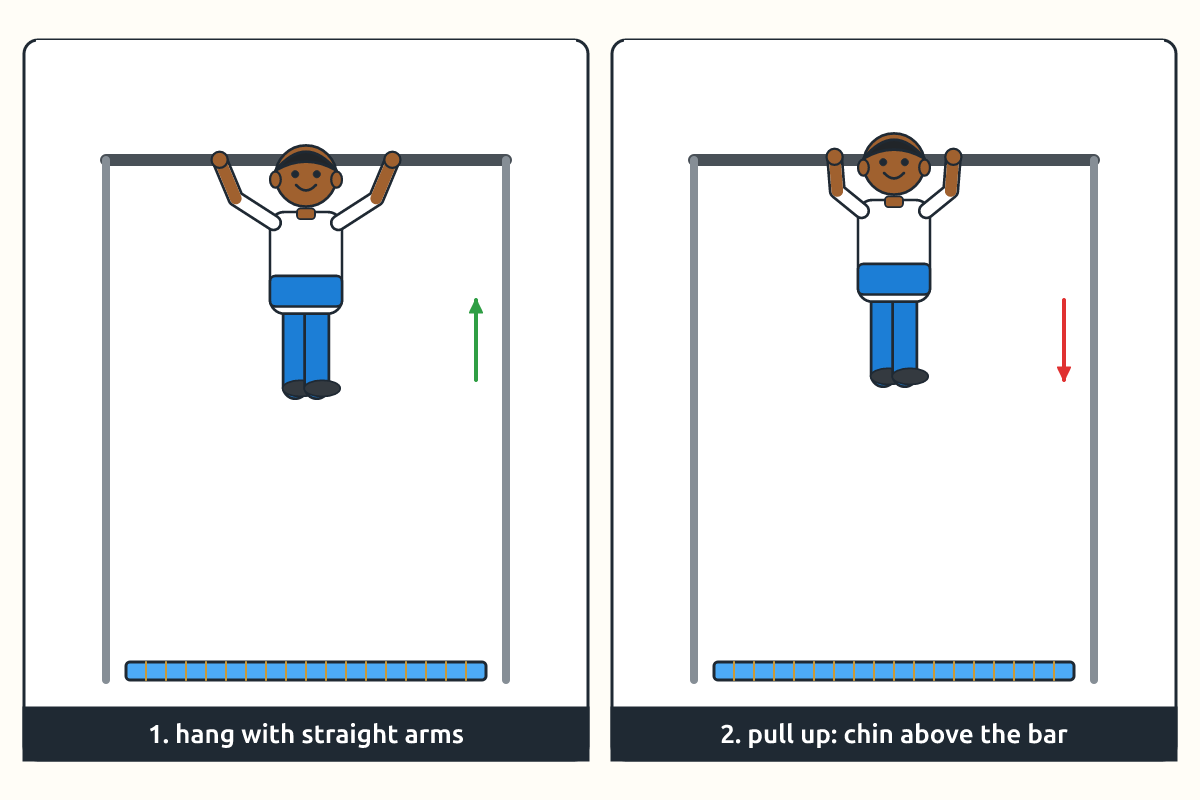
- Grip a secure bar with hands shoulder-width apart, palms facing away (overhand grip).
- Hang with arms straight and feet off the ground.
- Pull your body up until your chin is above the bar.
- Lower yourself slowly until your arms are straight again.
- Repeat without swinging or kicking.
3. Modified Pull-Ups
Many pupils cannot do a full pull-up at first. These easier versions build strength:
| Exercise | How to do it |
|---|---|
| flexed-arm hang | hold yourself with your chin above the bar for as long as possible |
| negative pull-up | jump to the top position and lower yourself slowly (3–5 seconds) |
| low-bar (inclined) pull-up | lie under a low bar with feet on the ground and pull your chest to the bar |
| partner-assisted pull-up | a partner supports your feet or legs to help you up |
4. Recording Progress
Count how many pull-ups (or seconds of flexed-arm hang) you can do with good form. Record the number each week. Rest one to two minutes between sets. Your muscles grow stronger when you exercise and then rest.
Safety: Use a strong, secure bar that does not move. Place a mat below. Do not swing or drop suddenly. Dry your hands to avoid slipping.
New words
- muscular strength
- A muscle's ability to exert force.
- resistance
- A force a muscle works against.
- overhand grip
- Holding the bar with palms facing away.
- repetition
- One complete movement of an exercise.
- set
- A group of repetitions.
- modified
- Changed to make easier.
Summary
- Pull-ups build back, arm and shoulder strength.
- Pull until the chin is above the bar, then lower slowly.
- Use modified pull-ups to build strength.
- Use a secure bar and a mat; record progress weekly.
Class activity: Strength Stations
- Rotate through flexed-arm hang, negative pull-ups and low-bar pull-ups.
- Do two sets at each station.
- Record your best result.
You need: Low secure horizontal bar, Woven safety mat, Pull-up count cards
Exercises
Answer in your exercise book first, then check your answers.
1. Pull-ups mainly strengthen the…
- A. upper body
- B. toes
- C. ears
- D. eyes
Show answer
Answer: upper bodyBack, arms and shoulders.2. In a full pull-up, pull until your…
- A. chin is above the bar
- B. feet touch the bar
- C. head hits the bar
- D. knees reach the bar
Show answer
Answer: chin is above the barThat is a full repetition.3. Holding the bar with palms facing away is the…
- A. overhand grip
- B. underhand grip
- C. fist grip
- D. no grip
Show answer
Answer: overhand gripStandard pull-up grip.4. A mat should be placed under the bar.
- A. True
- B. False
Show answer
Answer: TrueFor safety.5. Swinging and kicking make a pull-up correct.
- A. True
- B. False
Show answer
Answer: FalseUse controlled movement.6. One complete movement of an exercise is a ______.
Show answer
Answer: repetitionSeveral make a set.7. Describe two modified pull-ups.
Show answer
Answer: Flexed-arm hang and negative pull-ups (or low-bar, assisted).Any two.8. Why should you rest between sets?
Show answer
Answer: Muscles need time to recover so they can work again with good form and grow stronger.Recovery.
Homework
- Do a flexed-arm hang (on a safe bar or tree branch with an adult) and record your time.