Basic 5 · Mathematics · Number Operations
Mental Strategies for Multiplication and Division Facts
In this topic you will use mental strategies to recall multiplication facts to 81 and the related division facts.
By the end of these notes you should be able to:
- Recall multiplication facts up to 9 × 9 = 81
- Use strategies such as doubling and the nines trick
- Use fact families to find division facts
What you already know
- Mental strategies for multiplication (Basic 4)
Copy everything that has a blue line on its left into your notebook. The other parts are for reading.
- Strand
- Number
- Sub-strand
- Number Operations
- Indicator
- B5.1.2.1.1 – Apply mental mathematics strategies to determine answers for basic multiplication facts to 81 and related division facts
Introduction
A seller who knows that 7 × 8 = 56 can quickly tell that 56 sweets shared among 8 children gives 7 each. Multiplication and division are closely linked.
1. Fact Families
One multiplication fact gives four facts.
| Multiplication | Division |
|---|---|
| 6 × 9 = 54 | 54 ÷ 9 = 6 |
| 9 × 6 = 54 | 54 ÷ 6 = 9 |
2. Mental Strategies
| Strategy | Example | Working |
|---|---|---|
| doubling | 4 × 7 | double 2 × 7 = 14 → 28 |
| double and double again (×4) | 4 × 9 | 9 → 18 → 36 |
| use a known fact | 6 × 7 | 5 × 7 = 35, plus 7 = 42 |
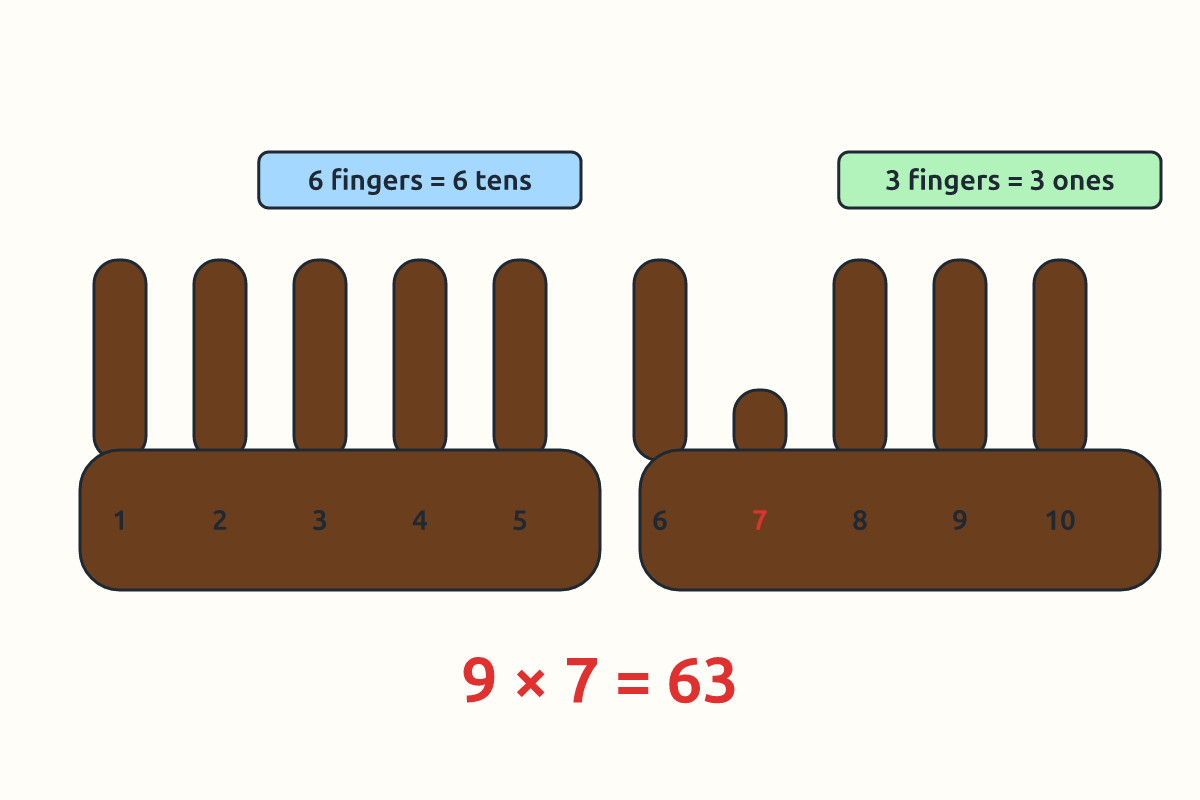
| nines trick | 9 × 7 | 10 × 7 = 70, minus 7 = 63 |
| square facts | 8 × 8 | 64 (learn by heart) |
3. Division by Thinking Multiplication
Example 1
72 ÷ 8 = ?
- Think: 8 × ? = 72
- 8 × 9 = 72
Answer: 72 ÷ 8 = 9
Example 2
A trader shares 63 oranges equally among 7 baskets. How many in each?
- Think: 7 × ? = 63
- 7 × 9 = 63
Answer: 9 oranges in each basket
Remember: Square numbers up to 81: 1, 4, 9, 16, 25, 36, 49, 64, 81.
4. Building a Forgotten Fact
Knowing the facts by heart saves time in every other topic, because long multiplication, division, fractions and money all depend on them. When you forget a fact, build it from one you know. If you know 5 × 8 = 40, then 6 × 8 is one more eight: 40 + 8 = 48. If you know 2 × 7 = 14, then 4 × 7 is double that (28) and 8 × 7 is double again (56). Practise a few facts each day until you can answer each one in under three seconds.
New words
- fact family
- Related multiplication and division facts.
- inverse
- The opposite operation; division undoes multiplication.
- quotient
- The answer to a division.
- product
- The answer to a multiplication.
- square number
- A number multiplied by itself.
- mental
- Done in the head.
Summary
- Each multiplication fact has related division facts.
- Doubling, known facts and the nines trick help recall.
- Divide by thinking of the missing factor.
- Learn the square numbers up to 81.
Class activity: Fact Family Cards
- Pick a multiplication card, e.g. 7 × 6.
- Write all four facts in the family.
- Quiz your partner with the division facts.
You need: Bottle tops, Bundles of sticks, Exercise books
Exercises
Answer in your exercise book first, then check your answers.
1. 7 × 8 = ?
- A. 56
- B. 54
- C. 48
- D. 63
Show answer
Answer: 56Seven eights are 56.2. 63 ÷ 9 = ?
- A. 7
- B. 6
- C. 8
- D. 9
Show answer
Answer: 79 × 7 = 63.3. Which uses the nines trick for 9 × 6?
- A. 60 − 6 = 54
- B. 6 + 9 = 15
- C. 9 − 6 = 3
- D. 90 − 6 = 84
Show answer
Answer: 60 − 6 = 5410 × 6 − 6.4. 81 is a square number.
- A. True
- B. False
Show answer
Answer: True9 × 9 = 81.5. 48 ÷ 6 = 9
- A. True
- B. False
Show answer
Answer: False48 ÷ 6 = 8.6. 6 × 9 = 54, so 54 ÷ 9 = ______
Show answer
Answer: 6Inverse of multiplication.7. Write the fact family for 4, 8 and 32.
Show answer
Answer: 4 × 8 = 32, 8 × 4 = 32, 32 ÷ 8 = 4, 32 ÷ 4 = 8Four related facts.8. Use a known fact to find 7 × 7 if you know 7 × 6 = 42.
Show answer
Answer: 7 × 7 = 42 + 7 = 49Add one more group of 7.
Homework
- Practise the 6, 7, 8 and 9 times tables with a family member.