Basic 5 · Mathematics · Counting, Representation and Cardinality
Factors, Multiples and Their Relationship
In this topic you will explore the relationship between factors and multiples, and find common factors, the HCF and the LCM.
By the end of these notes you should be able to:
- Explain how factors and multiples are related
- Find the highest common factor (HCF) of two numbers
- Find the lowest common multiple (LCM) of two numbers
What you already know
- Prime and composite numbers
Copy everything that has a blue line on its left into your notebook. The other parts are for reading.
- Strand
- Number
- Sub-strand
- Counting, Representation and Cardinality
- Indicator
- B5.1.1.3.4 – Recognise the relationship between factors and multiples of whole numbers from 1 to 100
Introduction
4 × 6 = 24. This one fact tells us two things: 4 and 6 are factors of 24, and 24 is a multiple of both 4 and 6. Factors and multiples are two sides of the same coin.
1. The Relationship
If a is a factor of b, then b is a multiple of a.
| Fact | Factor statement | Multiple statement |
|---|---|---|
| 3 × 8 = 24 | 3 and 8 are factors of 24 | 24 is a multiple of 3 and of 8 |
| 5 × 9 = 45 | 5 and 9 are factors of 45 | 45 is a multiple of 5 and of 9 |
2. Highest Common Factor (HCF)
HCF: The largest number that is a factor of two or more numbers.
Example 1
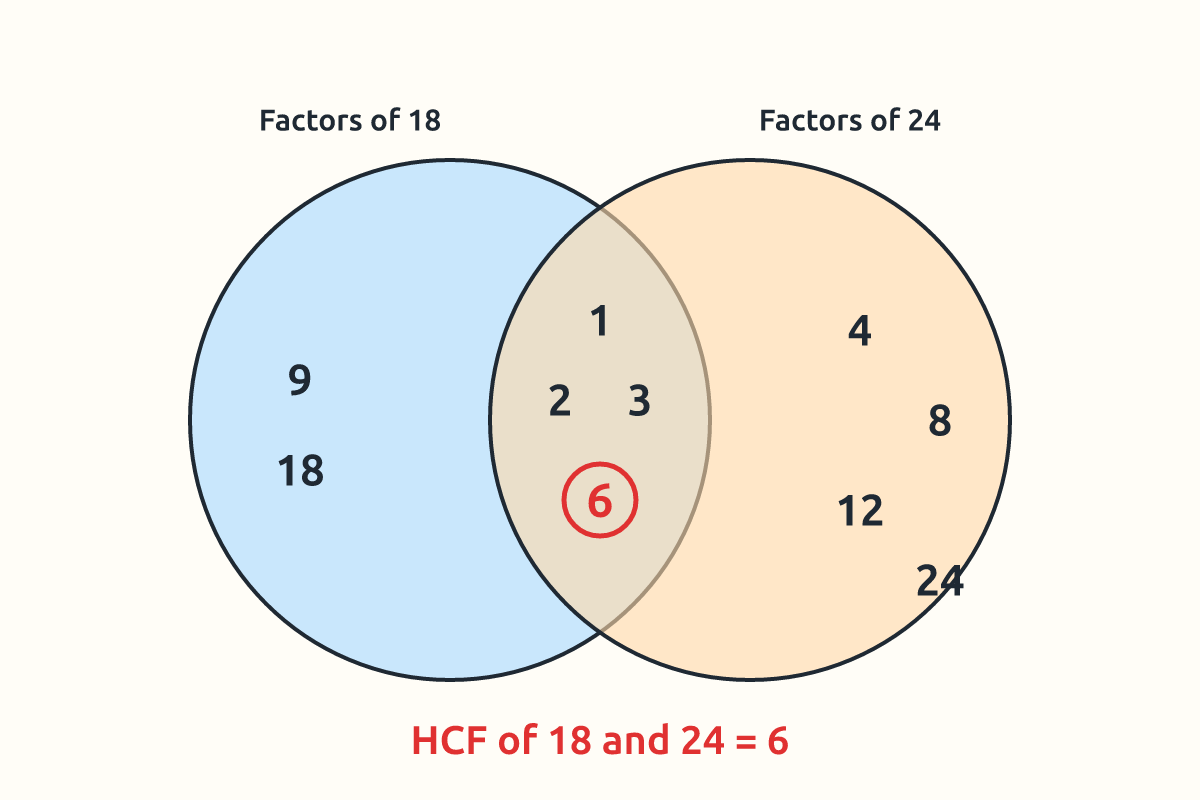
Find the HCF of 18 and 24.
- Factors of 18: 1, 2, 3, 6, 9, 18
- Factors of 24: 1, 2, 3, 4, 6, 8, 12, 24
- Common factors: 1, 2, 3, 6
Answer: HCF = 6
3. Lowest Common Multiple (LCM)
LCM: The smallest number that is a multiple of two or more numbers.
Example 2
Find the LCM of 6 and 8.
- Multiples of 6: 6, 12, 18, 24, 30 …
- Multiples of 8: 8, 16, 24, 32 …
Answer: LCM = 24
4. Using HCF and LCM
| Problem type | Use |
|---|---|
| sharing into the largest equal groups | HCF |
| when events happen together again | LCM |
Example 3
Two buses leave a station every 12 and 15 minutes. If they leave together at 7:00 a.m., when will they next leave together?
- LCM of 12 and 15: multiples of 15 are 15, 30, 45, 60; 60 ÷ 12 = 5.
- LCM = 60 minutes.
Answer: They leave together again at 8:00 a.m.
New words
- factor
- A number that divides another exactly.
- multiple
- A number in another number's times table.
- common factor
- A factor shared by two or more numbers.
- HCF
- Highest common factor.
- LCM
- Lowest common multiple.
- Venn diagram
- Overlapping circles that show shared items.
Summary
- If a is a factor of b, then b is a multiple of a.
- The HCF is the largest shared factor.
- The LCM is the smallest shared multiple.
- HCF helps with sharing; LCM helps with events that repeat together.
Class activity: Factor and Multiple Hunt
- Choose two numbers below 50.
- List their factors and find the HCF.
- List their multiples and find the LCM.
You need: Bottle tops, Locally made number cards, Exercise books
Exercises
Answer in your exercise book first, then check your answers.
1. Which statement is true?
- A. 7 is a factor of 35
- B. 35 is a factor of 7
- C. 7 is a multiple of 35
- D. 35 has no factors
Show answer
Answer: 7 is a factor of 357 × 5 = 35.2. What is the HCF of 12 and 20?
- A. 4
- B. 2
- C. 60
- D. 12
Show answer
Answer: 4Common factors are 1, 2, 4.3. What is the LCM of 4 and 10?
- A. 20
- B. 40
- C. 2
- D. 14
Show answer
Answer: 2020 is the first common multiple.4. 48 is a multiple of 8.
- A. True
- B. False
Show answer
Answer: True8 × 6 = 48.5. The HCF of 9 and 16 is 3.
- A. True
- B. False
Show answer
Answer: FalseTheir only common factor is 1.6. The largest factor shared by two numbers is the ______.
Show answer
Answer: HCFHighest common factor.7. Find the HCF and LCM of 15 and 25.
Show answer
Answer: HCF = 5; LCM = 75Factors and multiples lists.8. A teacher has 24 pencils and 36 erasers. She wants to make identical packs with no items left over. What is the greatest number of packs she can make?
Show answer
Answer: 12 packsHCF of 24 and 36 is 12.
Homework
- Find the HCF and LCM of 16 and 40. Show your lists.