Basic 5 · Mathematics · Counting, Representation and Cardinality
Prime and Composite Numbers
In this topic you will generate and identify prime and composite numbers between 1 and 100.
By the end of these notes you should be able to:
- Define prime and composite numbers
- Use the Sieve of Eratosthenes to find primes up to 100
- Classify numbers as prime or composite
What you already know
- Factors (Basic 4)
Copy everything that has a blue line on its left into your notebook. The other parts are for reading.
- Strand
- Number
- Sub-strand
- Counting, Representation and Cardinality
- Indicator
- B5.1.1.3.1 – Generate and identify prime numbers and composite numbers between 1 and 100
Introduction
Some numbers can only be divided exactly by 1 and themselves. These special numbers are called prime numbers. Mathematicians have studied them for over 2,000 years.
1. Definitions
Prime number: A whole number greater than 1 with exactly two factors: 1 and itself.
Composite number: A whole number greater than 1 with more than two factors.
| Number | Factors | Type |
|---|---|---|
| 7 | 1, 7 | prime |
| 9 | 1, 3, 9 | composite |
| 13 | 1, 13 | prime |
| 15 | 1, 3, 5, 15 | composite |
| 1 | 1 | neither |
Remember: 1 is neither prime nor composite because it has only one factor. 2 is the only even prime number.
2. The Sieve of Eratosthenes
Eratosthenes was a Greek mathematician who invented a quick way to find primes.
- Write the numbers 1 to 100 in a 10 × 10 grid.
- Cross out 1.
- Circle 2, then cross out all other multiples of 2.
- Circle 3, then cross out all other multiples of 3.
- Circle 5 and 7 and cross out their other multiples.
- All the numbers left are prime.
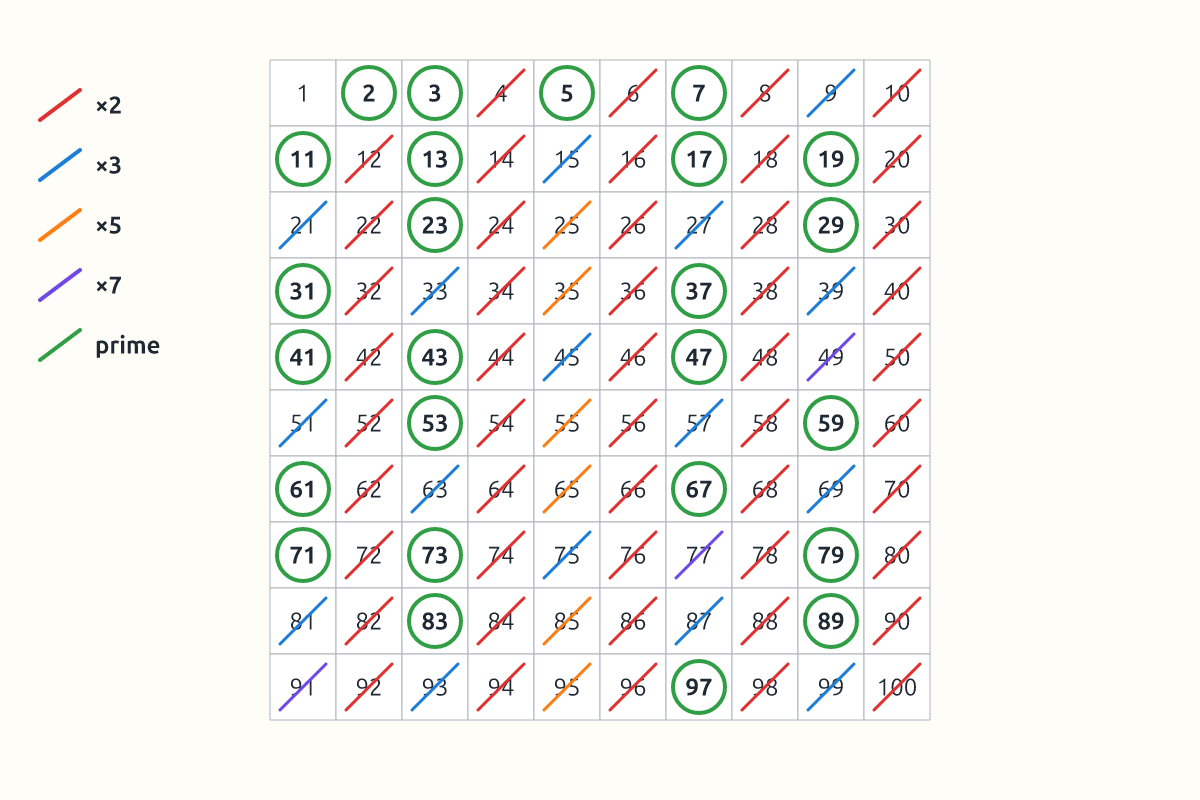
3. The Primes up to 100
2, 3, 5, 7, 11, 13, 17, 19, 23, 29, 31, 37, 41, 43, 47, 53, 59, 61, 67, 71, 73, 79, 83, 89, 97
There are 25 prime numbers between 1 and 100.
Tip: To test if a number under 100 is prime, check whether 2, 3, 5 or 7 divides it exactly. If none does, it is prime.
Example
Is 91 prime?
- 91 ÷ 2: no. 91 ÷ 3: no (9 + 1 = 10, not a multiple of 3). 91 ÷ 5: no.
- 91 ÷ 7 = 13 exactly.
Answer: 91 is composite (7 × 13).
New words
- prime number
- A number with exactly two factors.
- composite number
- A number with more than two factors.
- factor
- A number that divides exactly into another.
- multiple
- The result of multiplying a number by a whole number.
- sieve
- A method for separating some numbers from others.
- divisible
- Able to be divided exactly.
Summary
- A prime number has exactly two factors: 1 and itself.
- A composite number has more than two factors.
- 1 is neither prime nor composite; 2 is the only even prime.
- There are 25 primes below 100.
Class activity: Sieve Race
- Write 1 to 100 on a grid sheet.
- Use the Sieve of Eratosthenes with different colours.
- Count your primes and check that you have 25.
You need: Bottle tops, Locally made number cards, Exercise books
Exercises
Answer in your exercise book first, then check your answers.
1. Which is a prime number?
- A. 17
- B. 21
- C. 27
- D. 33
Show answer
Answer: 17Its only factors are 1 and 17.2. Which is a composite number?
- A. 51
- B. 53
- C. 59
- D. 61
Show answer
Answer: 5151 = 3 × 17.3. How many prime numbers are there between 1 and 100?
- A. 25
- B. 20
- C. 30
- D. 50
Show answer
Answer: 25Counted with the sieve.4. 2 is a prime number.
- A. True
- B. False
Show answer
Answer: TrueIts factors are 1 and 2.5. 1 is a prime number.
- A. True
- B. False
Show answer
Answer: FalseIt has only one factor.6. A number with more than two factors is a ______ number.
Show answer
Answer: compositeThat is composite.7. List the prime numbers between 40 and 60.
Show answer
Answer: 41, 43, 47, 53, 59Check divisibility by 2, 3, 5, 7.8. Is 87 prime or composite? Explain.
Show answer
Answer: Composite, because 87 = 3 × 29 (8 + 7 = 15 is a multiple of 3).It has factors other than 1 and 87.
Homework
- Find all the composite numbers between 80 and 90 and write their factors.