Basic 5 · Mathematics · Number Operations
Multiplying by 2-Digit Numbers
In this topic you will multiply multi-digit numbers by 2-digit numbers using the grid and column (long multiplication) methods.
By the end of these notes you should be able to:
- Multiply using the grid (area) method
- Multiply using long multiplication
- Solve word problems involving multiplication
What you already know
- Mental strategies for multiplication and division
Copy everything that has a blue line on its left into your notebook. The other parts are for reading.
- Strand
- Number
- Sub-strand
- Number Operations
- Indicator
- B5.1.2.2.1 – Multiply multi-digit numbers by 2-digit numbers efficiently
Introduction
A school buys 27 boxes of chalk with 346 sticks in each. How many sticks is that? We need to multiply a 3-digit number by a 2-digit number.
1. The Grid Method
Split each number into place values, multiply each part, then add.
Example 1
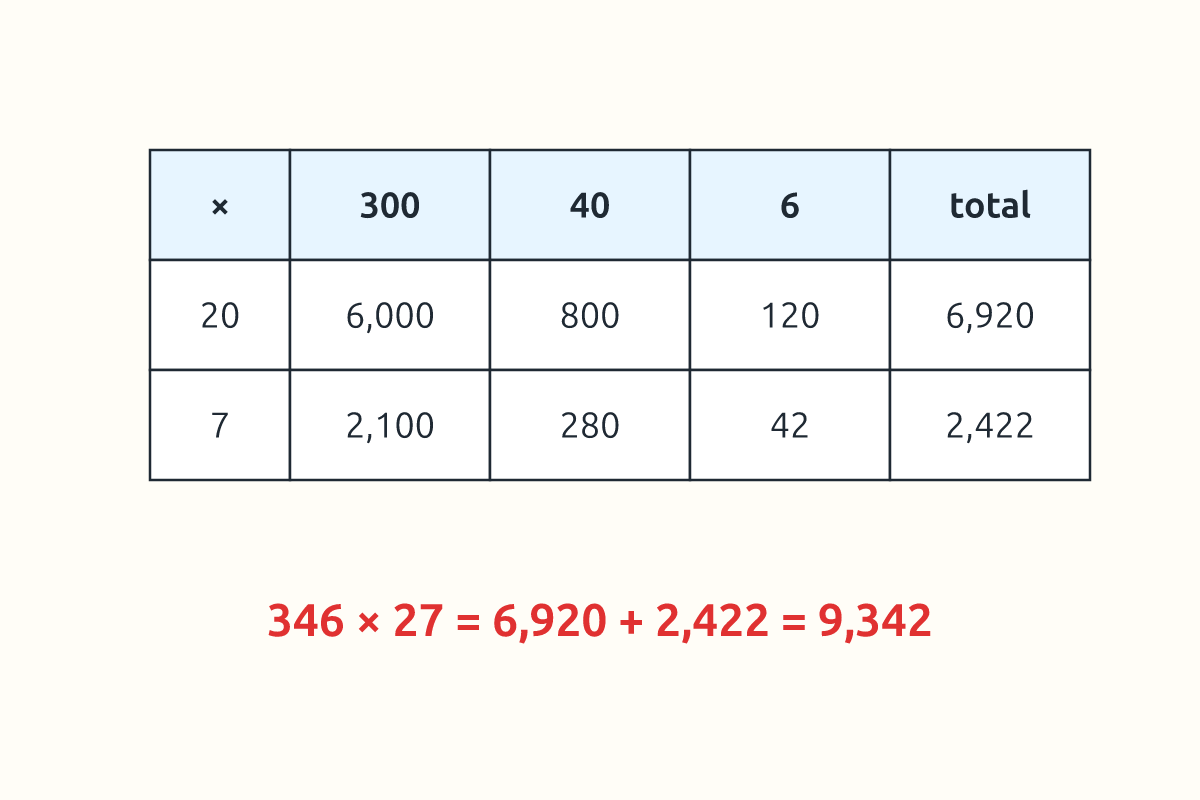
346 × 27 using the grid method.
- 300 × 20 = 6,000; 40 × 20 = 800; 6 × 20 = 120 → 6,920
- 300 × 7 = 2,100; 40 × 7 = 280; 6 × 7 = 42 → 2,422
- 6,920 + 2,422 = 9,342
Answer: 346 × 27 = 9,342
2. Long Multiplication (Column Method)
- Multiply the top number by the ones digit of the bottom number.
- Write a 0 in the ones place, then multiply by the tens digit.
- Add the two rows.
Example 2
346 × 27 in columns.
- 346 × 7 = 2,422
- 346 × 20 = 6,920 (write 0, then 346 × 2 = 692)
- 2,422 + 6,920 = 9,342
Answer: 9,342 sticks of chalk
| 3 | 4 | 6 | |
|---|---|---|---|
| × | 2 | 7 | |
| 2 4 | 2 | 2 | |
| + 6 | 9 | 2 | 0 |
| = 9 | 3 | 4 | 2 |
Line up the place values carefully. The zero in the second row shows we are multiplying by tens.
3. Estimating to Check
346 × 27 is about 350 × 30 = 10,500, so 9,342 is reasonable.
Common mistake: Forgetting the zero when multiplying by the tens digit makes the answer ten times too small.
4. Multiplying a 4-Digit Number
Example 3
1,205 × 34 = ?
- 1,205 × 4 = 4,820
- 1,205 × 30 = 36,150
- 4,820 + 36,150 = 40,970
Answer: 1,205 × 34 = 40,970
The steps are the same however long the top number is. Multiply every digit of the top number by the ones digit, then by the tens digit, carrying where needed, and add the two rows. Check with an estimate: 1,200 × 34 is a little more than 1,200 × 30 = 36,000, so 40,970 is sensible.
New words
- product
- The answer to a multiplication.
- grid method
- Multiplying parts in a grid and adding.
- long multiplication
- Multiplying in columns, one digit at a time.
- partial product
- The result of multiplying by one part.
- estimate
- A close, rounded answer.
- place holder
- A zero that holds a place.
Summary
- The grid method splits numbers into place values.
- Long multiplication multiplies by the ones, then the tens.
- Add a zero when multiplying by the tens digit.
- Estimate to check your answer.
Class activity: Multiplication Challenge
- Each partner solves 258 × 43, one with the grid method and one with long multiplication.
- Compare answers.
- Estimate to check if the answer is reasonable.
You need: Bottle tops, Bundles of sticks, Exercise books
Exercises
Answer in your exercise book first, then check your answers.
1. 23 × 10 = ?
- A. 230
- B. 23
- C. 2,300
- D. 33
Show answer
Answer: 230Multiplying by 10 adds a zero.2. 125 × 12 = ?
- A. 1,500
- B. 1,250
- C. 1,350
- D. 1,512
Show answer
Answer: 1,500125 × 10 + 125 × 2 = 1,250 + 250.3. Which is the best estimate for 412 × 19?
- A. 8,000
- B. 800
- C. 80,000
- D. 4,000
Show answer
Answer: 8,000400 × 20 = 8,000.4. When multiplying by the tens digit, we write a zero first.
- A. True
- B. False
Show answer
Answer: TrueIt holds the ones place.5. 214 × 31 = 6,534
- A. True
- B. False
Show answer
Answer: False214 × 31 = 6,634.6. 40 × 30 = ______
Show answer
Answer: 1,2004 × 3 = 12, add two zeros.7. Work out 156 × 24.
Show answer
Answer: 3,744156 × 20 = 3,120; 156 × 4 = 624.8. A bus carries 48 passengers. How many passengers can 235 buses carry?
Show answer
Answer: 11,280 passengers235 × 48 = 9,400 + 1,880.
Homework
- Work out 307 × 26 and 528 × 15. Check by estimating.