Basic 5 · History · The People of Ghana
How Our Ancestors Lived: Work, Crafts and Trade
In this topic you will learn about the occupations, crafts and trade of our ancestors before the 15th century.
By the end of these notes you should be able to:
- Describe the main occupations of our ancestors
- Explain how iron-working changed their lives
- Describe early trade in Ghana
What you already know
- The Stone Age
Copy everything that has a blue line on its left into your notebook. The other parts are for reading.
- Strand
- My Country Ghana
- Sub-strand
- The People of Ghana
- Indicator
- B5.2.1.1.1 – Describe how our ancestors lived in ancient times (before the 15th century) and compare it with how we live today
Introduction
Before the Europeans came, our ancestors were skilled farmers, iron-workers, weavers, potters and traders. They built kingdoms and towns and traded with people across the Sahara Desert.
1. Farming, Hunting and Fishing
Most people were farmers. They cleared land with iron cutlasses and hoes, and grew yam, millet, sorghum, cowpea, oil palm and kola. Farmers in the north kept cattle, sheep and goats. People along the coast and the Volta River were fishermen who used canoes and nets. Hunting continued and provided meat and animal skins.
2. The Iron Age
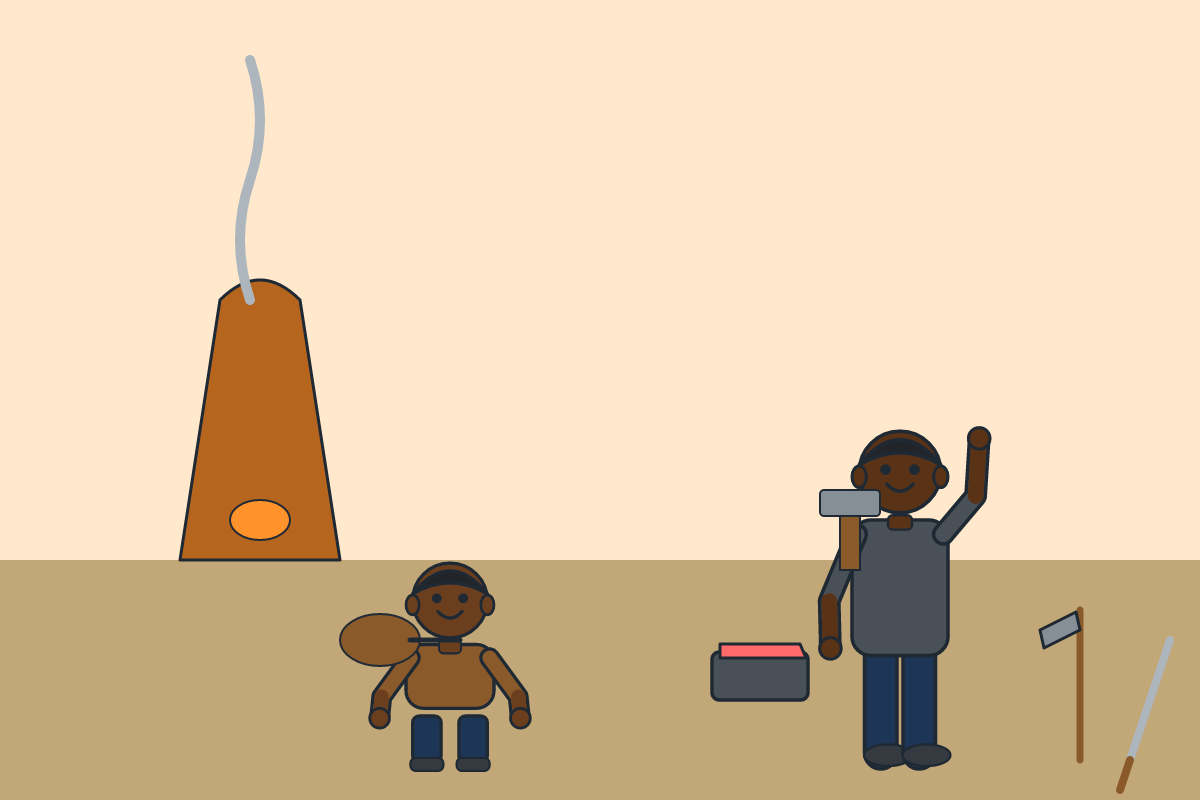
Iron-working came to Ghana more than 2,000 years ago. Smelters heated iron ore with charcoal in clay furnaces to get iron. Blacksmiths then shaped the hot iron into hoes, cutlasses, axes, knives, arrowheads and spears. Iron tools were much stronger than stone tools, so people could clear forests, farm more land and hunt better. Blacksmiths were respected and important in society.
3. Crafts
| Craft | Products |
|---|---|
| pottery | cooking pots, water pots, bowls |
| weaving | cloth from cotton and bark; baskets and mats from raffia |
| wood carving | stools, drums, mortars and pestles |
| goldsmithing | gold ornaments and gold weights |
| leatherwork | bags, sandals and sheaths |
4. Trade
People traded in local markets, exchanging goods by barter, which means swapping one item for another. Later, cowrie shells and gold dust were used as money. Traders called the Wangara (Mande traders) came from the north to buy gold and kola nuts from the forest areas. They brought salt, cloth, copper and horses from across the Sahara Desert. This was called the trans-Saharan trade. Towns grew up along the trade routes.
| Goods from Ghana's forests | Goods from the north |
|---|---|
| gold | salt |
| kola nuts | cloth |
| ivory | copper and brass |
| slaves (in small numbers) | horses, beads |
Trade brought more than goods. Northern traders brought Islam and the Arabic script, and some forest and savannah towns had Muslim scholars who kept records. New crops, cloth styles and ideas spread along the routes. Rulers who controlled trade routes and gold fields grew rich and powerful, and they used this wealth to build strong states such as Bono and, later, Asante.
New words
- occupation
- The work a person does to earn a living.
- smelting
- Heating ore to get metal out of it.
- blacksmith
- A person who makes things from iron.
- barter
- Exchanging goods without using money.
- cowrie
- A small shell once used as money.
- trans-Saharan trade
- Trade across the Sahara Desert.
Summary
- Our ancestors were farmers, fishermen, hunters and craftsmen.
- Iron tools made farming and hunting easier.
- Pottery, weaving, carving and goldsmithing were important crafts.
- Gold and kola were traded north for salt, cloth and horses.
Class activity: Market Day
- Set up a pretend ancient market with drawings of goods.
- Trade by barter with other groups.
- Discuss the problems of barter and why money was later used.
You need: Clay pot, Calabash, Printed photographs of ancient Ghanaian settlements, Ghana map
Exercises
Answer in your exercise book first, then check your answers.
1. What did early people use as money?
- A. Cowrie shells
- B. Paper notes
- C. Coins with pictures
- D. Mobile money
Show answer
Answer: Cowrie shellsGold dust was also used.2. Which metal tools made farming easier?
- A. Iron tools
- B. Stone tools
- C. Plastic tools
- D. Glass tools
Show answer
Answer: Iron toolsThey were stronger.3. Which goods did traders bring from the north?
- A. Salt and cloth
- B. Gold and kola
- C. Cocoa and timber
- D. Cars and phones
Show answer
Answer: Salt and clothIn exchange for gold and kola.4. Barter means exchanging goods without money.
- A. True
- B. False
Show answer
Answer: TrueGoods are swapped.5. Cocoa was the main export of ancient Ghana.
- A. True
- B. False
Show answer
Answer: FalseGold and kola were; cocoa came much later.6. Heating ore to get iron out is called ______.
Show answer
Answer: smeltingDone in clay furnaces.7. Name three crafts practised by our ancestors.
Show answer
Answer: Pottery, weaving and wood carving (or goldsmithing, leatherwork).Any three.8. Explain how the trans-Saharan trade led to the growth of towns.
Show answer
Answer: Traders stopped at places along the routes to buy and sell, so markets, homes and services grew into towns.Trade attracts people.
Homework
- Find one craft still practised in your community. Describe how it is done.