Basic 5 · History · The People of Ghana
How Our Ancestors Lived: The Stone Age
In this topic you will learn how the earliest people in Ghana lived as hunters and gatherers and later as the first farmers.
By the end of these notes you should be able to:
- Describe the life of early hunters and gatherers in Ghana
- Name the tools early people used
- Explain how archaeologists know about ancient times
What you already know
- Our ancestors (Basic 4)
Copy everything that has a blue line on its left into your notebook. The other parts are for reading.
- Strand
- My Country Ghana
- Sub-strand
- The People of Ghana
- Indicator
- B5.2.1.1.1 – Describe how our ancestors lived in ancient times (before the 15th century) and compare it with how we live today
Introduction
Thousands of years ago, there were no towns, schools, roads or shops in the land we now call Ghana. People lived in small groups, moved from place to place and made their tools from stone.
1. How Do We Know About the Past?
People in ancient Ghana did not write books. We learn about them from archaeology, oral traditions and comparisons with how some people live today. Archaeologists dig carefully into the ground to find objects left by early people, such as stone tools, pieces of pottery, bones and the remains of houses. These objects are called artefacts. Oral traditions are stories, songs and proverbs passed down by word of mouth from elders to children.
2. Hunters and Gatherers
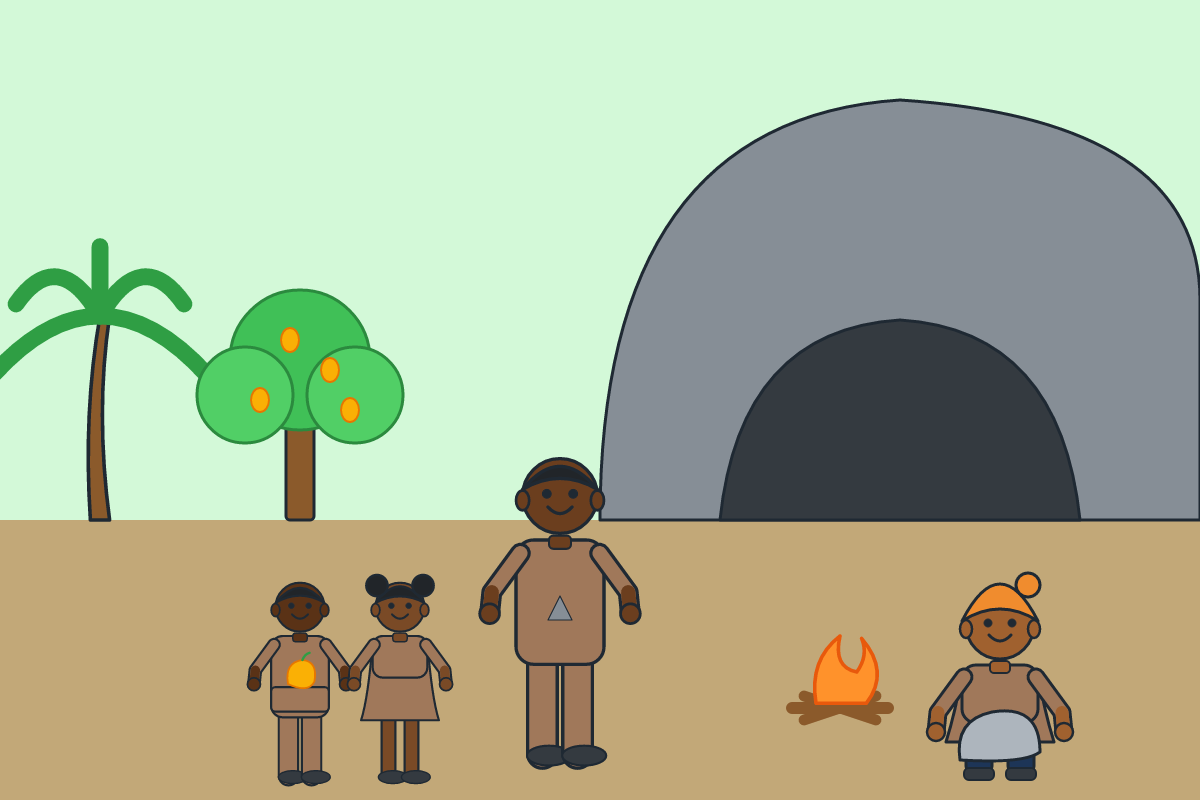
The earliest people were hunters and gatherers. Men hunted animals such as antelopes and grasscutters with stone-tipped spears, bows and arrows. Women and children gathered wild fruits, nuts, roots, snails and honey. People moved from place to place following animals and the seasons. They lived in caves and rock shelters or in simple huts made of sticks and leaves.
| Need | How it was met |
|---|---|
| food | hunting, fishing and gathering wild plants |
| shelter | caves, rock shelters, huts of sticks and leaves |
| clothing | animal skins and bark cloth |
| tools | stone axes, scrapers, spear points and grinding stones |
| fire | rubbing sticks or striking stones to make sparks |
3. The First Farmers: The Kintampo Culture
About 4,000 years ago, people in central Ghana began to settle in one place. Archaeologists call them the Kintampo culture, after the town of Kintampo in the Bono East Region where their remains were first studied. They kept goats and cattle, grew crops such as yam and cowpea, made clay pots and polished stone tools, and built houses with mud walls. Settling down allowed villages to grow, because people no longer needed to move to find food.
Did you know?: Small polished stone objects called "terracotta cigars" or stone rasps are found at Kintampo sites. Archaeologists still discuss what they were used for.
New words
- ancestors
- People in our family who lived long ago.
- Stone Age
- The time when people made tools mainly from stone.
- hunter-gatherer
- A person who gets food by hunting and collecting wild plants.
- archaeologist
- A person who studies the past by digging up remains.
- artefact
- An object made and used by people in the past.
- oral tradition
- History passed down by word of mouth.
Summary
- We learn about ancient Ghana from archaeology and oral traditions.
- The earliest people were hunters and gatherers who used stone tools.
- About 4,000 years ago, the Kintampo people began farming and settling.
- Settling down allowed villages to grow.
Class activity: Artefact Detectives
- Your teacher shows pictures of stone tools, pots and grinding stones.
- Guess what each artefact was used for.
- Write a sentence describing how people used it.
You need: Clay pot, Calabash, Printed photographs of ancient Ghanaian settlements, Ghana map
Exercises
Answer in your exercise book first, then check your answers.
1. Who studies the past by digging up old objects?
- A. Archaeologist
- B. Doctor
- C. Farmer
- D. Pilot
Show answer
Answer: ArchaeologistThey study artefacts.2. Early people who moved about to find food were…
- A. hunters and gatherers
- B. traders
- C. teachers
- D. miners
Show answer
Answer: hunters and gatherersThey hunted and collected wild food.3. The Kintampo culture is known for…
- A. early farming and settlement
- B. building castles
- C. writing books
- D. using cars
Show answer
Answer: early farming and settlementAbout 4,000 years ago.4. Early people used tools made of stone.
- A. True
- B. False
Show answer
Answer: TrueThat is why it is called the Stone Age.5. Oral traditions are written in books.
- A. True
- B. False
Show answer
Answer: FalseThey are passed down by word of mouth.6. An object made and used by people in the past is an ______.
Show answer
Answer: artefactFound by archaeologists.7. Name two ways archaeologists learn about the past.
Show answer
Answer: Digging up artefacts and studying remains of houses (or bones, pottery).Any two.8. Explain why farming allowed people to settle in one place.
Show answer
Answer: Growing crops and keeping animals gave a steady food supply, so people did not need to move to find food.Settlement followed farming.
Homework
- Ask an elder to tell you an oral tradition about where your people came from. Write it down.