Basic 5 · History · The People of Ghana
Life Then and Now
In this topic you will compare how our ancestors lived in ancient times with how we live today.
By the end of these notes you should be able to:
- Compare housing, food, clothing and transport in the past and today
- Explain the causes of change
- Identify traditions we still keep
What you already know
- Work, crafts and trade of our ancestors
Copy everything that has a blue line on its left into your notebook. The other parts are for reading.
- Strand
- My Country Ghana
- Sub-strand
- The People of Ghana
- Indicator
- B5.2.1.1.1 – Describe how our ancestors lived in ancient times (before the 15th century) and compare it with how we live today
Introduction
Your great-great-grandparents' ancestors never saw a car, a phone or a light bulb. Yet many of the things they did, such as farming, festivals and respecting elders, are still part of our lives.
1. Comparing Then and Now
| Area of life | Ancient times | Today |
|---|---|---|
| housing | mud huts with thatch roofs | block houses with roofing sheets; also mud houses in villages |
| lighting | fire and palm-oil lamps | electricity, solar lamps |
| food | yam, millet, game, wild fruits | rice, bread, gari, yam and many imported foods |
| clothing | bark cloth, animal skin, hand-woven cloth | factory cloth, kente, smock, school uniforms |
| transport | walking, canoes, carrying loads on the head | cars, trotros, motorbikes, aeroplanes |
| communication | drums, messengers, horns | phones, radio, TV, internet |
| education | learning from elders by watching and doing | schools, books, computers |
| health | herbal medicine | hospitals and herbal medicine |
| money | barter, cowries, gold dust | cedis and pesewas, mobile money |
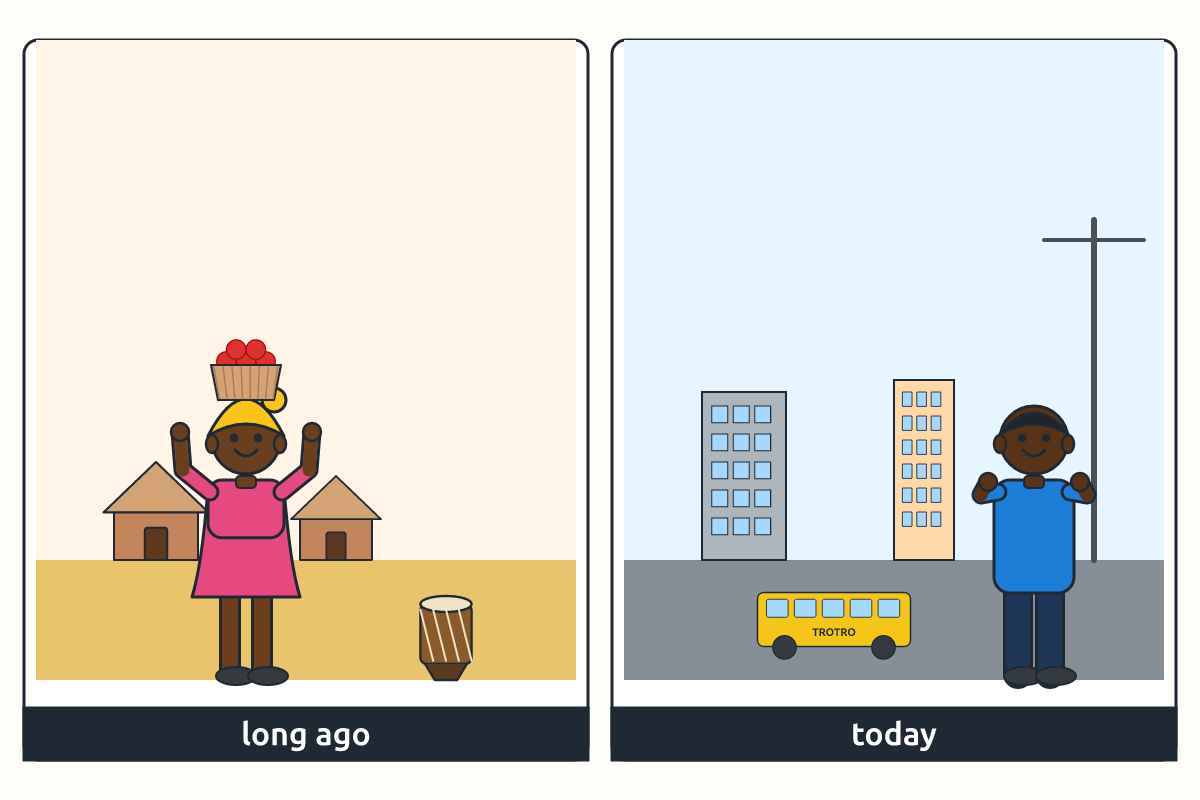
2. Why Life Has Changed
Many things have caused change. Contact with Europeans brought new goods such as cloth, guns and later machines. Formal schools taught reading and writing. Science and technology produced electricity, vehicles and phones. Towns and cities grew as people moved to find work. Religions such as Christianity and Islam also changed some customs.
3. What Has Stayed the Same
Some ways of life have continued. People still farm and fish. Families still name babies in outdooring ceremonies. Chiefs and queen mothers still lead communities. Festivals such as Homowo, Aboakyer, Hogbetsotso and Damba are celebrated every year. Talking drums are still used at durbars. Respect for elders and caring for the extended family are still important values.
Change brings benefits, such as better health care and faster communication. But it also brings problems, such as pollution, loss of some traditions and too much dependence on imported goods. We should keep the good parts of our culture while using the benefits of modern life.
New words
- ancient
- Belonging to the very distant past.
- modern
- Belonging to the present time.
- change
- Becoming different.
- continuity
- Things that stay the same over time.
- tradition
- A custom passed down over generations.
- technology
- Tools and machines made using science.
Summary
- Housing, food, clothing, transport and communication have changed greatly.
- Contact with Europeans, schools and technology caused change.
- Farming, festivals, chieftaincy and respect for elders continue.
- We should keep good traditions while enjoying modern benefits.
Class activity: Then-and-Now Chart
- Choose four areas of life (e.g. transport, food).
- Draw or write how each was in ancient times and how it is today.
- Present one change and one continuity to the class.
You need: Clay pot, Calabash, Printed photographs of ancient Ghanaian settlements, Ghana map
Exercises
Answer in your exercise book first, then check your answers.
1. How did ancient people send messages over long distances?
- A. Talking drums and messengers
- B. Phones
- C. Email
- D. Radio
Show answer
Answer: Talking drums and messengersThere were no phones.2. Which of these has stayed the same since ancient times?
- A. Celebrating festivals
- B. Using cowries as money
- C. Bark cloth for school uniform
- D. Only walking
Show answer
Answer: Celebrating festivalsFestivals continue today.3. Which was a cause of change in Ghana?
- A. Formal education
- B. Thatch roofs
- C. Hunting with stones
- D. Barter
Show answer
Answer: Formal educationSchools brought new knowledge.4. Our ancestors used electricity.
- A. True
- B. False
Show answer
Answer: FalseThey used fire and palm-oil lamps.5. Chiefs still lead communities in Ghana today.
- A. True
- B. False
Show answer
Answer: TrueChieftaincy continues.6. A custom passed down over generations is a ______.
Show answer
Answer: traditione.g. outdooring.7. Compare transport in ancient times and today.
Show answer
Answer: Ancient: walking, canoes, head-loading. Today: cars, trotros, aeroplanes.One example each.8. Give one benefit and one problem of change in Ghana.
Show answer
Answer: Benefit: better health care (or faster communication). Problem: pollution (or loss of traditions).Any reasonable pair.
Homework
- Interview a grandparent about how life was when they were young. Write three differences from today.