Basic 5 · Ghanaian Language · Use of Action Words
Present and Past Tense Action Words
In this topic you will recognise and use simple present and simple past tense action words (verbs) in sentences.
By the end of these notes you should be able to:
- Explain what an action word (verb) is
- Distinguish the simple present and simple past tense
- Use verbs in the correct tense in sentences
What you already know
- Action words (Basic 4)
Copy everything that has a blue line on its left into your notebook. The other parts are for reading.
- Strand
- Writing Conventions
- Sub-strand
- Use of Action Words
- Indicator
- B5.5.3.1.1-2 – Recognize and use simple present and past tense action words in sentences
Introduction
Action words tell us what someone does. The tense of the verb tells us when the action happens: now (present) or before (past).
1. Action Words (Verbs)
Verb: A word that shows an action or a state, such as run, eat, sing or is.
2. Simple Present Tense
The simple present tense describes actions that happen regularly, habits or general truths.
- Kofi farms every day.
- The sun rises in the east.
- We go to school on weekdays.
3. Simple Past Tense
The simple past tense describes actions that happened and finished in the past. Words such as yesterday, last week and ago often show the past tense.
| Present | Past | Type |
|---|---|---|
| farm | farmed | regular (+ed) |
| plant | planted | regular |
| fish | fished | regular |
| go | went | irregular |
| eat | ate | irregular |
| sing | sang | irregular |
| catch | caught | irregular |
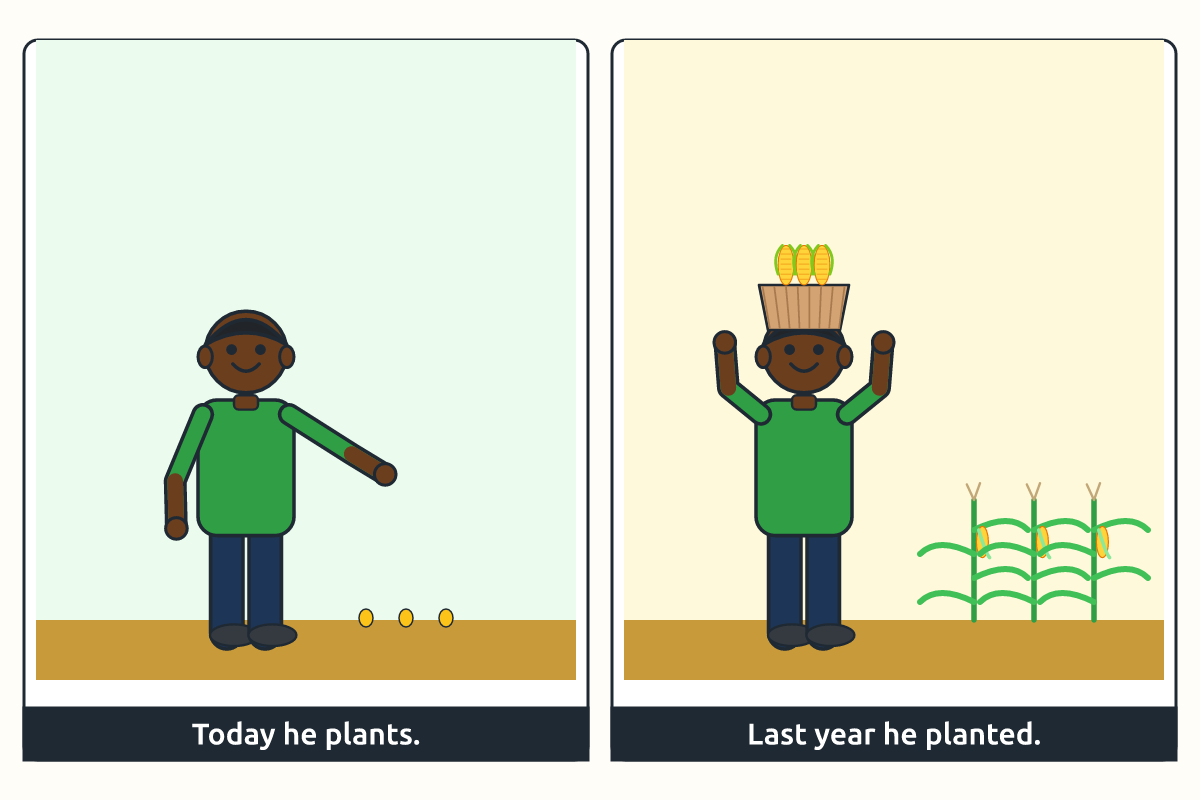
4. Tense in Ghanaian Languages
Ghanaian languages show tense in different ways. Many change the verb or add a small marker. For example, in Twi, "Ɔdi aduane" means "He/she eats food" and "Ɔdii aduane" means "He/she ate food". The vowel is lengthened to show the past. Your teacher will show you how tense is shown in your language.
Example
Change to the past tense: "Ama sweeps the compound every morning."
- The verb is "sweeps" (present).
- Past of sweep is swept.
- Change "every morning" to "yesterday morning".
Answer: Ama swept the compound yesterday morning.
Common mistake: Do not add -ed to irregular verbs. It is "went", not "goed".
When you write a story about something that has already happened, keep all the verbs in the past tense. Changing tense in the middle of a story confuses the reader. When you describe your daily routine or facts that are always true, use the present tense. Read your writing again and underline every verb to check that the tense is correct.
New words
- verb
- An action or state word.
- tense
- The form of a verb that shows time.
- present tense
- Shows actions happening now or regularly.
- past tense
- Shows actions already completed.
- regular verb
- A verb that adds -ed in the past.
- irregular verb
- A verb that changes form in the past.
Summary
- Verbs are action words.
- The simple present shows habits and truths.
- The simple past shows completed actions.
- Ghanaian languages mark tense in their own ways.
Class activity: Tense Switch
- One partner says a sentence in the present tense in your Ghanaian language.
- The other changes it to the past tense.
- Write five pairs of sentences.
You need: Printed action-picture cards of farming, Fishing, Locally made verb cards, Exercise books, Pencils
Exercises
Answer in your exercise book first, then check your answers.
1. Which is a verb?
- A. Run
- B. Table
- C. Blue
- D. Happy
Show answer
Answer: RunIt shows action.2. The past tense of "go" is…
- A. went
- B. goed
- C. goes
- D. going
Show answer
Answer: wentIt is irregular.3. Which sentence is in the past tense?
- A. Esi danced at the festival.
- B. Esi dances every day.
- C. Esi is dancing now.
- D. Esi will dance.
Show answer
Answer: Esi danced at the festival."Danced" is past.4. "Yesterday" often shows the past tense.
- A. True
- B. False
Show answer
Answer: TrueIt refers to a past time.5. "Catched" is the correct past tense of catch.
- A. True
- B. False
Show answer
Answer: FalseIt is "caught".6. The past tense of "eat" is ______.
Show answer
Answer: ateIrregular verb.7. Change to the past tense: "We plant maize in April."
Show answer
Answer: We planted maize in April.Regular verb.8. Explain the difference between regular and irregular verbs with examples.
Show answer
Answer: Regular verbs add -ed (farm → farmed); irregular verbs change form (sing → sang).Two types.
Homework
- Write ten sentences in your Ghanaian language about what you did last weekend (past tense).