Basic 5 · Ghanaian Language · Reading
Reading Aloud from Novels and Newspapers
In this topic you will read aloud passages from novels and newspapers with correct pronunciation, tone and expression.
By the end of these notes you should be able to:
- Distinguish novels from newspapers
- Read a newspaper passage clearly and correctly
- Read a novel passage with expression
What you already know
- Reading aloud with correct tone
Copy everything that has a blue line on its left into your notebook. The other parts are for reading.
- Strand
- Extensive Reading
- Sub-strand
- Reading
- Indicator
- B5.6.1.1.1 – Read aloud passages from novels and newspapers with correct pronunciation and tone
Introduction
Novels tell long stories, while newspapers report news and events. Reading both aloud builds confidence, vocabulary and fluency in your language.
1. Novels and Newspapers
| Feature | Novel | Newspaper |
|---|---|---|
| purpose | to tell a long imaginative story | to inform about current events |
| style | descriptive, with dialogue and feelings | short, factual paragraphs |
| reading tone | expressive, changing with characters | clear, steady and serious |
| examples | storybooks in Ghanaian languages published by the Bureau of Ghana Languages | Daily Graphic; newspapers and news bulletins in Ghanaian languages |
2. A Newspaper Passage (English Version)
"TREE PLANTING EXERCISE IN TECHIMAN. Pupils of the Techiman Municipal Assembly Basic School planted 500 tree seedlings on Saturday as part of the Green Ghana programme. The headteacher said the trees would provide shade and protect the land from erosion. The pupils promised to water the seedlings every day."
Read it with a clear, steady voice. Pronounce names and numbers carefully. Pause at full stops.
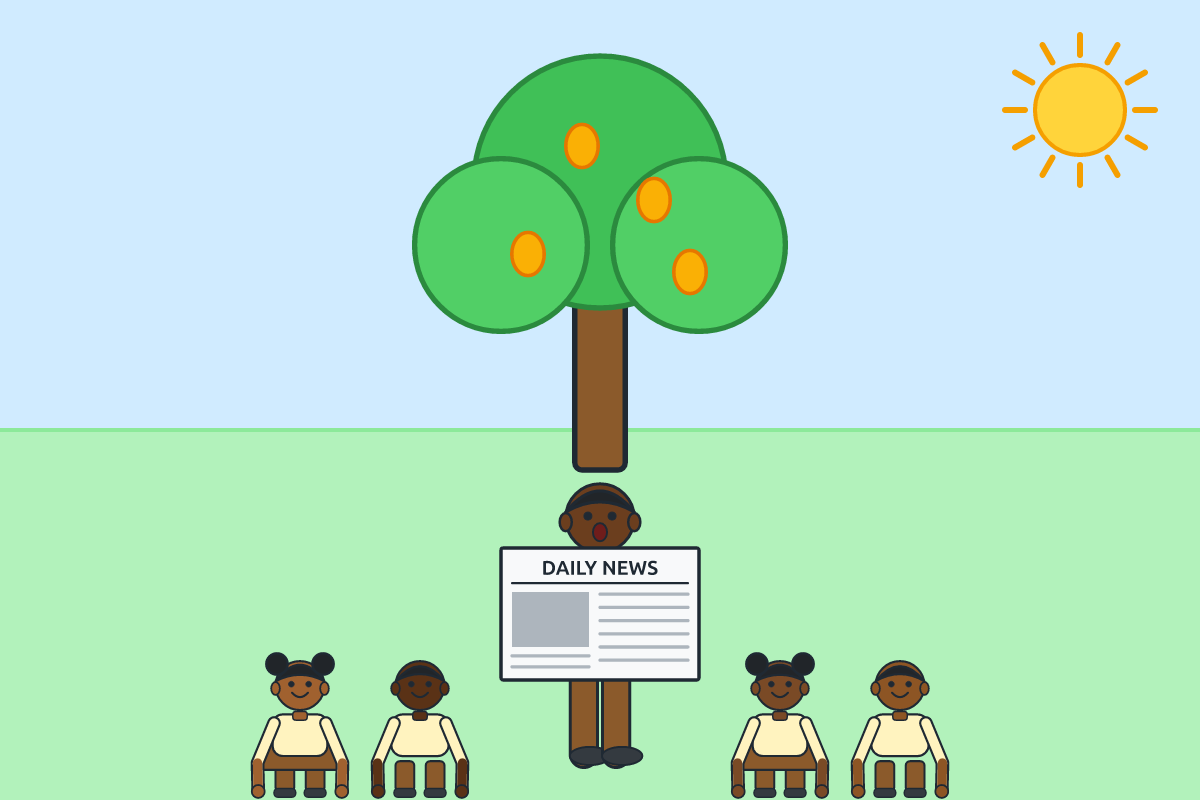
3. A Novel Passage (English Version)
"The rain had not fallen for many weeks. Kwabena stood at the edge of his father's farm and stared at the dry maize. 'Father, will the rain ever come?' he whispered. His father placed a hand on his shoulder. 'Be patient, my son. The rain always returns.' That night, thunder rolled across the sky, and Kwabena laughed as the first drops fell."
Read with expression: worried when Kwabena asks, calm and wise for the father, and joyful at the end.
4. Reading-Aloud Checklist
- Preview the passage and practise difficult words.
- Use the correct tone and pronunciation.
- Read at a good pace and volume.
- Pause at punctuation marks.
- Change your voice for different characters in novels.
- Keep a steady, serious voice for news.
- Look up at your audience from time to time.
Practise with passages in your Ghanaian language from storybooks and Ghanaian-language news.
New words
- novel
- A long story book.
- newspaper
- A publication that reports news.
- headline
- The title of a news report.
- report
- A written account of an event.
- expression
- Showing feeling in your voice.
- preview
- To look over a passage before reading.
Summary
- Novels tell long stories; newspapers report current events.
- Read news clearly and steadily; read novels with expression.
- Pronounce names, numbers and difficult words correctly.
- Use the reading-aloud checklist to improve.
Class activity: News and Story Hour
- Each member reads a short newspaper report and a novel passage in your Ghanaian language.
- The group scores pronunciation, tone and expression.
- Give each reader one compliment and one suggestion.
You need: Sample Ghanaian-language semi-formal letter, Ghanaian-language reading passage, Exercise books, Pencils
Exercises
Answer in your exercise book first, then check your answers.
1. Which reports current events?
- A. Newspaper
- B. Novel
- C. Poem
- D. Song
Show answer
Answer: NewspaperIt gives news.2. When reading news aloud, your voice should be…
- A. clear and steady
- B. very playful
- C. whispered
- D. changing for characters
Show answer
Answer: clear and steadyNews is serious.3. The title of a news report is the…
- A. headline
- B. chapter
- C. stanza
- D. caption
Show answer
Answer: headlinee.g. "Tree Planting Exercise".4. Novels often contain dialogue.
- A. True
- B. False
Show answer
Answer: TrueCharacters speak.5. You should not practise difficult words before reading aloud.
- A. True
- B. False
Show answer
Answer: FalsePreview and practise first.6. To look over a passage before reading it is to ______ it.
Show answer
Answer: previewIt helps fluency.7. State two differences between a novel and a newspaper.
Show answer
Answer: A novel tells a long imaginative story; a newspaper reports real current events in short factual paragraphs.Purpose and style.8. How should your voice change when reading the novel passage about Kwabena?
Show answer
Answer: Worried for Kwabena's question, calm for the father, joyful at the end.Expression matches feelings.
Homework
- Read a news report or story passage in your Ghanaian language aloud to your family and ask for feedback.