Basic 5 · Ghanaian Language · Punctuation
Using Punctuation Marks in Writing
In this topic you will recognise and use commas, full stops, quotation marks, exclamation marks and question marks appropriately in writing.
By the end of these notes you should be able to:
- Revise the uses of five punctuation marks
- Use them correctly in sentences and paragraphs
- Punctuate a passage correctly
What you already know
- Capital letters
Copy everything that has a blue line on its left into your notebook. The other parts are for reading.
- Strand
- Writing Conventions
- Sub-strand
- Punctuation
- Indicator
- B5.5.2.1.1-3 – Recognize and use commas full stops quotation marks exclamation mark and question marks appropriately in writing
Introduction
You have learnt several punctuation marks. Now you will use all of them together to make your writing clear and lively.
1. Five Important Marks
| Mark | Name | Main use |
|---|---|---|
| . | full stop | ends a statement or command |
| , | comma | separates items; shows a pause |
| " " | quotation marks | show the exact words spoken |
| ! | exclamation mark | shows strong feeling, surprise or a loud command |
| ? | question mark | ends a direct question |
2. Using Them Together
Example
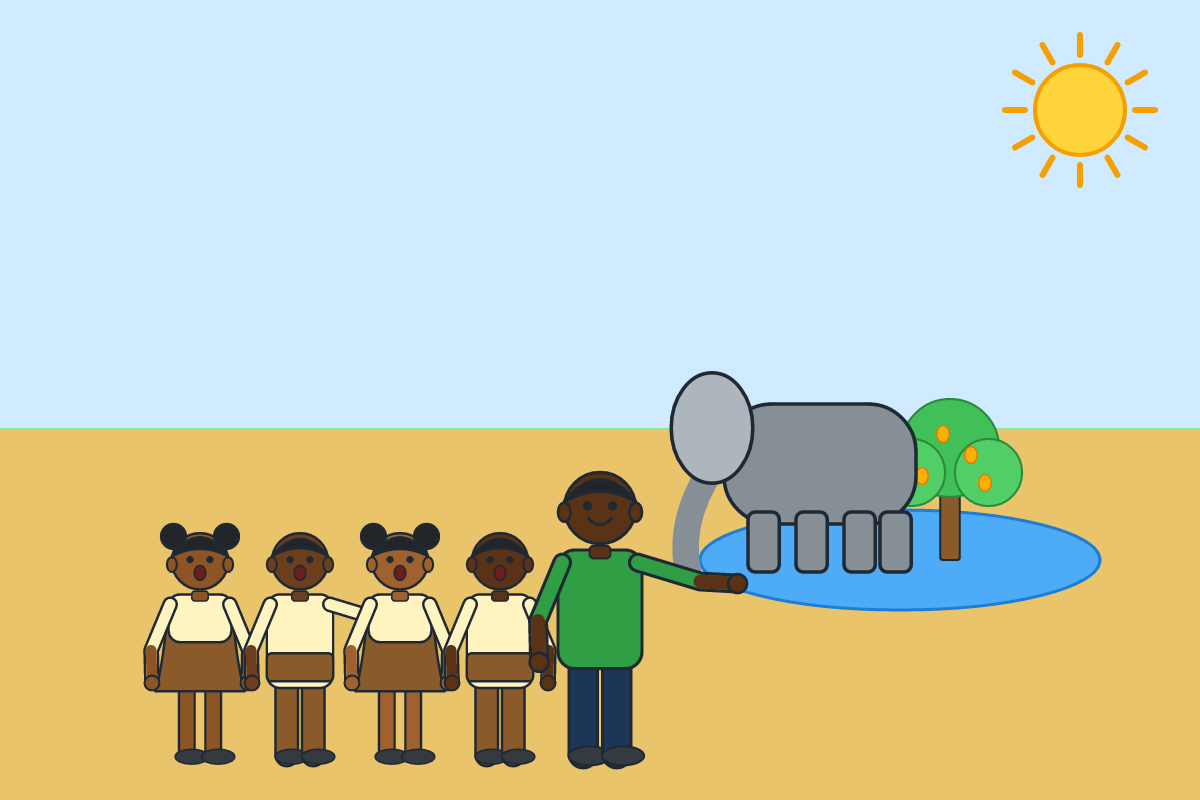
Punctuate: wow shouted kojo look at that big elephant where did it come from asked esi
- "Wow!" is an exclamation, so add an exclamation mark.
- Kojo's words go inside quotation marks: "Wow! Look at that big elephant!"
- Esi's words are a question: "Where did it come from?"
- Add capitals for names and new sentences.
Answer: "Wow!" shouted Kojo. "Look at that big elephant!" "Where did it come from?" asked Esi.
3. Rules for Quotation Marks
- Put only the exact spoken words inside the quotation marks.
- Start the spoken words with a capital letter.
- Put the punctuation that belongs to the speech inside the closing quotation mark: "Come here," she said.
- Start a new line for each new speaker in a story.
4. Practice Passage
Punctuate this passage, then write it in your Ghanaian language:
"the school bus stopped at mole national park the children jumped out excitedly look shouted ama an elephant can we go closer asked kofi no said the guide we must stay at a safe distance"
Answer: The school bus stopped at Mole National Park. The children jumped out excitedly. "Look!" shouted Ama. "An elephant!" "Can we go closer?" asked Kofi. "No," said the guide. "We must stay at a safe distance."
New words
- punctuation
- Marks that make writing clear.
- exclamation
- A sudden cry or strong expression.
- direct speech
- The exact words a person says.
- command
- A sentence telling someone to do something.
- question
- A sentence that asks something.
- passage
- A piece of writing.
Summary
- Full stops end statements; commas show pauses.
- Quotation marks show exact spoken words.
- Exclamation marks show strong feeling; question marks end questions.
- Start a new line for each new speaker.
Class activity: Punctuation Challenge
- Each group gets an unpunctuated passage in your Ghanaian language.
- Add all the punctuation marks.
- Read it aloud with the correct expression.
You need: Locally made punctuation cards, Sentence strips about local life, Exercise books, Pencils
Exercises
Answer in your exercise book first, then check your answers.
1. Which mark ends a direct question?
- A. ?
- B. !
- C. .
- D. ,
Show answer
Answer: ?Question mark.2. Which sentence is correctly punctuated?
- A. "Come here," she said.
- B. "Come here" she said,
- C. Come here, "she said."
- D. "come here," She said.
Show answer
Answer: "Come here," she said.Comma inside the quotation marks.3. "Wow!" uses an exclamation mark to show…
- A. surprise
- B. a question
- C. a list
- D. ownership
Show answer
Answer: surpriseStrong feeling.4. Quotation marks show the exact words spoken.
- A. True
- B. False
Show answer
Answer: TrueDirect speech.5. Two speakers can share the same line in a story.
- A. True
- B. False
Show answer
Answer: FalseEach new speaker starts a new line.6. The exact words a person says is direct ______.
Show answer
Answer: speechShown in quotation marks.7. Punctuate: help cried the boy
Show answer
Answer: "Help!" cried the boy.Exclamation inside quotation marks.8. Explain two rules for using quotation marks.
Show answer
Answer: Only exact words go inside; spoken words begin with a capital (or speech punctuation goes inside, new line for new speaker).Any two.
Homework
- Write a short conversation between two people in your Ghanaian language using all five punctuation marks.