Basic 5 · English Language
Features of Spoken Language, Synonyms and Antonyms, Comparatives, Writing Formats and Past Feelings
In this topic you will notice the features of spoken language, use synonyms and antonyms, use comparative adjectives, choose formats for writing and use the simple past to express past needs and feelings.
By the end of these notes you should be able to:
- Identify features of spoken language
- Use synonyms and antonyms in speech and writing
- Use comparative forms of regular and irregular adjectives
- Choose suitable formats for different writing purposes
- Use the simple past to express past needs, feelings and interests
What you already know
- Lessons in Stories, Closing Diphthongs, Indefinite Pronouns, Setting and Characters, and Two Past Tenses
Copy everything that has a blue line on its left into your notebook. The other parts are for reading.
Lesson 1
- Strand
- Oral Language
- Sub-strand
- Presentation
- Indicator
- B5.1.10.1.1 – Demonstrate awareness of the features of spoken language
Introduction
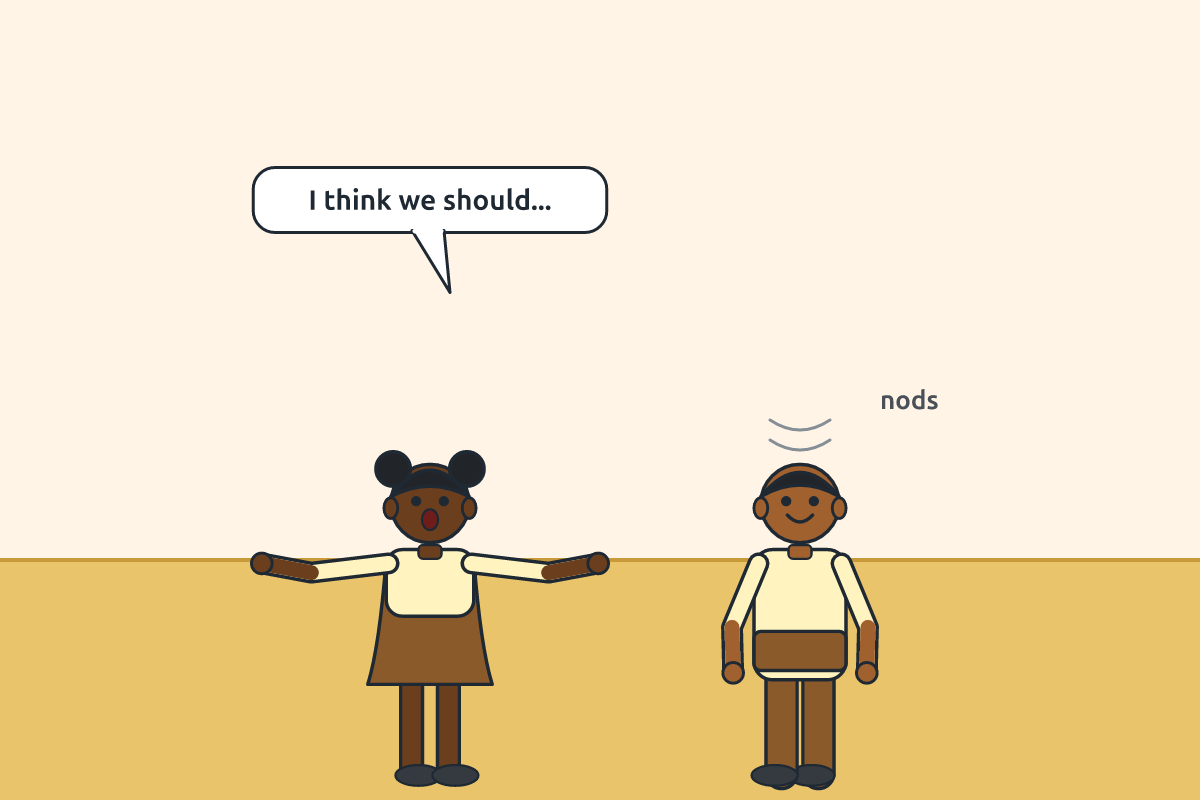
Spoken language is different from written language. When we speak, we use our voice, face and body to help our meaning.
Features of Spoken Language
| Feature | Example |
|---|---|
| greetings and polite forms | "Good morning, Madam." "Please." |
| short and incomplete sentences | "Coming!" "Not now." |
| fillers | "Er…", "you know", "well" |
| tone and stress | "YOU did it?" (surprise) |
| gestures and facial expression | nodding, pointing, smiling |
| turn-taking | waiting for one speaker to finish |
In formal speech, such as a presentation, we reduce fillers, speak in full sentences and use respectful language. In informal talk with friends, we may use shorter sentences and everyday words.
New words
- spoken language
- Language we speak aloud.
- filler
- A sound or word used while thinking, like "er".
- gesture
- A movement of the hands or body to show meaning.
Summary
- Spoken language uses tone, gestures, fillers and turn-taking.
- Formal speech uses full sentences and few fillers.
Exercises
Answer in your exercise book first, then check your answers.
1. Which is a filler?
- A. er
- B. book
- C. Accra
- D. run
Show answer
Answer: erUsed while thinking.2. Gestures help us show meaning when we speak.
- A. True
- B. False
Show answer
Answer: Truee.g. nodding.3. Waiting for one speaker to finish is called turn-______.
Show answer
Answer: takingTurn-taking.4. State two differences between formal and informal spoken language.
Show answer
Answer: Formal: full sentences, few fillers, respectful words. Informal: short sentences, everyday words.Any two.
Lesson 2
- Strand
- Reading
- Sub-strand
- Vocabulary
- Indicator
- B5.2.6.1.2 – Use synonyms and antonyms in spoken and written expressions
Introduction
Synonyms are words with similar meanings. Antonyms are words with opposite meanings. Using them makes our language rich.
Synonyms and Antonyms
| Word | Synonym |
|---|---|
| big | large |
| begin | start |
| happy | glad |
| quick | fast |
| shut | close |
| Word | Antonym |
|---|---|
| early | late |
| brave | cowardly |
| buy | sell |
| increase | decrease |
| ancient | modern |
Using synonyms avoids repeating the same word: "The market was big. The large crowd moved slowly."
Passage: "The ancient town of Elmina has a modern harbour. In the early morning, fishermen leave; late in the evening, they return. Some sell fish, others buy it. The quick traders rush to the beach, while the slow ones wait. Everyone is glad when the catch is big and happy when prices are fair." Find the antonym pairs (ancient/modern, early/late, sell/buy, quick/slow) and a synonym pair (glad/happy).
New words
- synonym
- A word with a similar meaning.
- antonym
- A word with the opposite meaning.
- vocabulary
- All the words a person knows.
Summary
- Synonyms have similar meanings; antonyms have opposite meanings.
- They make speech and writing richer.
Exercises
Answer in your exercise book first, then check your answers.
1. A synonym of "begin" is…
- A. start
- B. end
- C. stop
- D. finish
Show answer
Answer: startSimilar meaning.2. "Buy" and "sell" are antonyms.
- A. True
- B. False
Show answer
Answer: TrueOpposite meanings.3. The antonym of "early" is ______.
Show answer
Answer: lateOpposite.4. Rewrite using a synonym for "happy": "Ama was happy."
Show answer
Answer: Ama was glad (joyful/pleased).Similar word.
Lesson 3
- Strand
- Grammar
- Sub-strand
- Adjectives
- Indicator
- B5.3.4.1.1 – Use comparatives forms of regular and irregular adjectives
Introduction
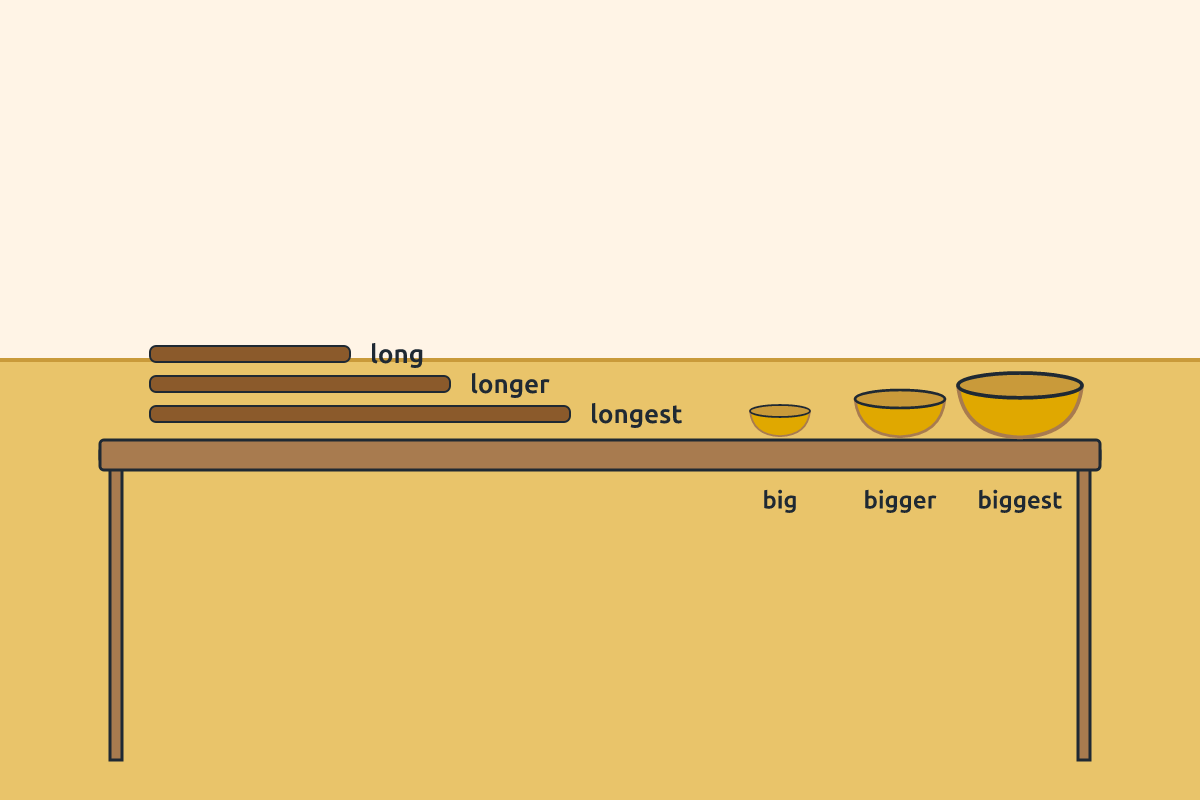
We use comparative adjectives to compare two people or things.
Comparative Adjectives
| Adjective type | Rule | Example |
|---|---|---|
| short (one syllable) | add -er | tall → taller |
| ending in -e | add -r | large → larger |
| short with one vowel + consonant | double the consonant + -er | big → bigger |
| ending in -y | change y to i + -er | heavy → heavier |
| long (two or more syllables) | use "more" | beautiful → more beautiful |
| irregular | special form | good → better, bad → worse, far → farther/further, little → less, many/much → more |
Use "than" after the comparative: "Kumasi is bigger than Ho." "Mango is sweeter than lime."
New words
- comparative
- The form used to compare two things.
- irregular
- Not following the usual rule.
- than
- A word used after a comparative.
Summary
- Add -er or use "more" to form comparatives.
- Learn irregular forms such as good → better and bad → worse.
Exercises
Answer in your exercise book first, then check your answers.
1. The comparative of "big" is…
- A. bigger
- B. biger
- C. more big
- D. biggest
Show answer
Answer: biggerDouble the g.2. The comparative of "good" is "gooder".
- A. True
- B. False
Show answer
Answer: FalseIt is "better".3. This road is ______ (busy) than that one.
Show answer
Answer: busiery → i + er.4. Compare yourself with a friend using two comparatives.
Show answer
Answer: E.g. I am taller than Kofi. Kofi is faster than me.Comparatives with than.
Lesson 4
- Strand
- Writing
- Sub-strand
- Paragraph Development
- Indicator
- B5.4.3.1.1 – Choose appropriate ways and modes of writing for a variety of purposes
Introduction
Different purposes need different formats. A notice, a diary entry and an informal letter all look different.
Choosing a Writing Format
| Format | Purpose | Key features |
|---|---|---|
| informal letter | to write to a friend or relative | address, date, greeting ("Dear…"), body, friendly closing |
| notice | to inform many people briefly | title, what, when, where, who to contact |
| diary entry | to record personal events and feelings | date, first person ("I"), feelings |
| report | to give facts about an event | title, what happened, when, where, who |
Sample notice:
"NOTICE – CLEAN-UP DAY. All Basic 5 pupils should bring brooms and cutlasses on Friday, 6th November, at 7:00 a.m. Meet at the school field. – Class Prefect"
New words
- format
- The layout and features of a piece of writing.
- notice
- A short public announcement.
- diary
- A personal daily record.
Summary
- Choose the format that fits your purpose and audience.
- Letters, notices, diaries and reports have different features.
Exercises
Answer in your exercise book first, then check your answers.
1. Which format informs many people briefly?
- A. notice
- B. diary
- C. story
- D. poem
Show answer
Answer: noticeIt is public and short.2. A diary is written in the first person.
- A. True
- B. False
Show answer
Answer: TrueUsing "I".3. An informal letter begins with "______ Kofi".
Show answer
Answer: DearGreeting.4. List four details a notice should contain.
Show answer
Answer: Title, what, when, where (or who to contact).Key features.
Lesson 5
- Strand
- Writing Conventions/ Extensive Reading
- Sub-strand
- Using Action Words, Building the Love and Culture of Reading
- Indicator
- B5.5.4.1.2 – Use the simple past verb form to express past needs feelings and interests
Introduction
When we tell others how we felt, what we needed or what we liked in the past, we use the simple past tense.
Expressing Past Needs, Feelings and Interests
| Type | Simple past sentence |
|---|---|
| need | I needed a new pair of sandals last term. |
| feeling | We felt proud when our team won. |
| interest | As a child, Esi liked drawing animals. |
| want | Kofi wanted to become a pilot. |
| fear | The children feared the dark forest. |
Diary extract: "Saturday, 10th October. Today I felt very nervous before my reading competition. I wanted to win, but I needed more practice. When I finished, the judges smiled. I came second and I was very happy."
New words
- need
- Something necessary.
- feeling
- An emotion such as joy or fear.
- interest
- Something you like doing.
Summary
- Use the simple past to express past needs, feelings and interests.
- Verbs like needed, felt, liked and wanted are common.
Exercises
Answer in your exercise book first, then check your answers.
1. Choose: Yesterday I ___ tired.
- A. felt
- B. feel
- C. feeling
- D. feels
Show answer
Answer: feltSimple past.2. "She liked dancing as a child" is in the simple past.
- A. True
- B. False
Show answer
Answer: Trueliked.3. Last year we ______ (need) more books.
Show answer
Answer: neededSimple past.4. Write two sentences about how you felt on your first day at school.
Show answer
Answer: E.g. I felt shy. I wanted to go home.Simple past.
Homework
- Write a diary entry about a day you felt very happy or very worried.