Basic 5 · English Language
Parallel Stories, Main Ideas in Sequence, Types of Verbs, Plot and Superlatives
In this topic you will tell stories parallel to ones you have heard, recall main ideas in sequence, use different types of verbs, build a plot and use comparative and superlative adjectives to make comparisons.
By the end of these notes you should be able to:
- Tell a story parallel to one heard or read
- Note and recall the main ideas of a passage in sequence
- Use action, linking and helping verbs
- Build a plot with a problem, climax and resolution
- Make comparisons with comparative and superlative adjectives
What you already know
- Features of Spoken Language, Synonyms and Antonyms, Comparatives, Writing Formats and Past Feelings
Copy everything that has a blue line on its left into your notebook. The other parts are for reading.
Lesson 1
- Strand
- Oral Language
- Sub-strand
- Story Telling
- Indicator
- B5.1.4.1.2 – Tell stories which are parallel to stories heard or read
Introduction
A parallel story follows the same pattern as a story you know but changes the characters, setting or events.
Telling Parallel Stories
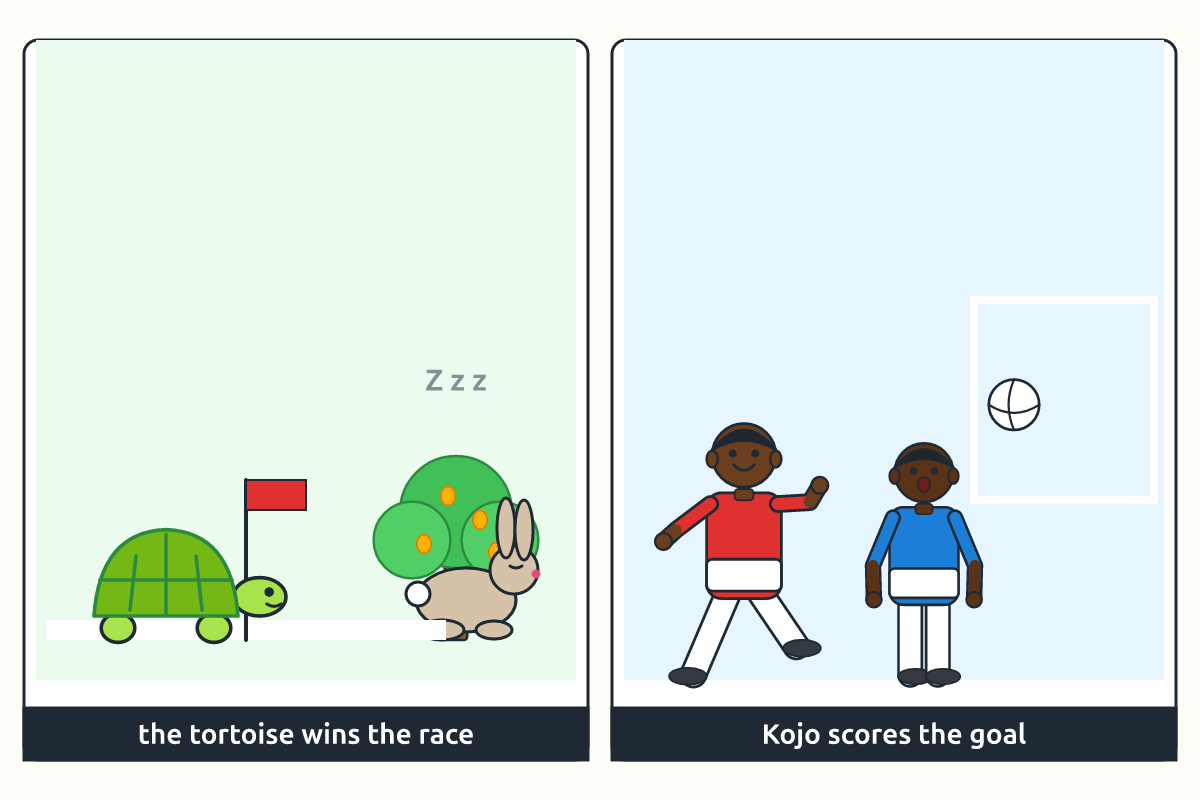
Original story (summary): "A hare boasted that he was the fastest animal. A slow tortoise challenged him to a race. The hare ran ahead and then slept under a tree. The tortoise kept walking and won."
Parallel story: "Kwesi was the best footballer in Basic 5 and never practised. Yaw was a slow player but trained every evening. At the inter-school match, Kwesi played carelessly, while Yaw played steadily and scored the winning goal."
| Part | Original | Parallel |
|---|---|---|
| characters | hare and tortoise | Kwesi and Yaw |
| setting | a forest path | a school football field |
| event | a race | a football match |
| lesson (stays the same) | slow and steady wins | slow and steady wins |
New words
- parallel story
- A new story that follows the pattern of another.
- pattern
- The way something is arranged or repeated.
- boast
- To talk proudly about oneself.
Summary
- A parallel story keeps the pattern and lesson but changes characters and setting.
- It shows you understand the original story.
Exercises
Answer in your exercise book first, then check your answers.
1. In a parallel story, what usually stays the same?
- A. the lesson
- B. the names
- C. the setting
- D. the title
Show answer
Answer: the lessonCharacters change.2. Kwesi in the parallel story is like the hare.
- A. True
- B. False
Show answer
Answer: TrueBoth were careless.3. Yaw trained every ______.
Show answer
Answer: eveningFrom the parallel story.4. Suggest a parallel story to "The Tortoise and the Feast in the Sky".
Show answer
Answer: E.g. a pupil who tricks classmates to eat all the party food and loses their friendship.Same lesson, new setting.
Lesson 2
- Strand
- Reading
- Sub-strand
- Comprehension
- Indicator
- B5.2.7.1.2 – Construct meaning from text read note and recall main ideas in a sequence
Introduction
Good readers note the main idea of each paragraph and remember them in order.
Reading Passage: The Boy Who Harnessed the River
"Edem lived in a small village near the Volta Lake where there was no electricity. Every night, he did his homework by the light of a smoky kerosene lamp, and his eyes often hurt.
One day, his science teacher explained how moving water can turn a wheel and produce electricity. Edem could not stop thinking about it. After school, he collected old bicycle parts, plastic blades from a broken fan and wire from a discarded radio.
For three weeks, he worked by the stream behind his house. His first wheel broke in the strong current. His second wheel turned too slowly. Some villagers laughed, but his grandmother brought him food and said, 'Keep trying, my son.'
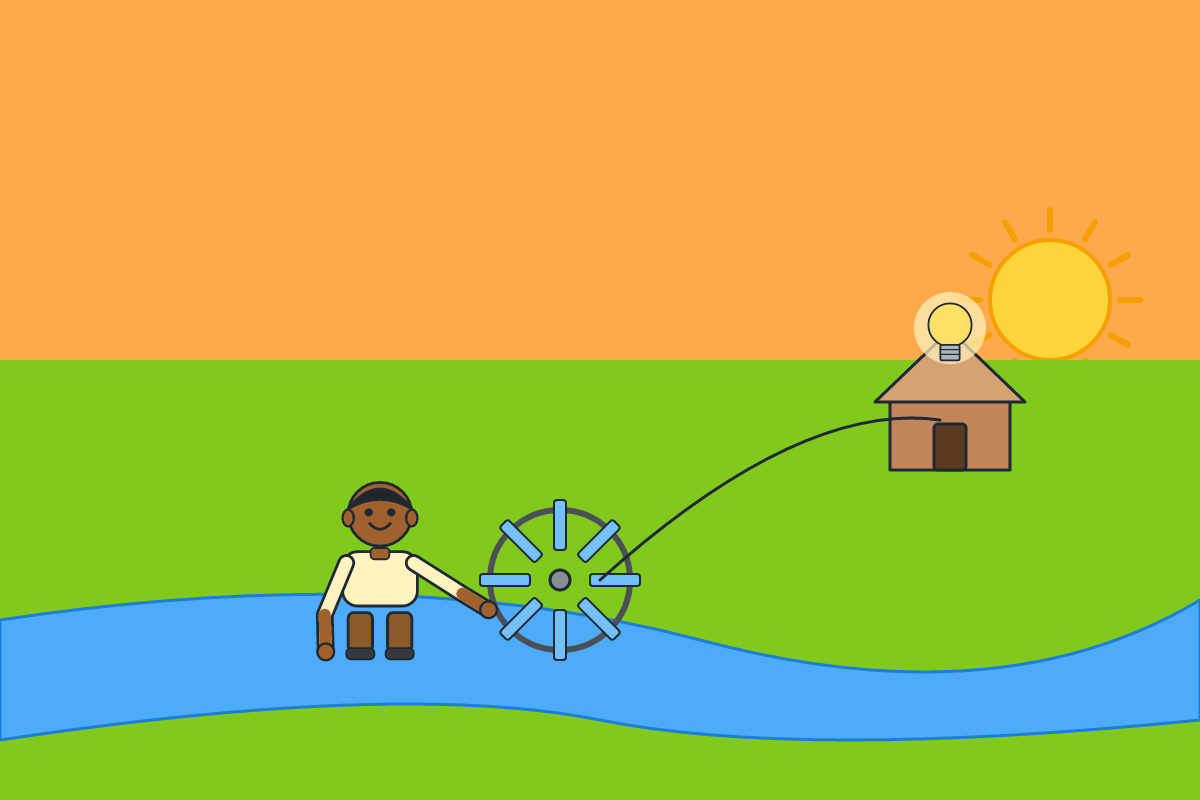
Finally, on a Saturday evening, a small bulb in his room flickered and then glowed. Children ran from all over the village to see it. The assemblyman visited and promised to help Edem improve his machine so that it could light the village school.
Today, three classrooms have light in the evening. Edem says, 'Every failure taught me something new.'"
| Paragraph | Main idea |
|---|---|
| 1 | Edem's village had no electricity, making homework difficult. |
| 2 | A science lesson inspired him to build a water-powered generator. |
| 3 | His first attempts failed, but his grandmother encouraged him. |
| 4 | He succeeded, and the assemblyman offered to help. |
| 5 | His machine now lights classrooms; failures taught him lessons. |
New words
- harness
- To control and use a natural force.
- discarded
- Thrown away.
- flicker
- To shine unsteadily.
Summary
- Each paragraph has one main idea.
- Recalling main ideas in order helps you understand and summarise a passage.
Exercises
Answer in your exercise book first, then check your answers.
1. What inspired Edem?
- A. a science lesson
- B. a football match
- C. a festival
- D. a song
Show answer
Answer: a science lessonParagraph 2.2. Edem succeeded on his first attempt.
- A. True
- B. False
Show answer
Answer: FalseHis first wheels failed.3. Edem's ______ encouraged him to keep trying.
Show answer
Answer: grandmotherParagraph 3.4. What is the main idea of paragraph 4?
Show answer
Answer: Edem finally succeeded and the assemblyman promised to help him.The bulb glowed.
Lesson 3
- Strand
- Grammar
- Sub-strand
- Verbs
- Indicator
- B5.3.5.1.1 – Use different types of verbs in sentences
Introduction
Verbs are not all the same. Some show action, some link the subject to a description, and some help other verbs.
Types of Verbs
| Type | Use | Examples |
|---|---|---|
| action verbs | show what someone does | run, write, cook, plant |
| linking verbs | join the subject to a word that describes it | is, am, are, was, seem, become |
| helping (auxiliary) verbs | help the main verb | is, have, has, do, will, can |
| transitive verbs | take an object | Ama kicked the ball. |
| intransitive verbs | do not take an object | The baby slept. |
Examples: "The farmers planted cassava." (action, transitive) "The soup smells delicious." (linking) "We are going home." (helping verb "are" + main verb "going") "The sun rose." (intransitive)
Passage: "Mother is cooking jollof. The kitchen smells wonderful. My brother has set the table, and I will wash the plates after we eat. Everyone seems happy today."
New words
- action verb
- A verb that shows action.
- linking verb
- A verb that connects the subject to a description.
- auxiliary verb
- A helping verb.
Summary
- Action verbs show actions; linking verbs connect; helping verbs support main verbs.
- Transitive verbs take objects; intransitive verbs do not.
Exercises
Answer in your exercise book first, then check your answers.
1. Which is an action verb?
- A. plant
- B. is
- C. seem
- D. are
Show answer
Answer: plantIt shows action.2. In "The soup smells delicious", "smells" is a linking verb.
- A. True
- B. False
Show answer
Answer: TrueIt links soup to delicious.3. My brother ______ set the table. (has/have)
Show answer
Answer: hasHelping verb.4. Find the helping verb and main verb: "We are going home."
Show answer
Answer: Helping: are. Main: going.Auxiliary + main verb.
Lesson 4
- Strand
- Writing
- Sub-strand
- Narrative Writing
- Indicator
- B5.4.10.1.1 – Create settings characters and at least one plot in a narrative text
Introduction
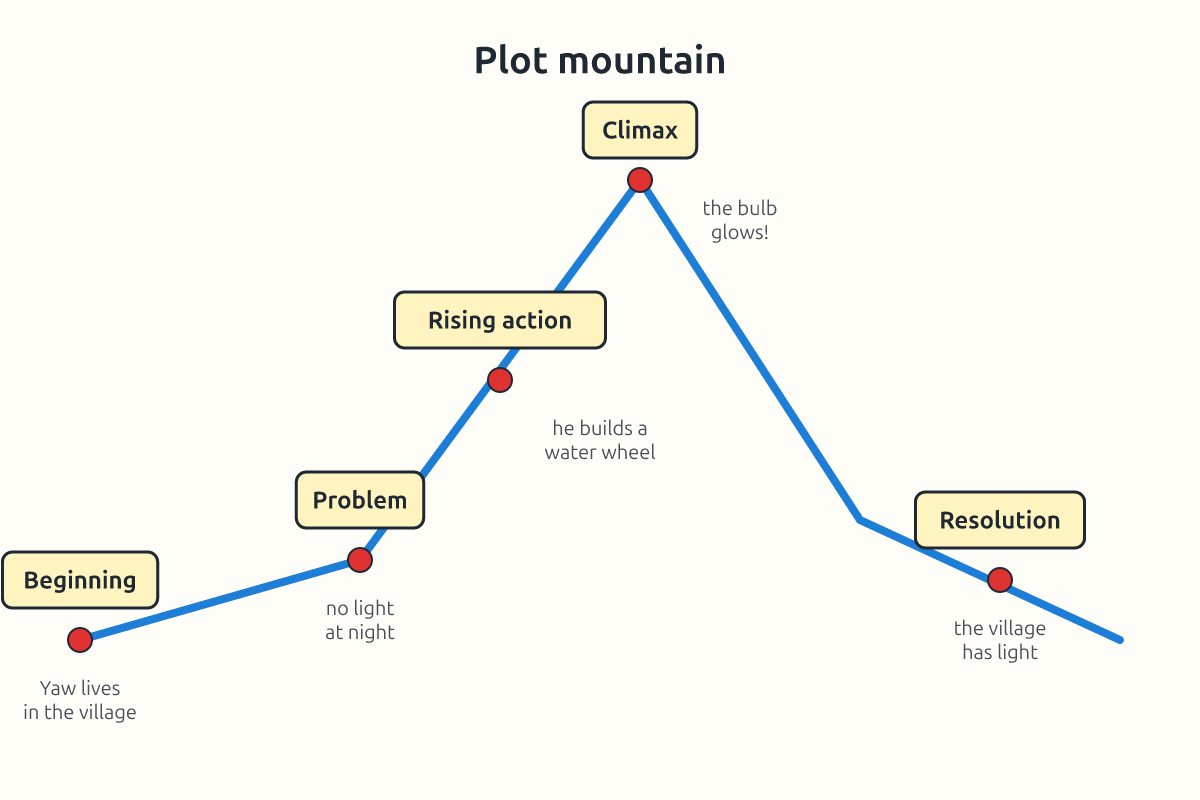
A plot is the chain of events in a story. A good plot keeps the reader wanting to know what happens next.
Building a Plot
| Part | Meaning | Example |
|---|---|---|
| beginning | introduce characters and setting | Yaw and his sister arrive at Kejetia market. |
| problem | something goes wrong | His sister gets lost in the crowd. |
| rising action | attempts to solve the problem | Yaw searches stalls and asks traders. |
| climax | the most exciting moment | He hears her voice on the market radio announcement. |
| resolution | how the problem is solved | They meet at the information office and hug. |
Sample climax and resolution: "Just as Yaw was about to give up, a loudspeaker crackled: 'A little girl called Ama is waiting at the information office.' Yaw ran faster than he had ever run. There she was, eating a piece of bread a kind trader had given her. He hugged her tightly and promised never to let go of her hand again."
New words
- plot
- The sequence of events in a story.
- climax
- The most exciting point of the story.
- resolution
- How the problem is solved.
Summary
- A plot has a beginning, problem, rising action, climax and resolution.
- The climax is the turning point; the resolution solves the problem.
Exercises
Answer in your exercise book first, then check your answers.
1. The most exciting moment of a story is the…
- A. climax
- B. beginning
- C. title
- D. setting
Show answer
Answer: climaxThe turning point.2. The resolution comes before the problem.
- A. True
- B. False
Show answer
Answer: FalseIt comes at the end.3. The sequence of events in a story is the ______.
Show answer
Answer: plotIt keeps readers interested.4. What was the problem in Yaw's story?
Show answer
Answer: His little sister got lost in the market.Something goes wrong.
Lesson 5
- Strand
- Writing Conventions/ Extensive Reading
- Sub-strand
- Building the Love and Culture of Reading
- Indicator
- B5.5.5.1.1 – Use comparative forms of regular and irregular adjectives to make comparisons
Introduction
Earlier, we compared two things. To compare three or more, we use superlative adjectives.
Comparatives and Superlatives
| Positive | Comparative (two) | Superlative (three or more) |
|---|---|---|
| tall | taller | tallest |
| big | bigger | biggest |
| happy | happier | happiest |
| beautiful | more beautiful | most beautiful |
| good | better | best |
| bad | worse | worst |
| little | less | least |
Use "the" before superlatives: "Lake Volta is the largest man-made lake in Ghana." We can also compare equal things with "as … as": "Kofi is as tall as Yaw."
Reading extract: "Mount Afadjato is often called the highest mountain in Ghana. The Volta is the longest river in the country. Kumasi is busier than Ho, but Accra is the busiest city of all."
New words
- superlative
- The form used to compare three or more things.
- degree
- Level of comparison.
- positive
- The basic form of an adjective.
Summary
- Use -est or "most" for superlatives and put "the" before them.
- Use "as … as" for equal comparisons.
Exercises
Answer in your exercise book first, then check your answers.
1. The superlative of "good" is…
- A. best
- B. better
- C. goodest
- D. most good
Show answer
Answer: bestIrregular.2. We use "the" before superlatives.
- A. True
- B. False
Show answer
Answer: Truee.g. the tallest.3. Accra is the ______ (busy) city of all.
Show answer
Answer: busiesty → i + est.4. Compare three animals using a superlative.
Show answer
Answer: E.g. The elephant is the biggest of the three.Superlative with the.
Homework
- Write a parallel story to a folktale you know, with a clear plot.